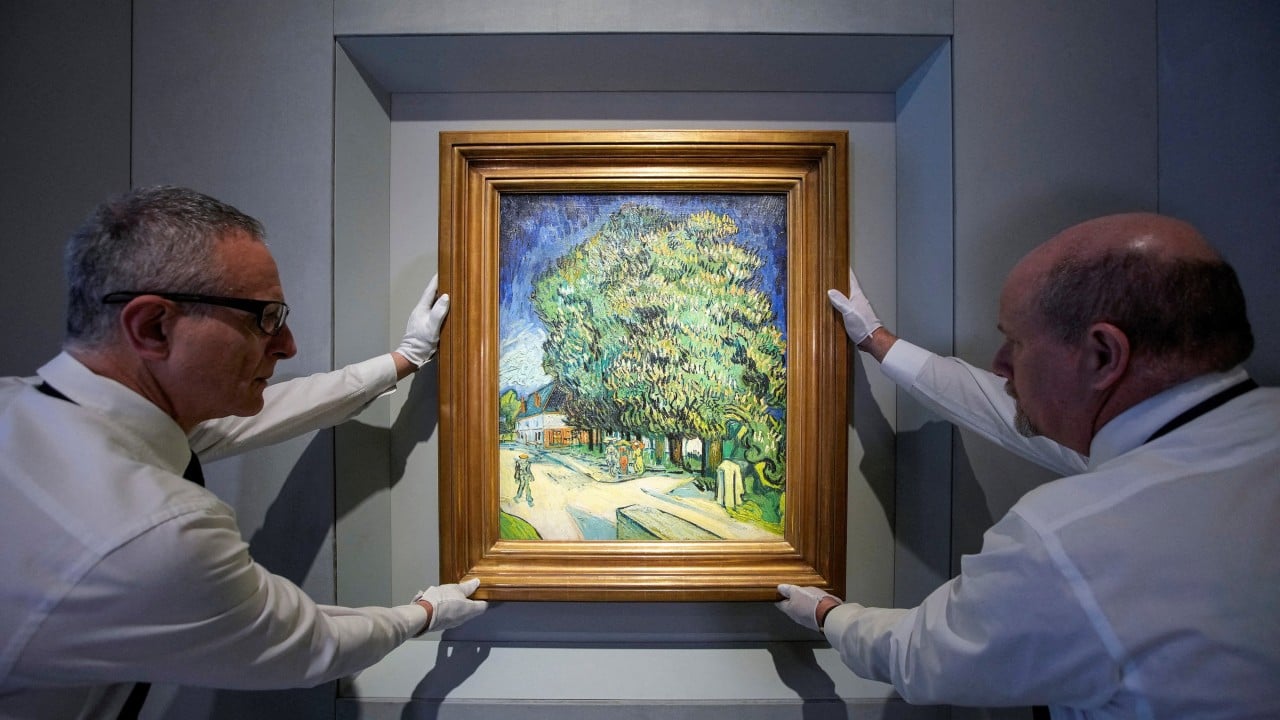
Paint dries. Memory rots. Yet somehow, in a quiet room thick with the smell of old wool, floor wax, and generational spite, a piece of stretched linen smeared with Prussian blue and zinc white just became worth more than a small fleet of passenger jets.
US$190.4 million.
Say the number out loud and it loses all meaning. It stops sounding like money and starts sounding like a weather report from another planet, or the distance between two dying stars. When the gavel finally came down, resetting the auction record for Vincent van Gogh and turning a disputed canvas into a nine-figure trophy, the headline writers did what headline writers always do. They treated it like a scoreboard. A new high score. Another billionaire’s victory lap.
They missed the blood on the frame.
To understand how a painting by a man who died with less than a few francs to his name ends up commanding US$190.4 million after a bitter legal war, you have to stop looking at the auction house stage. Stop watching the men in bespoke suits whispering into burner phones near the back exits. Instead, look at the shadow of the courtroom just down the street, where two sides of a fractured legacy spent years tearing each other apart over who actually owned the right to cash in on a dead man’s misery.
I have spent enough years watching the upper tiers of the art market—standing in the back rows of preview nights while collectors inspect brushstrokes with jewelers' loupes as if they were checking the teeth on a racehorse—to know a simple, ugly truth. The price of a masterpiece almost never reflects the love people feel for the art. It reflects the ferocity of the fight over who gets to hold the deed.
The Anatomy of a Nine-Figure Tug-of-War
Before the paddle ever went up, the canvas was already bruised by lawyers.
Consider a hypothetical buyer sitting in the front row on auction night—let’s call him Julian, a man whose private equity fund moves billions before breakfast, yet whose palms are sweating through his silk handkerchief because he wants something he cannot manufacture. Julian isn't buying a picture of a landscape or a portrait of a tormented soul. He is buying immunity from being forgotten. When men like Julian bid past the $100 million mark, they aren't thinking about Vincent van Gogh starving in Arles or shivering in Saint-Rémy. They are thinking about the rival sitting three rows behind them, and the sheer, intoxicating thrill of watching that rival blink first.
Yet Julian could not have raised his paddle at all if the dispute hadn't been cleared from the docket.
Disputes in the high-end art world are rarely about beauty. They are about provenance—that paper trail of receipts, export stamps, wartime confiscations, and messy divorces that proves a painting wasn't stolen at gunpoint or smuggled out of a basement in the dead of night. When a major Van Gogh gets tangled in an ownership battle, the canvas enters a state of purgatory. Museums won't touch it for loan exhibitions. Insurers treat it like radioactive waste. Banks refuse to accept it as collateral for the massive credit lines billionaires use to buy other paintings.
So the lawyers circle. For months, sometimes years, depositions pile up like snowdrifts. Heirs pull out faded letters from safety deposit boxes. Dealers dig through ledger books written in fountain pen a century ago. Everyone claims to be protecting the integrity of the work, while everyone is quietly calculating the commission percentage on a nine-figure hammer price.
Think of a disputed masterpiece like a prize racehorse locked in a legal quarantine while two syndicates argue over the stud fees. The horse gets older. The grass outside grows tall. Nobody gets to watch it run until someone signs a settlement agreement thick enough to stop a bullet.
Once that settlement is inked—once the competing claimants agree on how to carve up the spoils—something strange happens to the market's psychology. Instead of scaring buyers away, a resolved dispute acts like gasoline thrown onto dry brush. Why? Because survival adds myth. A painting that went to war and came back clean carries a scar that billionaires adore. It becomes "fresh to the market," a phrase auction specialists whisper with the reverence priests reserve for miracles.
Why Van Gogh Breaks Every Rule of Logic
Even by the distorted math of trophy assets, US$190.4 million is a staggering leap.
To grasp how wild that figure is, you have to compare Van Gogh to his peers. Plenty of nineteenth-century painters had better technical control. Plenty lived longer, produced cleaner catalogues, and didn't leave behind mountains of letters detailing their own psychological collapse. Yet when a top-tier Van Gogh hits the block—especially one that has been locked away during a high-profile dispute—the market loses its mind.
Part of it is simple scarcity. Vincent painted furiously, producing roughly 900 paintings in a career that lasted barely a decade, from his dark, muddy Dutch beginnings to the blinding, swirling finales in France. Most of the best ones are already bolted to museum walls in Amsterdam, New York, Paris, and London. They will never be sold. Not for two hundred million. Not for two billion. They belong to the public, guarded by motion sensors and climate-control systems that hum twenty-four hours a day.
That leaves a shrinking pool of private works. Every time a museum acquires one, or a sovereign wealth fund tucks one into a freeport vault in Geneva or Singapore, the supply tightens another notch.
I admit, whenever I stand in front of a late Van Gogh, the rational part of my brain struggles to reconcile the object in front of me with the numbers attached to it. You look closely at the surface and you don't see perfection. You see haste. You see thick ridges of pigment squeezed straight from the tube because he couldn't afford to wait for layers to dry. You see hairs from his brushes stuck in the yellow ochre. You see cheap canvas he bought by the roll because his brother Theo’s allowance was running late again.
It is jarring. And honestly, it is a little terrifying to realize how easily our culture converts raw human desperation into an asset class.
When Theo van Gogh tried to sell Vincent’s work in Paris during the late 1880s, dealers laughed politely and steered clients toward safe, polished salon paintings of nymphs and historical battles. Vincent sold virtually nothing. Historians still debate whether he sold a single painting during his lifetime—The Red Vineyard, bought by Anna Boch in Brussels for 400 francs—or perhaps a couple of minor works traded for paint supplies and meals. Either way, the man lived on coffee, bread, and tobacco, losing his teeth, wrecking his stomach, and begging his brother for enough cash to buy ultramarine blue.
Now, a century and a half later, the descendants of dealers, collectors, and industrialists fight in courtrooms over the right to sell a single canvas for US$190.4 million.
If you don't feel a slight wave of vertigo thinking about that gap, you aren't paying attention.
Inside the Room Where Money Loses Gravity
Auction nights at this level are choreographed like high-stakes theater, designed to strip away hesitation until spending nine figures feels like picking up the check at dinner.
Picture the room ten minutes before the lot comes up. The air conditioning is cranked high to offset the body heat of four hundred people packed into rows of folding chairs, plus the camera crews lining the back wall. Specialists stand along the flanks in immaculate dark suits, holding sleek black receivers to their ears, murmuring in Mandarin, French, Arabic, and English to clients sitting on yachts in the Mediterranean or penthouses overlooking Central Park.
Nobody in the room looks excited. Excitement is amateurish. At this altitude, boredom is the ultimate flex.
When the Van Gogh is finally brought out—or revealed on the rotating turntable as the lights shift to make the impasto ridges catch the glare—a hush falls over the floor. Not because everyone is moved by the brushwork, though plenty of people in that room genuinely love art. They go quiet because the numbers are about to become violent.
The auctioneer starts low, maybe around $90 million or $100 million, to build momentum.
Bidding increments jump by two million, then five million at a time. Five million dollars. Think about that. Every time a specialist on the telephone bank gives a slight nod to the podium, the price increases by enough money to endow a small hospital wing, fund a mid-sized feature film, or pay the lifetime salaries of fifty schoolteachers. Nod. Five million. Flick of a pencil. Five million.
And through it all, the shadow of the dispute hangs over the podium.
Why did the battle end when it did? Because in the art market, timing is everything. Hold onto a contested work too long, and the generation of buyers who grew up fetishizing Impressionism and Post-Impressionism begins to fade, replaced by younger tech fortunes chasing contemporary names or digital collectibles. Settle too early, and you leave tens of millions on the table while clouding the title with unanswered questions.
The parties behind this sale waited until the storm cleared, brought the work out into the daylight with clean paperwork, and watched two or three determined bidders collide at the top of the market.
The Invisible Stakes Behind the Record
It would be easy to dismiss the whole spectacle as a billionaire circus—rich people moving numbers around on spreadsheets while the rest of the world worries about groceries and rent. Many people do dismiss it that way, and I can't entirely blame them.
Yet what happens in that room ripples outward in ways most observers never notice.
First, a US$190.4 million sale instantly revalues every other Van Gogh on earth. Museums that own major works suddenly face spiking insurance premiums, forcing cash-strapped institutions to think twice before lending paintings across borders for international exhibitions. A record price doesn't just make the seller rich; it makes the art harder for ordinary people to see. When a single canvas carries a valuation approaching two hundred million dollars, transporting it requires armored trucks, decoy convoys, dedicated couriers, and security budgets that dwarf the curatorial funds of regional galleries.
Second, it sends a signal to every estranged family, museum board, and estate executor sitting on contested art right now.
Around the world, thousands of masterpieces are currently locked in quiet stalemates—tangled in inheritance feuds, disputed wartime sales, or arguments over authenticity. For years, many of those cases dragged on because nobody knew whether the market could still absorb giant prices amid higher interest rates and global uncertainty. A nine-figure Van Gogh record answers that question with a sledgehammer. It tells every lawyer in New York, London, and Zurich that the trophy market is wide awake, and that settling a messy dispute in time for the evening sales is worth every penny of legal fees.
Finally, there is the quiet, unsettling shift in what we treat as sacred.
In an era where money itself feels increasingly abstract—digital digits blinking on banking screens, currencies fluctuating, algorithms trading stocks in microseconds—a physical object made by human hands in 1889 becomes an anchor. You cannot print another Van Gogh. You cannot code a shortcut to the madness and discipline it took to lay down those strokes. The very thing that ruined Vincent’s life—his inability to compromise, his refusal to paint what was easy or fashionable—is precisely what makes his work irreplaceable in an age of endless synthetic copies.
What Remains After the Gavel Falls
Eventually, the bidding slows. One telephone specialist shakes their head slowly, signaling that their client is out. The auctioneer looks around the room, pauses for three agonizing seconds to squeeze out one last gasp of competition, and brings the hammer down.
Applause breaks out. It always does, though nobody ever stops to ask who they are clapping for.
They aren't clapping for Vincent. He died in an upstairs room at the Auberge Ravoux in Auvers-sur-Oise on July 29, 1890, thirty-seven years old, after a bullet tore into his chest in a wheatfield and failed to kill him cleanly. He spent his final hours smoking his pipe, talking quietly with Theo, and apologizing for being a burden.
Within days of the sale, the painting disappears again.
Handlers wearing white nitrile gloves lift it off the easel, slide it into a custom-built, climate-buffered crate lined with high-density foam, and load it onto a truck bound for an undisclosed location. Maybe it will hang in a sunlit dining room overlooking a Swiss lake, watched only by the owner, their family, and the occasional dinner guest. Maybe it will go straight into a reinforced concrete vault next to an airport tarmac, sitting in the dark while its value quietly ticks upward on a wealth manager’s quarterly statement.
The lawyers get paid. The auction house posts its press release celebrating a historic triumph. The former disputants walk away with nine-figure wire transfers clearing their accounts, the bitterness of their legal battle neatly converted into liquidity.
And somewhere inside that dark crate, stripped of headlines, gavel strikes, and court filings, dried oil paint still clings to rough linen—holding onto the exact afternoon a lonely man stood in a field, squinted against the glare, and tried to prove he was alive.


