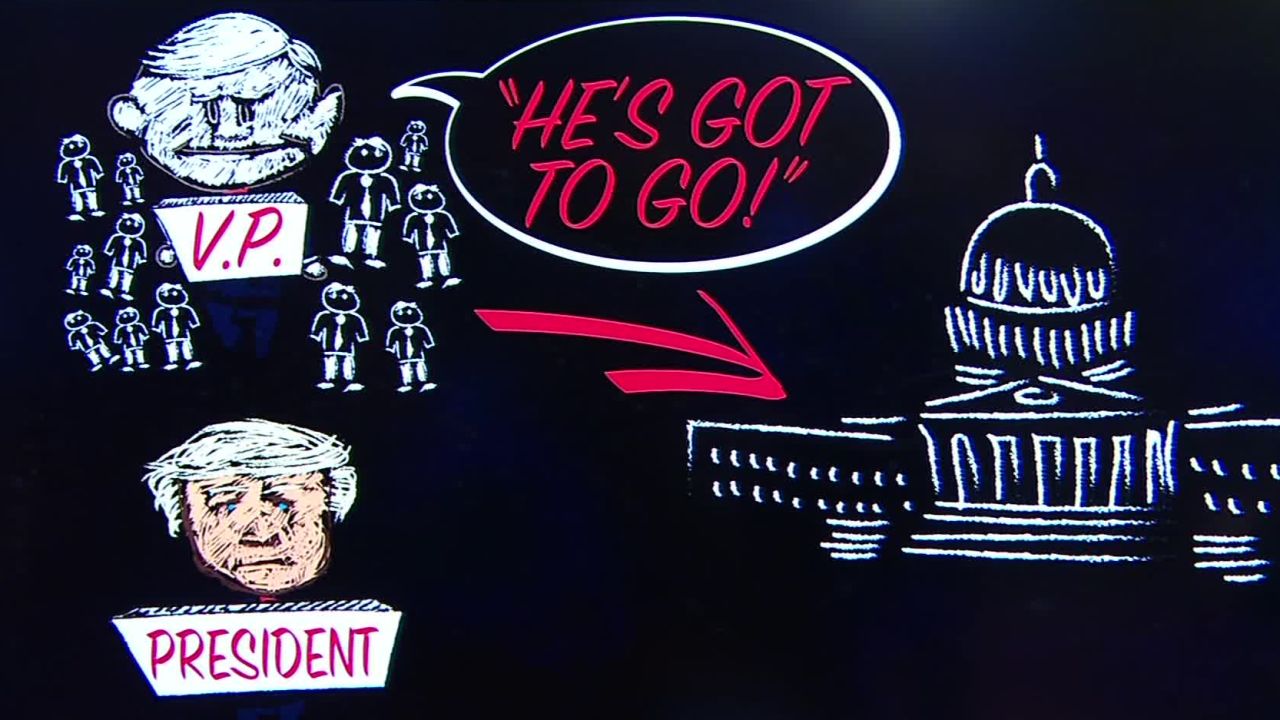
Lawmakers are clutching their pearls again. The latest round of outrage centers on a stray expletive from Donald Trump, sparking the usual Pavlovian response from the gallery: "Invoke the 25th Amendment!" It is a predictable, exhausting cycle. But here is the cold truth that cable news pundits won't tell you: the 25th Amendment is not a "bad behavior" clause. It is not a "he said something mean" ejector seat. Using it as a response to a vulgarity isn't just a misunderstanding of the law; it is a desperate attempt to bypass the ballot box that would shatter the very institutions these lawmakers claim to protect.
The Section 4 Delusion
The media loves to fixated on Section 4 of the 25th Amendment. They treat it like a political "get out of jail free" card. For the uninitiated, Section 4 allows the Vice President and a majority of the Cabinet to declare the President "unable to discharge the powers and duties of his office."
Note the wording. Unable. Not "unpleasant." Not "rude." Not "guilty of a PR nightmare."
The 25th Amendment was birthed from the shadow of the JFK assassination. Its purpose was to address medical emergencies—strokes, comas, or literal brain death—where the line of succession needed to be instantaneous to prevent a vacuum of power. When you try to stretch that medical definition to cover "using a four-letter word on camera," you aren't being a guardian of democracy. You are performing a constitutional heist.
The Math of a Failed Coup
Let's look at the mechanics, because the "25th Amendment" crowd rarely bothers with the fine print. Even if a Cabinet magically turned on its leader, the President can immediately send a written declaration to Congress stating that no disability exists.
At that point, the burden shifts to the Vice President and the Cabinet to re-assert the disability within four days. Then, it goes to a vote in Congress. To actually remove the President, you need a two-thirds majority in BOTH the House and the Senate.
Think about that. In a polarized Washington, you can barely get a two-thirds majority to name a post office. The idea that you could strip a President of his power because he used an "F-bomb" is statistically impossible and intellectually dishonest. It’s a ghost story told to donors to keep the checks flowing.
Profanity is Not a Pathology
The competitor articles love to frame vulgarity as a sign of mental decline or "unfitness." This is the "lazy consensus" at its peak. It ignores the history of the American presidency and the reality of power.
Lyndon B. Johnson was a walking obscenity. He conducted meetings from the toilet and used language that would make a sailor blush. Richard Nixon’s tapes are a masterclass in vitriol. Andrew Jackson literally threatened to hang his own Vice President.
The standard for "fitness" has never been "politeness." In fact, from a purely strategic perspective, raw language is often used as a tool of populist authenticity. When a politician swears, their base doesn't see a breakdown; they see a human being who is as fed up as they are. By pearl-clutching over an F-bomb, lawmakers are inadvertently proving Trump’s point: that the "establishment" is more concerned with decorum than with the actual mechanics of governance.
The Market Hates a Vacuum
From a business and economic perspective, the 25th Amendment chatter is a massive liability. Markets thrive on predictability. The moment you credibly threaten to remove a sitting President via a Cabinet mutiny, you inject a level of "Third World" instability into the US dollar.
I’ve spent years watching how markets react to political volatility. A President losing an election is priced in. A President being impeached is a known quantity with clear rules. But a President being deposed by his own Cabinet because of a verbal gaffe? That is a black swan event.
If lawmakers actually succeeded in this theater, the immediate result wouldn't be "peace and restoration." It would be a constitutional crisis that would make 2020 look like a rehearsal. You would see a bifurcated executive branch, competing orders given to the military, and a total freeze of the global financial system as the world waits to see who actually holds the nuclear codes.
The Cowardice of the Short-Cut
Why do lawmakers keep bringing up the 25th? Because it’s easier than winning an argument.
Democracy is messy. It requires persuading people that your ideas are better than the other guy's ideas. It requires winning elections. When you realize you can't win the hearts and minds of the electorate, the temptation is to find a legal trapdoor.
The 25th Amendment talk is the ultimate "short-cut" for the politically bankrupt. It’s a way to say, "The people chose wrong, so we’ll use a medical clause to fix it."
The Dangerous Precedent
Imagine a scenario where this succeeds. Imagine a world where "mental unfitness" is defined by the opposition party based on a President's temperament or speech patterns.
- A President gets depressed after a personal tragedy? 25th.
- A President has a hot-mic moment during a stressful negotiation? 25th.
- A President makes a radical policy shift that the Cabinet dislikes? 25th.
We would move from a Republic to a Parliamentary system where the "Government" (the Cabinet) can fire the "Head of State" (the President) at will. That is not the American system. Our system was designed to make it exceedingly difficult to remove a leader outside of an election cycle. That difficulty is a feature, not a bug. It prevents the "tyranny of the temporary majority."
Stop Asking the Wrong Question
The media asks: "Is Trump's language a sign of unfitness under the 25th?"
The real question is: "Why is the opposition so terrified of the 2024/2028 election that they are trying to weaponize the medical manual?"
By focusing on the 25th Amendment, lawmakers are telegraphing their own weakness. They are admitting that they cannot defeat the man at the ballot box, so they must try to diagnose him out of office. It is a tactic that alienates moderate voters and galvanizes the opposition. It turns a politician into a martyr.
If you hate the rhetoric, beat it with better rhetoric. If you hate the policy, offer a better one. But stop pretending that a swear word is a neurological event requiring a constitutional coup.
The 25th Amendment is a fire extinguisher behind glass. It is for when the building is literally burning down because the leader is in a coma or has lost the capacity for speech. Using it because you don't like the tone of the conversation is like using a fire extinguisher to put out a birthday candle. You’ll just end up making a mess of everything, and the fire will still be there.
Lawmakers need to put the Amendment back in the holster and go back to the one thing they seem to fear most: actually campaigning. If a leader is truly "unfit," the voters will be the ones to deliver the diagnosis. Anything else is just a desperate grab for power dressed up in the language of concern.
Stop looking for a trapdoor. There isn't one.