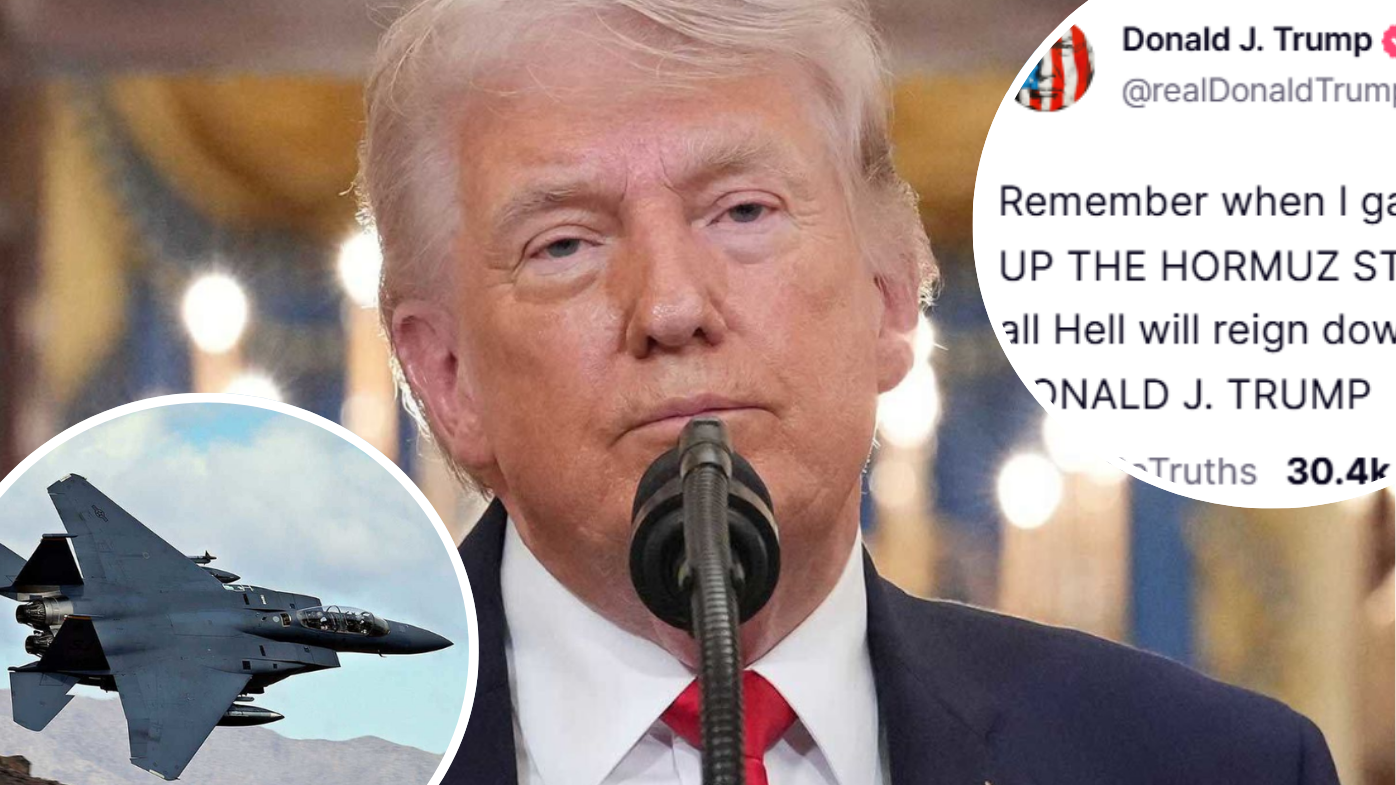
The clock is ticking on a deadline that looks more like a geopolitical gamble than a military strategy. On Saturday, President Donald Trump issued a final 48-hour ultimatum to Tehran: reopen the Strait of Hormuz or face "all hell." This directive, broadcast via Truth Social, sets a hard cutoff for Monday, April 6. While the White House projects an image of absolute dominance, the reality on the ground in southwestern Iran tells a more fractured story. Somewhere in the rugged terrain of Kohgiluyeh and Boyer-Ahmad province, a U.S. weapon systems officer is missing after their F-15E Strike Eagle was downed on April 3.
This isn't just about a missed deadline or a single aircraft. It is a collision between the high-altitude bravado of "Operation Epic Fury" and the gritty, unpredictable nature of modern anti-access/area-denial (A2/AD) warfare. For six weeks, the administration has claimed that Iranian radar was "100% annihilated" and that U.S. forces had total control of the skies. The loss of an F-15E—the first American fixed-wing combat loss in Iranian territory during this conflict—shatters that narrative. It suggests that despite thousands of sorties and the decimation of traditional military infrastructure, Iran’s mobile air defense networks remain a lethal, if intermittent, threat.
The Myth of the Empty Sky
The Pentagon’s confidence has been the cornerstone of its public messaging since the conflict began on February 28. Defense Secretary Pete Hegseth has repeatedly assured the public that Iranian defenses were neutralized. Yet, the April 3 incident reveals a massive intelligence gap. The F-15E wasn't just "lost" to mechanical failure; it was engaged and destroyed.
Intelligence suggests Iran is utilizing "passive" radar systems and indigenous batteries like the Bavar-373, which are harder to track and suppress than the older Russian-made S-300s. These systems are being used in a "pop-up" fashion. They stay silent, evading electronic intelligence (ELINT) aircraft, then activate only when a target is within a high-probability kill zone. This tactic makes the concept of "air supremacy" a dangerous misnomer. You can own the sky for 23 hours a day, but the one minute you don’t is when you lose a multi-million dollar jet and its crew.
The Search in the Shadows
The search for the missing crew member has become a microcosm of the larger war. One pilot was successfully extracted by U.S. military helicopters, but the second remains unaccounted for. The terrain in Kohgiluyeh and Boyer-Ahmad is a nightmare for search-and-rescue (SAR) operations. It is characterized by steep limestone ridges and a local population that is increasingly hostile and armed.
Reports from the region indicate that "popular forces" and local tribesmen have joined the Islamic Revolutionary Guard Corps (IRGC) in the hunt. This isn't just a military sweep; it is a bounty hunt. The regional governor has publicly promised rewards for the capture or killing of "hostile enemy forces." This creates a scenario where U.S. special operations teams are not just fighting a formal military, but a decentralized web of irregulars who know every cave and crevice of the mountains.
Economic Strangulation and the Hormuz Chokepoint
While the hunt for the pilot continues in the dirt, the global economy is suffocating at sea. The Strait of Hormuz, through which roughly 20% of the world's liquid petroleum passes, remains effectively closed. Iran’s strategy is simple: if they cannot win a conventional war, they will make the world pay for the attempt.
The closure has sent oil prices into a vertical climb, impacting everything from consumer gas prices in the U.S. to manufacturing costs in the E.U. and China. This is the "why" behind Trump’s 48-hour deadline. The pressure isn't just coming from the military situation; it’s coming from global markets and nervous allies.
The administration’s demand for Iran to "open up" the strait assumes that Tehran still has a centralized, functioning command structure that can simply flip a switch. However, the IRGC’s naval wing often operates with significant autonomy. Even if the central government in Tehran agreed to terms, rogue commanders or "ghost" cells equipped with anti-ship missiles and fast-attack craft could continue to harass shipping, making the strait "open" in name only.
The Failure of the Stone Age Strategy
The phrase "bomb them back to the Stone Age" is a classic piece of American military rhetoric, but it rarely accounts for the resilience of a decentralized adversary. The U.S. has targeted petrochemical hubs and infrastructure near the Bushehr nuclear plant. While these strikes cause significant economic damage, they also harden the resolve of the IRGC.
The irony is that as the formal state infrastructure crumbles, the IRGC becomes more dangerous, not less. They transition from a standing army into an insurgency with state-level weaponry. The downing of the F-15E and the subsequent damage to an A-10 Warthog over the Persian Gulf demonstrate that Iran’s ability to "sting" remains intact.
The Missing Piece of the Puzzle
The missing pilot is more than a service member; they are a political pawn in a game with no clear exit strategy. If the pilot is captured, the 48-hour deadline becomes infinitely more complicated. It is easy to threaten "all hell" when the only things at risk are machines and anonymous targets. It is much harder when a televised prisoner of war becomes the face of the conflict.
The administration’s current posture leaves no room for the "gray areas" of combat. By demanding a total reopening of the strait and a "deal" within 48 hours, they have backed themselves into a corner. If the deadline passes without compliance, the only remaining option is a massive escalation—possibly involving ground troops or tactical strikes on leadership bunkers. Both options carry risks that the U.S. public, already weary of "forever wars," may not be ready to bear.
A Negotiated Dead End
There are whispers of back-channel diplomacy. Pakistan, Turkey, and Egypt are reportedly trying to broker a ceasefire in Islamabad. Iran’s Foreign Minister, Abbas Araghchi, has indicated a willingness to talk, but the rhetoric from Washington remains focused on total capitulation.
The 48-hour window is likely intended to force Iran’s hand before these diplomatic efforts can gain enough steam to offer Tehran a "way out" that isn't total surrender. It is a race between the bomb and the briefcase.
The technical reality of the Strait of Hormuz is that it cannot be "secured" by airpower alone. To truly open the waterway, the U.S. would need to occupy the coastline or maintain a permanent, high-density naval presence that would be constantly under threat from shore-based batteries.
The Brutal Truth
The U.S. is currently winning the war of attrition but losing the war of objectives. We can destroy every refinery in Khuzestan, but if the Strait of Hormuz remains a no-go zone and American pilots are being hunted by tribesmen, the "victory" is hollow.
The 48-hour deadline is a theatrical device. It creates a sense of urgency for an administration that needs a quick win to justify the mounting costs—both in blood and in the global economy. But the mountains of Iran do not care about Truth Social posts. The missing pilot is likely moving through the darkness right now, trying to stay one step ahead of a population that has been told he is the architect of their misery.
The next 48 hours won't just determine the fate of a pilot or a shipping lane. They will reveal whether the U.S. has a plan for the day after the "hell" arrives. If the past six weeks are any indication, the answer is likely buried somewhere in the limestone of the southwest, hidden from the satellites and the sensors.
Stop looking at the clock and start looking at the map. The distance between a threat and a solution is growing wider with every passing hour.