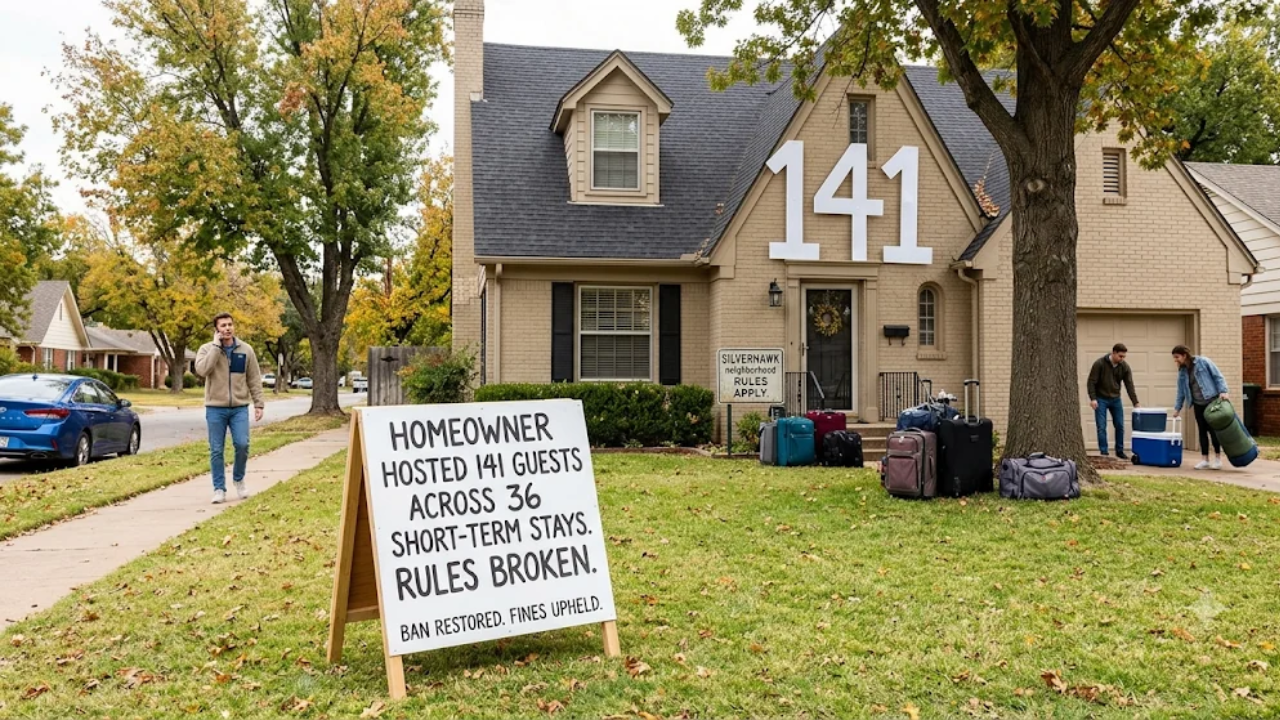
Eight thousand, five hundred, and twenty-eight dollars.
Read that number again. Think about what it represents in the quiet, brick-lined suburbs of Oklahoma. It is four months of a modest mortgage. It is a reliable used sedan sitting in the driveway. It is a child’s first year at a state university, or the exact amount tucked away in a high-yield savings account to cover a catastrophic roof leak after a spring hailstorm.
For one Oklahoma homeowner, however, $8,528 was the price of handing a set of house keys to a stranger for the weekend.
When the Oklahoma Supreme Court recently stepped into a neighborhood dispute and restored a ban on a homeowner’s short-term rental business—slapping him with that exact fine—the headlines treated it like a dry municipal footnote. A zoning quirk. A local squabble between a guy with an Airbnb listing and a Homeowners Association with too much time on its hands.
They missed the point entirely.
If you own a home, if you have ever dreamed of turning your spare bedroom into a side hustle, or if you have ever bought into a quiet cul-de-sac expecting peace and predictability, this ruling is sitting on your front porch right now. It is the latest flashpoint in a bitter, deeply personal cold war being fought across American neighborhoods—a war over what it actually means to own a piece of the earth.
The Architecture of a Broken Promise
To understand why a state supreme court had to referee a fight over weekend guests, you have to understand the two competing American dreams colliding on the same patch of grass.
Let’s step into the shoes of a hypothetical couple—we’ll call them Marcus and Elena—to see how this trap springs shut. Imagine Marcus and Elena spent ten years eating cheap pasta and skipping vacations to scrape together a down payment on a four-bedroom house in an established Oklahoma subdivision. They signed a stack of closing documents three inches thick. Somewhere near page forty-seven, buried beneath termite inspections and escrow disclosures, sat the Covenants, Conditions, and Restrictions—the dreaded CC&Rs.
Like ninety-nine percent of homebuyers, they skimmed it. They saw rules about paint colors, trash cans, and a standard clause stating that properties must be used strictly for "residential purposes."
"Of course," Marcus thought, his hand cramping from signing his name forty times. "We’re going to live here. We aren't opening a muffler shop."
Years pass. Inflation bites. Property taxes creep upward. Meanwhile, a spare bedroom sits empty, collecting dust. Marcus looks at his mortgage statement, then looks at a short-term rental app. Suddenly, that empty room isn't dead space; it’s an engine. It’s a way to pay down the principal five years early. They list the property, welcome polite weekend travelers visiting for a college football game, and watch the extra income smooth out the rough edges of their family budget.
Now, shift your gaze fifty feet to the left. Meet Arthur, their next-door neighbor.
Arthur bought into the exact same neighborhood twenty years ago for the exact opposite reason. He didn't buy a financial engine; he bought a sanctuary. He bought the quiet predictability of knowing who lives next door, knowing their kids' names, and knowing that on a Tuesday night at eleven o'clock, nobody is going to be rolling a hardshell suitcase across the concrete driveway while shouting into a cell phone.
When Arthur sees a revolving door of strangers pulling into Marcus and Elena’s driveway every Friday afternoon, he doesn't see entrepreneurial grit. He sees a boutique hotel operating illegally in a residential zone. He sees his property value tethered to the whims of transient tourists who have zero stake in the community.
Both of these people are right. And that is precisely why this fight gets so ugly.
When "Residential" Becomes a Battlefield
I have sat across the table from homeowners in the middle of HOA litigation, and the exhaustion in their eyes is visceral. You can smell the stale coffee and see the thick manila folders overflowing with certified letters, screenshots of rental listings, and legal invoices that bill by the tenth of an hour. When a neighbor sues a neighbor, the neighborhood dies a slow, agonizing death. Every trip to the mailbox becomes a tactical maneuver. Every glance over the fence feels like surveillance.
In the Oklahoma case that culminated in that $8,528 penalty, the battle hinged on a deceptively simple question: Does renting out a house for a few days at a time count as a "residential" use, or does it cross the line into a "commercial" business?
Think about that distinction for a moment. It is a legal tightrope suspended over a canyon of money.
On one side, the homeowner’s argument makes intuitive sense. What do guests actually do inside a short-term rental? They sleep in beds. They cook eggs in the kitchen. They watch television on the couch and take showers in the morning. They aren't manufacturing widgets or selling retail goods out of the garage. They are residing there, even if the stay is measured in days rather than years. If a homeowner is allowed to sign a twelve-month lease with a tenant—which almost every HOA allows—why does the calendar suddenly transform the exact same human behavior into an illegal commercial enterprise when the lease is shortened to forty-eight hours?
It feels arbitrary. It feels like a technicality weaponized by nosy neighbors.
On the other side, the HOA and the Oklahoma Supreme Court looked at the nature of the transaction rather than the activities inside the living room. Consider what happens when you book a hotel room. You pay a nightly rate, you are subject to transient occupancy taxes, and the entity taking your money is operating a hospitality business. The court looked at the homeowner’s operation—the rapid turnover, the online marketing, the nightly pricing structure—and saw a commercial enterprise wearing a residential disguise.
By restoring the ban and upholding the $8,528 fine, the court drew a hard, unforgiving line in the Oklahoma red dirt. A deed restriction promising "residential use" isn't just a polite suggestion; it is a binding contract that protects the collective character of a neighborhood against individual commercialization.
The Invisible Math of the Fine
Nobody wakes up intending to owe $8,528 to their homeowners association. That number isn't a random slap on the wrist; it is the result of a slow-motion financial avalanche.
Most HOA fines start small. Fifty dollars a day. Maybe a hundred dollars per violation. When a homeowner receives that first violation notice in the mail, pride usually takes the wheel. It’s my house, they think. I pay the mortgage. I pay the property taxes. Nobody gets to tell me who I can invite into my own home.
So they keep the listing active. They hire a lawyer, convinced that a judge will see the common sense of property rights.
Meanwhile, the meter is running.
Every weekend booking triggers another violation. Interest accrues. The HOA’s legal fees—which, under the fine print of almost every neighborhood covenant in America, get passed directly onto the losing homeowner—begin to compound. A lower court might even rule in the homeowner's favor temporarily, offering a false sense of victory that encourages them to keep hosting guests while the appeal winds its way through the system.
Then, months or years later, the state supreme court drops the gavel. The ban is restored. Every single day of operation during that legal limbo snaps back like a rubber band. Suddenly, a side hustle meant to bring in a few hundred extra dollars a month has morphed into an $8,528 anchor around the homeowner’s neck—and if they don't pay it, the HOA can slap a lien on the house and eventually foreclose on the very property they were trying to pay off.
It is a terrifying asymmetry of power. You are fighting an organization funded by the collective dues of your entire neighborhood, armed with specialized real estate attorneys who do nothing all day except enforce deed restrictions.
The Myth of Absolute Ownership
We like to believe in the castle doctrine—the comforting fiction that once the deed is recorded at the county clerk’s office, our home is our sovereign territory. We are kings and queens of our quarter-acre lot.
The truth is far messier, and honestly, a little unsettling once you stare directly at it.
When you buy a home inside a planned community or an older neighborhood governed by restrictive covenants, you aren't buying absolute freedom. You are buying a bundle of sticks, and you voluntarily handed several of those sticks to your neighbors the day you closed on the house. You traded the freedom to paint your front door neon pink for the guarantee that your neighbor won't park a rusted-out school bus on his front lawn.
For decades, that trade worked seamlessly because the threats to neighborhood harmony were obvious and physical. Everybody agreed on what a commercial business looked like. It had a neon sign in the window, a cash register on the counter, and delivery trucks backing up to the porch.
Then smartphones arrived and turned every spare bedroom, basement apartment, and vacation cabin into a globally accessible storefront. Technology erased the physical footprint of commerce. There is no neon sign anymore. There is just an algorithm, a smart lock with a four-digit keypad, and a cleaning crew arriving at eleven in the morning.
The law, by design, moves like a glacier, while Silicon Valley moves like lightning. Homeowners rushed into the gray area between "living in a house" and "running a hotel," encouraged by tech platforms that made the process look as effortless and innocent as lending a cup of sugar to a friend. Those platforms collected their service fees on every booking, took their cut, and left the homeowners standing completely alone on the courthouse steps when the neighborhood fought back.
Where the Next Battle Lines Are Drawn
If you think this is just an Oklahoma story, look at the docket of almost every state appellate court in the country. From Texas to Tennessee, from Colorado to Florida, the exact same collision is playing out with wildly different results.
In some states, courts have sided with property rights, ruling that if an HOA wants to ban short-term rentals, it has to amend its covenants explicitly rather than relying on vague "residential use" language from the 1980s. In others—like Oklahoma—the courts have looked at the spirit of those older covenants and decided that a revolving door of paying guests is fundamentally incompatible with residential living.
This legal patchwork creates a minefield for anyone looking to buy real estate today. You can no longer rely on a quick glance at the neighborhood rules or a casual assurance from a real estate agent saying, "Oh, nobody around here cares if you list it on weekends."
People care. And the rules that govern your house don't bend to verbal promises.
If you are considering turning a property into a short-term rental—or if you are buying a home specifically to avoid living next to one—you have to read the governing documents like a prosecutor looking for a loophole. You have to look at the amendment thresholds: how many neighbors does it take to rewrite the rules overnight? Even if your neighborhood allows weekend rentals today, a coordinated group of annoyed neighbors can often gather enough votes at the next annual meeting to outlaw your business by spring.
And if you decide to push the boundaries, to test the gray areas of municipal zoning or neighborhood covenants, you have to ask yourself a brutal question before you hand over that first key: Are you willing to absorb an $8,528 hit just to prove you were right?
Walk down any quiet residential street in America tonight, right around dusk. Look at the warm yellow light spilling out from behind living room curtains. On the surface, everything looks identical—identical mailboxes, identical manicured lawns, identical brick facades. Yet behind one door sits a family desperately trying to leverage their biggest asset just to stay ahead of the cost of living, and behind the door next to it sits a neighbor fiercely guarding the quiet sanctuary they spent a lifetime earning. Between them lies a strip of grass barely ten feet wide, a keypad gleaming faintly in the dark, and a bill waiting to come due.