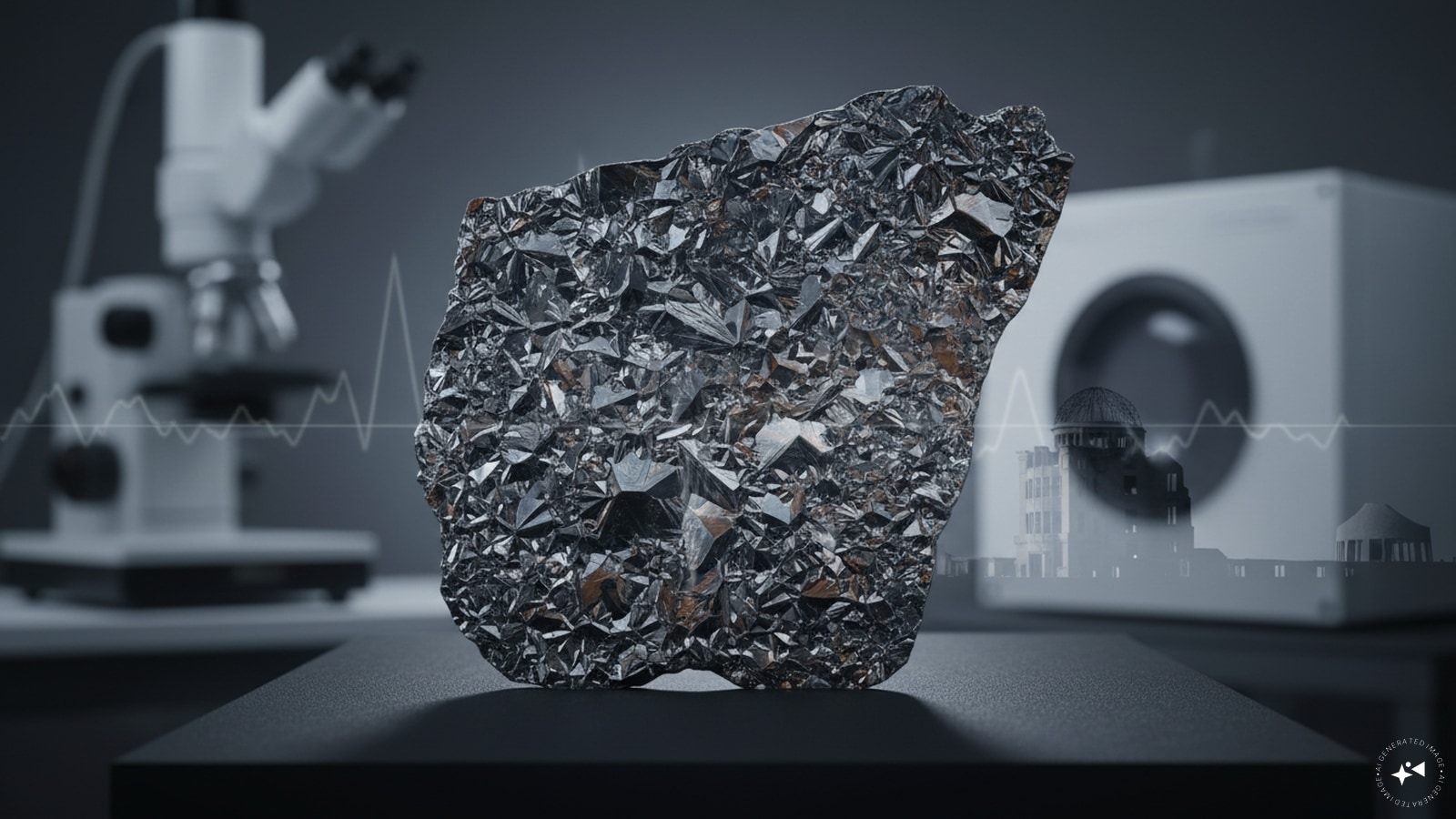
The Little Boy atomic bomb dropped on Hiroshima on August 6, 1945, did far more than level a city and alter the geopolitical architecture of the twentieth century. It initiated an accidental, high-pressure materials science experiment that researchers are only now beginning to fully understand. Recent scientific analysis reveals that the extreme thermal and mechanical forces of the blast fused surrounding materials into a unique multicomponent alloy, creating a microscopic metallic archive forged in a fraction of a second.
For decades, post-war investigation centered on the immediate human toll, the physics of fission, and the long-term radiological footprint of the blast. Material science took a backseat to macro-level survival and geopolitical fallout. That separation has changed. Advanced microscopic examination of debris from the hypocenter shows that the ultra-high temperatures and extreme shockwaves synthesized complex metallic mixtures that do not form under conventional terrestrial conditions. This discovery forces a reevaluation of how extreme environments alter matter at the atomic level, offering unintended insights into high-entropy alloys and materials engineering.
The Physics of an Accidental Synthesis
To understand how a nuclear detonation creates a multicomponent alloy, one must look closely at the immediate aftermath of detonation. The Hiroshima device detonated approximately six hundred meters above the city. Within microseconds, the ambient temperature at the hypocenter spiked to millions of degrees Celsius, accompanied by an unimaginably violent shockwave.
Building materials, electrical wiring, structural steel, personal belongings, and urban infrastructure vaporized instantly into a roiling plume of plasma and superheated gas. As the fireball expanded and rapidly cooled, these disparate elements did not simply settle as dust or separate ash. Instead, the rapid quenching rate—the speed at which the temperature dropped from extreme highs back to ambient levels—froze liquid and gaseous precursors mid-reaction.
In standard metallurgy, creating a stable alloy requires precise proportions, controlled atmospheric conditions, and carefully managed cooling schedules to prevent phase separation. Traditional alloys typically rely on one or two primary base metals, such as iron or copper, with minor additions of other elements.
The Hiroshima debris shattered this rulebook. The blast forced elements that normally reject one another into solid solutions. Nickel, iron, copper, zinc, and various trace construction elements locked together in proportions dictated purely by proximity rather than thermodynamic preference. The resulting structures are complex, disordered crystalline matrices that defy standard metallurgical classification.
Unlocking High Entropy Structures
The technical term driving modern interest in these findings is the high-entropy alloy. Traditional metals rely on a dominant solvent element. High-entropy alloys break this convention by mixing five or more elements in roughly equal atomic percentages.
These materials often exhibit extraordinary strength, resistance to extreme corrosion, and exceptional tolerance to radiation damage. Engineers spend millions of dollars in modern laboratories trying to synthesize these chaotic atomic configurations using high-powered lasers, vacuum chambers, and expensive elemental powders.
The blast wave over Hiroshima achieved this feat through brute force. By melting urban detritus and slamming the vaporized atoms together under hyper-velocity pressure gradients, the bomb acted as a chaotic forge.
Researchers examining samples recovered from specific architectural remnants found regions where multiple metallic elements distributed uniformly across microscopic grains. This atomic homogeneity is the holy grail of advanced materials design. When atoms are randomly distributed without forming distinct brittle phases, the material resists structural deformation under stress. Dislocations—the microscopic shifts in crystal lattices that cause metal to bend or break—find it difficult to move through such a disordered neighborhood.
The tragedy of August 1945 thus left behind an accidental blueprint for structural resilience. The irony is stark. A weapon designed explicitly to tear structures apart manufactured microscopic structures capable of withstanding extreme punishment.
Methodologies of the Post-War Microscopic Hunt
Detecting these anomalies required technology that did not exist when the Manhattan Project scientists evaluated the ruins. Early surveys cataloged structural damage through visual inspection, simple photography, and basic radiological surveys.
Modern investigators utilized transmission electron microscopy and atom probe tomography. These tools allow scientists to slice samples down to the nanometer scale and map the exact coordinates of individual atoms.
When researchers applied these techniques to melted fragments of iron-rich urban debris mixed with copper and zinc from electrical systems, the anomaly revealed itself. The grain boundaries showed unexpected stability. The diffusion rates of the atoms within the matrix were vastly slower than predicted by standard metallurgical models.
This slow diffusion rate is precisely what modern aerospace and nuclear engineers look for when designing materials for jet turbine blades or reactor cores. Extreme environments demand materials that do not degrade under thermal cycling or intense particle bombardment. The Hiroshima artifacts provided a natural stress test of what happens when matter is shoved past its threshold of stability and flash-frozen in time.
Historical Echoes and Scientific Ambivalence
The intersection of nuclear warfare and materials science carries an uncomfortable weight. Science often advances through catastrophe, harvesting data from human misery.
The medical community faced this ethical reality decades ago when data from atomic bomb survivors shaped modern radiation biology and oncology. The realization that metallurgy can also extract empirical data from the hypocenter extends this pattern into physical engineering.
Yet, researchers analyzing these alloys emphasize that the utility of the finding lies in synthesis, not destruction. Understanding how extreme shockwaves force metallic mixing helps scientists design better protective shielding for spacecraft entering planetary atmospheres or components meant to withstand hyper-velocity impacts.
The chaotic nature of the blast also highlights the limits of controlled laboratory synthesis. In a standard lab, researchers carefully calculate phase diagrams to see which elements will mix. The Hiroshima debris demonstrates that brute-force thermal spikes can bypass traditional thermodynamic barriers entirely, opening a window into non-equilibrium thermodynamics.
Rethinking Material Boundaries
The implications stretch far beyond historical curiosity. As industries push toward more extreme operating conditions, standard metals hit strict performance walls. Jet engines run hotter; deep-space probes encounter harsher radiation; industrial reactors demand longer lifespans under corrosive stress.
The study of blast-synthesized materials points toward alternative manufacturing pathways. If hyper-velocity kinetic energy and rapid thermal quenching can force disparate elements into stable, high-entropy configurations, engineers can explore novel synthesis techniques like shock-wave consolidation and laser-beam rapid quenching to replicate these structures safely.
The melted remnants sitting in archives and university labs serve as a silent testament to a morning that changed human history. They are physical reminders that matter itself remembers violence. Long after the structures fell and the radioactive isotopes decayed to baseline levels, the atomic bonds forged in an instant remain locked in a configuration that modern science is only beginning to decipher.
The debris demands a shift in how we view the physical aftermath of extreme events. It strips away the romanticism of technical progress, grounding it in the brutal reality of what happens when raw energy reorders the periodic table. The alloy did not form by design, nor did it rise from a clean workshop floor. It was born from the convergence of human engineering and catastrophic destruction, an unintended monument cast in metal at the absolute edge of human endurance.