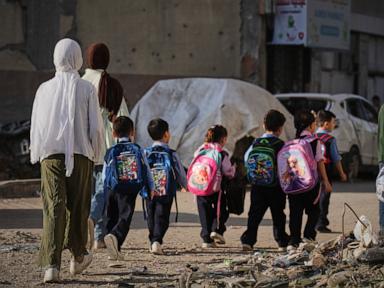
The chalk dust always settled first on the window sills, grey and heavy against the Mediterranean glare. In a schoolroom in Gaza, thirty pairs of eyes would track the dust motes dancing in the sunbeams, waiting for the lesson to begin. The teacher, standing before a blackboard worn smooth by decades of conflict, would raise a piece of white chalk.
That was a different era. Today, the blackboard is increasingly digital, the textbooks are filtered through screens, and the invisible ear of an American charity is listening.
Consider what happens next. A humanitarian organization, thousands of miles away in the United States, makes a quiet administrative choice. They decide to introduce artificial intelligence to monitor the classrooms they fund. The stated goal is noble on paper: to scan for hateful speech, to root out radicalization before it takes root, to protect the vulnerable minds of children growing up amidst the ruins of blockades and bombardments.
Silence.
Then, the friction begins.
It is easy to write policies in air-conditioned boardrooms in Washington or New York. It is entirely another to live inside the friction of a digital panopticon deployed in a war zone. When an algorithm listens to a classroom, it does not hear context. It hears frequency. It hears volume. It hears the raw, unedited anger of children who have watched their neighborhoods flattened, their water turn brackish, and their futures shrink to the dimensions of a concrete wall.
Anger in Gaza is not a curriculum deviation. It is an atmospheric pressure.
To understand why this initiative is sending shockwaves through educational circles, we have to look past the press releases and examine the mechanics of automated surveillance. Machine learning models, no matter how sophisticated, rely on training data. They rely on dictionaries of intent, linguistic markers, and cultural baselines. But whose baseline?
When a model built in Silicon Valley or developed by Western contractors listens to Arabic spoken under occupation, it encounters a linguistic universe rich with hyperbole, grief-stricken idioms, and the sharp, defensive rhetoric born of survival. What a western compliance officer might flag as hate speech, a local teenager might use simply to describe the weather of their existence.
Language here is heavier. It carries the weight of history.
Let us step into a hypothetical classroom to see the gears turn. Imagine Tariq, a fourteen-year-old boy whose notebooks are smudged with charcoal and tears. He is sitting at a wooden desk with three other boys, arguing over a history lesson. Voices rise. The ambient microphone hanging above the whiteboard picks up the escalation. The software flags a keyword—a term associated with resistance, anger, or historical grievance.
A flag blinks red on a dashboard three time zones away.
Is Tariq a threat? Or is he a child venting a generational trauma that no algorithm can parse?
The charity argues that oversight is necessary. They point to donor requirements, accountability metrics, and the legal minefield of international aid distribution. If a single textbook crosses the line into incitement, the funding disappears. The school closes. The children are cast out into the streets. From the perspective of the organization's directors, automated monitoring is a shield. It proves to sceptical governments that every dollar and every lesson adheres to strict neutrality.
Yet, safety bought at the price of constant surveillance creates a different kind of hazard.
When children learn that every syllable is being weighed by a machine that does not understand their tears, something shifts inside them. Spontaneity dies. The classroom transforms from a sanctuary of learning into a courtroom where an invisible judge is always taking notes. Trust evaporates. How do you teach poetry
The Invisible Classroom Guard That Listens in the Dark
news, technology
Note on dual categorization: This piece explores the intersection of international news and emerging educational technology.
Dust motes drift across a shaft of morning sunlight, settling on the wooden edge of a school desk in Gaza. Inside the room, twenty children sit shoulder-to-shoulder, their notebooks open, pencils worn down to stubs. Outside, the world is a pressure cooker of concrete, tension, and history. But inside this room, the air smells faintly of chalk dust and cheap tea.
For decades, the classroom was supposed to be a sanctuary. A place apart. A space where a child could build a mind without worrying about the storm raging outside the iron gate.
Today, that sanctuary is getting an invisible roommate.
A United States-based charity has set its sights on these very rooms, armed not with textbooks or medicine, but with code. The plan is precise, clinical, and controversial: to deploy artificial intelligence systems capable of monitoring classroom audio and interactions in real time, hunting specifically for what administrators designate as hateful speech.
It sounds like science fiction. It is happening now.
To understand why this matters, you have to step away from the abstract vocabulary of algorithms and look at a child named Tariq. He is ten years old. He has known three wars, two extended school closures, and an eternity of sirens. When Tariq raises his voice during a heated debate over history or geography, his words carry the weight of a generation that has inherited a battlefield.
When an algorithm listens to Tariq, it does not know about the uncle he lost or the roof that collapsed down the street. It does not hear the grief cracking beneath his anger. It hears variables. It measures cadence, pitch, and keywords against a predefined safety threshold. If his frustration crosses a line written by programmers thousands of miles away in a climate-controlled Silicon Valley office, a flag goes up.
A notification pings on a dashboard.
Proponents argue that this is a necessary shield. In regions scarred by generational conflict, education can easily curdle into indoctrination. The logic goes that if you want to build a lasting peace, you must police the nursery rhymes, the playground arguments, and the curriculum before radicalization takes root. It is an attempt to use digital guardrails to engineer tolerance. You sanitize the input to purify the output.
On paper, the humanitarian impulse is understandable. No one wants children taught to hate. No parent wants a classroom to incubate the next cycle of violence.
Yet, anyone who has ever spent time inside a real, messy, breathing classroom knows a fundamental truth: learning is loud, uncomfortable, and occasionally explosive.
Children test boundaries. They repeat the harsh words they overhear in the street, on the television, or from grieving relatives. They try on extreme ideas like ill-fitting coats to see how they feel. A skilled teacher hears that raw anger not as a permanent indictment, but as an invitation. They step in. They ask why. They guide the child through the tangled underbrush of their own rage.
An algorithm does not guide. An algorithm flags.
Consider what happens next in this automated ecosystem. When speech is continuously monitored by a machine looking for ideological infractions, human behavior changes instantly. It is called the chilling effect. Children stop arguing. They stop expressing the dark, difficult, messy truths of their lived reality. They learn to speak in sanitized platitudes that keep the green light on the dashboard from blinking red.
Silence is mistaken for peace.
We have seen this movie before, long before artificial intelligence entered the chat. Every time authorities try to mandate thought through surveillance, they achieve compliance, never harmony. They drive the ugliness underground, where it festers away from the light of open debate and empathetic correction.
The charity implementing this system insists the tools are robust, neutral, and designed with safety as the primary directive. But neutrality in software is a myth. Code is written by humans, trained on human data, and weighted with human biases. What one culture or administrator defines as a legitimate expression of historical grievance, another might classify as inflammatory rhetoric. When you automate the policing of human speech in a war zone, you are handing a blunt instrument to a machine that cannot comprehend context, irony, trauma, or poetry.
Imagine a teacher trying to read a poem about displacement aloud to her class. Imagine a student shouting out a line of desperate defiance, echoing the poetry of resistance they heard on the radio. The algorithm listens. It strips away the literary context, the cultural resonance, and the historical pain. It isolates the trigger words.
Alert generated.
The teacher is no longer an educator mentoring souls through trauma. She is an operator managing a compliance queue, constantly looking over her shoulder to ensure her classroom doesn't trip the wire.
Peace cannot be downloaded. It cannot be compiled in a software sprint or enforced by an invisible digital warden listening through the ceiling tiles. Real peace is agonizingly slow. It is built in the quiet, unrecorded moments when a teacher looks a angry child in the eye, listens to the worst things that child has to say, and teaches them a different way to be.
The charity will install its software. The dashboards will light up. The reports will be filed, neat and clean, for donors thousands of miles away who want to see measurable metrics of progress.
Meanwhile, back in the classroom, the dust motes will keep falling. Tariq will sit at his desk, staring at the blank page, learning a new and much more dangerous lesson about the world: that even when you are finally allowed back inside to learn, someone is always listening, waiting for you to slip.