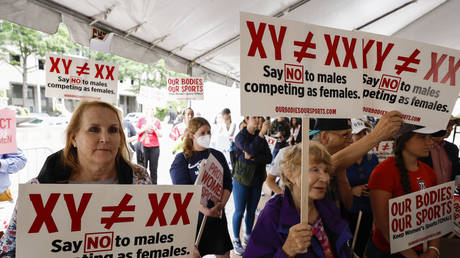
Public opinion polling in the United States consistently shows broad cross-party support for restricting athletic categories based on biological sex, driven not by generalized partisan alignment, but by a specific collision between fairness heuristics and physiological variance. While most contemporary cultural debates fracture cleanly along Democratic and Republican party lines, surveys conducted by organizations such as Gallup, the Pew Research Center, and The Washington Post-University of Maryland reveal a durable majority—often exceeding 60% to 70% of respondents—favoring policies that require athletes to compete on teams matching their sex assigned at birth. Understanding this phenomenon requires stripping away political rhetoric and analyzing the underlying cognitive, physiological, and institutional mechanisms that generate bipartisan convergence on an otherwise polarizing issue.
The Architecture of the Consensus
Standard political analysis treats voter behavior as a function of partisan identity, assuming individuals adopt the policy positions of their preferred political coalition. On the issue of transgender participation in female sports categories, that predictive model fails. Polling data demonstrates that while Republican support for sex-segregated athletic categories routinely exceeds 85%, a substantial plurality or outright majority of Independents and a significant bloc of Democratic voters hold identical views.
This cross-party alignment occurs because voters evaluate athletic competition through a bounded fairness framework rather than an abstract civil rights framework. When respondents are asked about anti-discrimination protections in housing, employment, or public accommodations, Democratic and Independent support surges, restoring the expected partisan split. When the context shifts to competitive athletics, voter evaluation criteria change immediately.
Three structural variables drive this shift in voter calculus:
- Zero-Sum Resource Allocation: Unlike housing or employment, where extending protections to one group does not inherently remove a finite spot from another, competitive sports operate as a strict zero-sum system. Roster spots, starting positions, championship titles, and athletic scholarships are fixed quantities. Voters intuitively recognize that altering eligibility criteria directly redistributes finite rewards.
- Asymmetric Physiological Baseline: Voters distinguish between social identity and physical capacity. Public perception anchors heavily on the observable divergence in human athletic performance post-puberty, viewing male puberty as conferring an irreversible structural advantage in muscle mass, bone density, lung capacity, and hemoglobin levels.
- Institutional Precedent of Title IX: For over five decades, American public policy has explicitly justified sex-segregated sports as a necessary mechanism to ensure female athletes have equitable access to competition and resources. Voters view biological eligibility rules not as a novel exclusion, but as the maintenance of an established protective boundary.
Physiological Variance and the Fairness Heuristic
To understand why non-conservative voters break from progressive orthodoxy on this issue, one must examine the mechanics of human sexual dimorphism and how laypeople process scientific consensus. In sports science, the performance gap between biological males and biological females is well-documented across nearly every discipline requiring strength, speed, or endurance. Prior to puberty, athletic performance metrics between boys and girls show minimal divergence. Following the onset of male puberty, driven by endogenous testosterone surges, the divergence becomes pronounced, typically ranging from 10% to 12% in running and swimming events, and exceeding 20% to 30% in activities reliant on upper-body strength and explosive power.
Medical interventions, specifically testosterone suppression through hormone replacement therapy, reduce circulating testosterone levels in transgender women. However, peer-reviewed longitudinal studies in sports physiology—including research published in the British Journal of Sports Medicine and the Journal of Clinical Endocrinology & Metabolism—indicate that while muscle mass and strength decrease over 12 to 36 months of hormone suppression, they do not regress to the female baseline. Skeletal architecture, including pelvic width, limb length, and bone mineral density, remains unchanged.
Voters do not need to read sports physiology journals to grasp this mechanism. They apply an intuitive fairness heuristic: a rule system is deemed fair only when the starting conditions neutralize immutable physical advantages that fall outside the intended scope of the competition. Just as weight classes in combat sports and age divisions in youth leagues exist to prevent structural mismatches, voters categorize biological sex divisions as a foundational necessity for meaningful competition. When a policy permits an athlete who has undergone male puberty to enter a female category, voters perceive a breach of the foundational rule set, triggering opposition regardless of their broader political sympathies.
Question Framing and Polling Sensitivity
While the headline finding of bipartisan support is statistically robust, granular examination of survey methodology reveals that voter sentiment is highly sensitive to question framing and competitive context. Polling organizations that alter the phrasing of their prompts observe measurable shifts in response distributions, exposing the boundaries of the consensus.
- The Competitive Tier Distinction: When surveys differentiate between recreational youth sports and elite, collegiate, or professional athletics, support for strict biological eligibility rules climbs sharply at the higher competitive tiers. Voters apply a sliding scale of utility: at the youth recreational level, the primary objective is socialization and participation, which softens opposition. At the high school varsity, NCAA, and Olympic levels, the primary objective shifts to meritocratic sorting and scholarship allocation, hardening voter insistence on biological boundaries.
- The Inclusion vs. Fairness Framing: Surveys conducted by the Pew Research Center show that when questions emphasize "protecting transgender athletes from discrimination," overall support for restrictions drops by 10 to 15 percentage points compared to prompts that emphasize "protecting fairness in women's sports." This variance does not indicate voter confusion; rather, it demonstrates that the electorate holds two competing values simultaneously. When forced to prioritize one value over the other in a zero-sum scenario, a majority prioritizes competitive fairness.
- The Awareness Effect: longitudinal tracking by Gallup between 2021 and 2023 demonstrated that as media coverage of specific high-profile athletic controversies increased, public opposition to transgender women competing in female categories actually grew, moving from 62% to 69%. Increased public familiarity with the issue did not generate greater acceptance; instead, it solidified the perception of competitive imbalance.
Institutional Friction and Governance Failures
The persistence of cross-party voter alignment is also a direct consequence of institutional governance failures by major athletic bodies. Over the past decade, organizations such as the International Olympic Committee (IOC), the National Collegiate Athletic Association (NCAA), and various national governing bodies have struggled to establish coherent, scientifically grounded eligibility frameworks.
Initially, many federations adopted a single-variable threshold: measuring serum testosterone levels over a 12-month period. This approach proved operationally flawed. By relying exclusively on circulating testosterone, governing bodies ignored the retained anatomical advantages of male puberty while simultaneously creating complex medical surveillance requirements for athletes. When high-profile victories by transgender athletes occurred under these rules, the public perceived the governing bodies as prioritizing ideological compliance over competitive integrity.
This governance vacuum created a regulatory whiplash effect. Facing mounting pressure from female athletes, sports scientists, and public opinion, several international federations—including World Athletics, World Aquatics, and the Union Cycliste Internationale—reversed course, implementing strict restrictions barring athletes who have experienced any part of male puberty from female elite categories.
In the United States, the absence of a unified federal athletic standard pushed the issue into state legislatures and federal courts. Because athletic governing bodies failed to self-regulate through transparent, sport-specific physiological criteria, state lawmakers intervened with statutory bans. Polling shows that even voters who dislike legislative intervention into sports often support the underlying intent of these laws because they view athletic administrators as having abdicated their responsibility to maintain fair competition.
Strategic Limitations of Current Policy Approaches
Evaluating the current policy landscape requires acknowledging that every available governance model carries significant operational and ethical trade-offs. No policy framework resolves the tension between inclusion and fairness without imposing costs on a specific stakeholder group.
- Strict Biological Sex Categorization: Enforcing eligibility strictly by sex assigned at birth maximizes competitive fairness for biological females and preserves the original intent of Title IX. However, it completely excludes transgender women from competing in alignment with their gender identity, and it creates enforcement challenges regarding privacy, medical verification, and the management of athletes with Differences of Sexual Development (DSD).
- Hormone Suppression Thresholds: Requiring 12 to 24 months of testosterone suppression attempts a compromise, yet it fails both constituencies. Sports science demonstrates that retained physiological advantages persist, meaning biological females still face a structural disadvantage. Simultaneously, transgender athletes are subjected to invasive medical monitoring and arbitrary biochemical cutoffs that do not correlate cleanly with performance metrics across different sports.
- Open and Female Categories: Establishing a "Female" category restricted to biological females and an "Open" category available to all athletes regardless of sex or gender identity solves the fairness problem while maintaining an avenue for participation. The limitation is practical and commercial: an Open category functions de facto as the men's category, meaning transgender women who undergo hormone therapy—and thus lose significant athletic capacity relative to biological males—will be non-competitive in the Open division.
The Trajectory of Athletic Governance and Voter Alignment
The cross-party consensus observed in American polling is not a transient emotional reaction; it is a structurally stable alignment rooted in how humans evaluate merit, physical dimorphism, and zero-sum competition. As long as policies allow retained physiological advantages from male puberty to enter female athletic divisions, public resistance will remain high across demographic and political lines.
For athletic governing bodies, policymakers, and institutional leaders, attempting to shift public opinion through messaging campaigns or ideological framing is a losing strategy. Voter resistance is anchored in observable physical reality and established fairness norms, not a lack of public education. Sustainable governance requires decoupling the political debate from sport-specific physiological reality. Institutions must abandon universal, one-size-fits-all eligibility mandates in favor of sport-by-sport empirical standards that prioritize competitive fairness in female categories, while developing alternative competitive structures—such as open divisions or handicap-adjusted formats—where physical dimorphism does not dictate the outcome. Until governing bodies align their eligibility rules with foundational sports science, both voter backlash and legislative intervention will continue to escalate.



