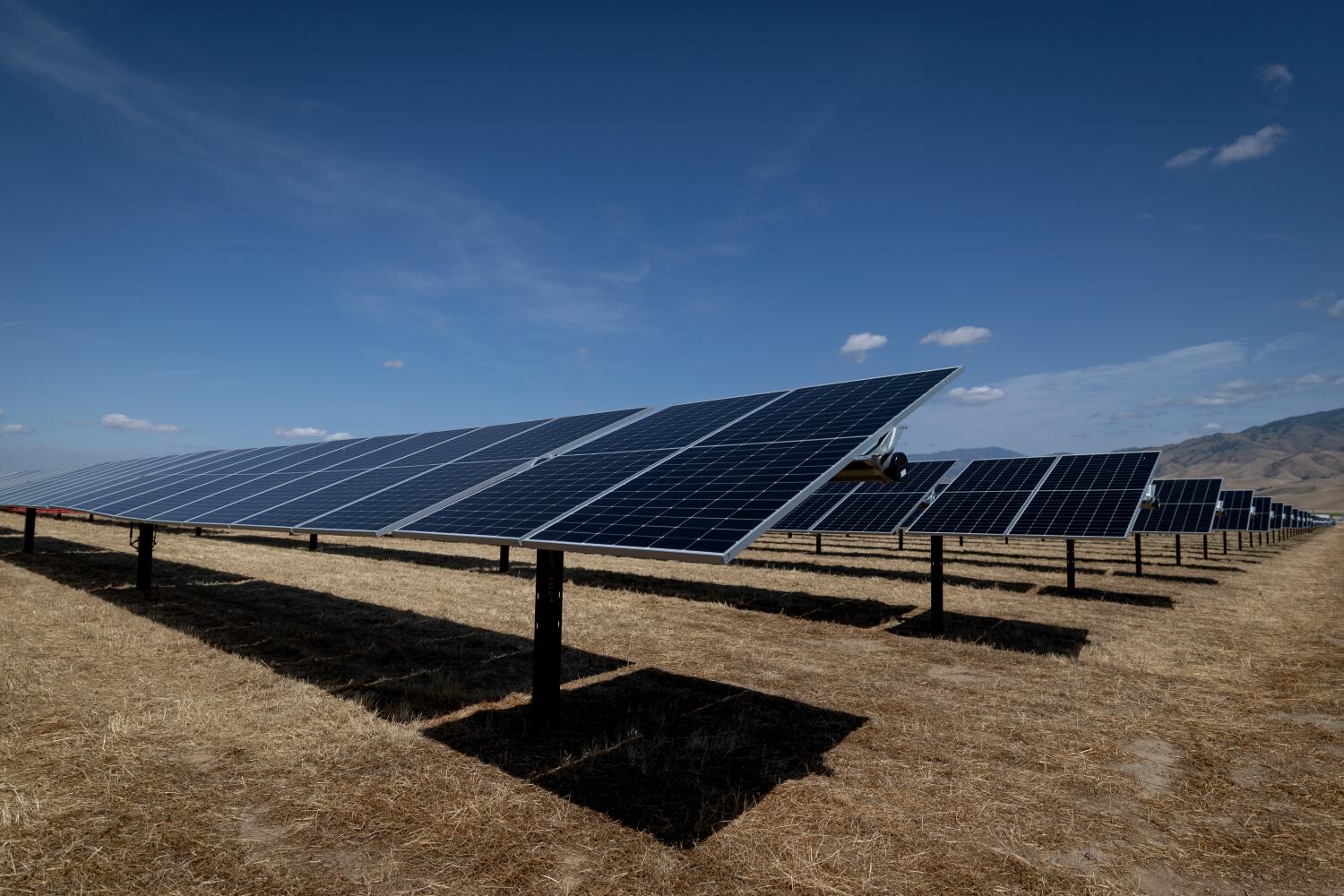
In May, the California Independent System Operator recorded a structural milestone: solar generation accounted for over fifty percent of the total electricity supplied across an entire calendar month. No other macro-economic grid of equivalent scale has reached this threshold.
Popular commentary attributes this event to mild spring weather and an abundance of sunshine. That explanation is functionally incomplete. The transition of a major industrial grid past the halfway mark of photovoltaic supply is not a meteorological accident. It is the result of a deliberate, multi-year reconfiguration of capital expenditure, storage deployment, and load management mechanics.
Evaluating how California achieved this milestone requires deconstructing the underlying variables that govern modern power systems: generation intermittency, utility-scale storage capacity, and price-response elasticity.
The Three Structural Pillars of the May Milestone
The crossing of the fifty percent threshold relies on three distinct operational variables functioning in concert. Remove any single component, and the math fails.
1. Photovoltaic Overbuild and Capacity Factor Realities
Nameplate capacity tells an incomplete story. Solar photovoltaic assets operate under an intermittent generation profile dictated by diurnal cycles and atmospheric turbidity. To sustain a monthly average above fifty percent, the peak midday generation capacity must vastly exceed baseline demand.
During May, moderate ambient temperatures reduced thermal derating in photovoltaic panels, allowing them to operate closer to their theoretical efficiency limits. However, high instantaneous generation creates a severe structural anomaly: the midday duck curve.
When generation peaks while demand remains moderate, wholesale electricity prices plummet, occasionally turning negative. The system cannot consume the power in real time without extensive curtailment unless an absorption mechanism exists.
2. The Mechanics of Battery Arbitrage
The primary operational variable that enabled the May record was the rapid expansion of lithium-ion utility-scale battery storage across the CAISO footprint.
For years, the limitation of solar power was temporal misalignment. Peak generation occurred at noon, while peak demand occurred during the evening ramp when solar output collapsed. Utility-scale batteries resolved this structural deficit through time-shifting or temporal arbitrage.
During May, battery fleets absorbed thousands of megawatts of excess midday solar generation instead of forcing curtailment. As solar output dropped during the late afternoon, these assets discharged concurrently, effectively substituting electrochemical storage for fossil-peaker plants during the highest-stress hours of the grid cycle.
The system routinely discharged over twelve thousand megawatts from battery arrays during peak demand windows, substituting output that previously required natural gas combustion turbines.
3. Favorable Thermal and Load Baselines
May represents an optimal operational window for electrical grids in temperate zones. Heating demand from winter has dissipated, and heavy residential and commercial air conditioning loads associated with peak summer have not yet materialized.
Total monthly load demand remains relatively low and stable compared to August or September extremes. Achieving a fifty percent solar share during a low-load shoulder month is a critical proving ground, but it tests a different set of physical constraints than a high-load heatwave scenario.
The Economic and Engineering Trade-Offs
While the gross generation figures validate the speed of the renewable transition, the underlying cost functions and operational risks reveal significant friction points. Transitioning a grid toward high-penetration variable renewables introduces structural trade-offs that standard reporting routinely ignores.
Curtailment Pressures and Asset Efficiency
As solar penetration scales upward, the marginal economic value of additional photovoltaic generation declines. When the grid is already saturated with cheap solar energy, every new megawatt built increases the frequency of curtailment. Operators must intentionally throttle clean generation to prevent over-voltage events and transmission line overloading.
This creates a diminishing return on capital expenditure for pure generation assets unless paired immediately with co-located storage or dedicated industrial load-sinking mechanisms, such as green hydrogen production or large-scale data center consumption.
The Capacity Adequacy Problem
Batteries solve short-duration intraday ramping problems, typically operating across two-to-four-hour windows. They do not solve multi-day dunkelflaute events—periods of low wind and low solar radiation persisting across consecutive days or weeks.
Relying on lithium-ion chemistry for multi-day storage is economically unviable due to capital costs and self-discharge rates. Consequently, the grid must maintain a parallel fleet of dispatchable thermal generation or long-duration energy storage resources to guarantee absolute reliability.
The cost of maintaining idle fossil-fuel infrastructure as an emergency insurance policy while simultaneously financing a massive buildout of solar and batteries creates a dual-capital burden. This dynamic directly impacts retail electricity rates for end-users, driving utility bills higher even as marginal generation costs drop to zero.
Systemic Bottlenecks in Transmission Topology
Generating fifty percent of monthly energy from solar is fundamentally an engineering challenge of moving electrons from point of generation to point of consumption. California faces severe transmission constraints.
High-yield solar developments concentrate heavily in specific geographic regions, such as the Central Valley and desert basins. Existing high-voltage transmission corridors connecting these regions to urban load centers like the San Francisco Bay Area and the Los Angeles basin operate near capacity.
Interconnection queues remain sluggish, delaying the integration of new storage assets that could otherwise capture and redistribute trapped solar energy. Without a parallel acceleration in high-voltage direct current transmission buildouts, localized congestion will cap the efficiency gains of future renewable expansion.
Strategic Forward Projections
The May milestone confirms that high-penetration solar grids are technically feasible at scale when backed by dense battery deployment. However, scaling this model from a shoulder month to an annual average requires shifting the strategic focus from pure generation volume to system flexibility.
Future grid stability depends on three operational adaptations:
- Deploying long-duration energy storage technologies capable of shifting energy across multiple days rather than hours.
- Implementing dynamic pricing models that incentivize industrial and residential consumers to shift heavy electricity consumption to coincide with midday solar oversupply windows.
- Accelerating inter-regional transmission capacity to trade excess renewable energy dynamically with neighboring balancing authorities, smoothing out localized supply and demand imbalances.
Capital allocation must pivot entirely away from standalone photovoltaic expansion toward intelligent integration, storage duration scaling, and transmission hardening.