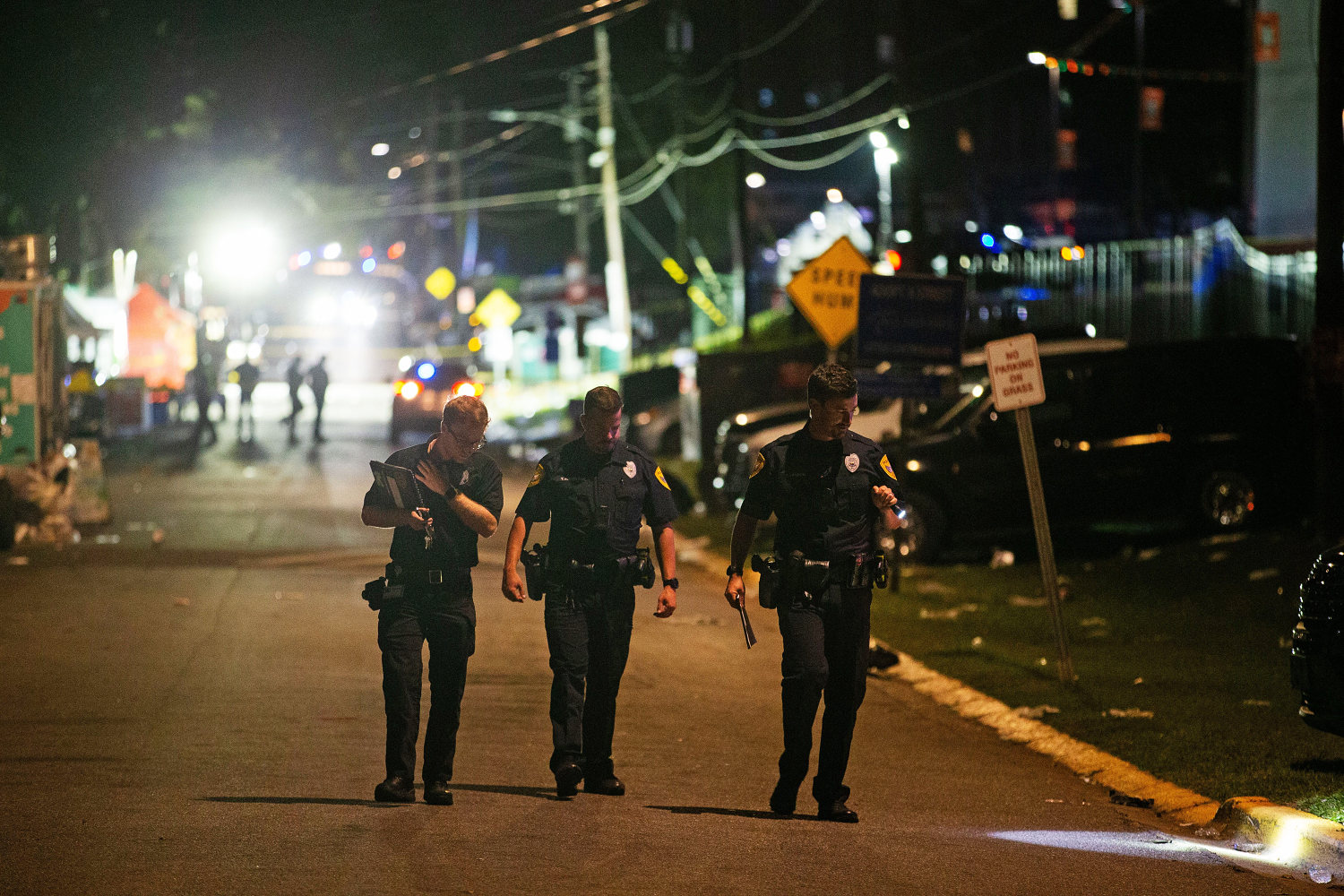
The arrest of a 15-year-old suspect following a shooting near Florida A&M University's Bragg Memorial Stadium that injured 12 people exposes a structural failure at the intersection of event security perimeters, juvenile firearm acquisition, and municipal policing. Standard news coverage treats this incident as an isolated criminal event—an anomaly resolved by an arrest. That framing misses the operational reality. Mass casualty events occurring immediately outside hard-secured venues follow predictable spatial, behavioral, and logistical patterns.
When an organization secures an interior perimeter—such as a university football stadium—without extending intelligence and physical deterrence to the surrounding buffer zone, risk is not eliminated; it is displaced. This phenomenon, known in criminology as spatial crime displacement, concentrates high-risk actors into unsecured staging areas immediately adjacent to large, dense crowds. Understanding how a 15-year-old gains access to a lethal weapon and deploys it within feet of a major university event requires decomposing the event into its component systems: perimeter architecture, juvenile supply chains, crowd dynamics, and evidentiary forensics.
The Architecture of Perimeter Failure
Event security operates on a tiered model of access control. At major collegiate venues like Bragg Memorial Stadium, the interior bowl is a hardened target. Attendees pass through magnetometers, bag checks, and credentialed checkpoints. Within this zone, the probability of a firearm entering is near zero.
The vulnerability lies in the semi-permeable buffer zone—the streets, parking lots, tailgating areas, and commercial corridors within a 500-meter radius of the venue. During major campus events, particularly high-attendance games or homecoming weekends, this buffer zone experiences a massive spike in population density without a corresponding increase in physical access controls.
Three structural variables govern risk in this buffer zone:
- Crowd Compression Without Screening: Thousands of individuals congregate in open-air environments where bag checks and metal detection are legally and logistically impossible to enforce across public right-of-ways.
- Jurisdictional Friction: Campus police departments operate under distinct statutory boundaries and resource constraints compared to municipal police forces. When an event draws non-students into the borderlands between university property and city streets, command-and-control handoffs often lag behind real-time crowd movements.
- Environmental Concealment: Parked vehicles, temporary structures, low-light corridors, and loud ambient noise degrade line-of-sight surveillance and delay acoustic detection of gunfire.
In the Tallahassee incident, the shooting occurred near the stadium rather than inside it. This distinction is critical. The suspect did not breach a hardened security checkpoint; the suspect exploited the predictable congregation of unscreened crowds at the edge of the secured zone. Security planners frequently optimize for interior metrics—zero weapons inside the gates—while ignoring the external casualty radius where crowds remain equally dense and entirely unprotected.
Juvenile Firearm Acquisition and Supply Chain Mechanics
A 15-year-old cannot legally purchase a handgun or rifle from a licensed federal firearms dealer (FFL) in the United States. Under federal law (18 U.S.C. § 922(x)), individuals under 18 are prohibited from possessing handguns, and licensed dealers are barred from selling long guns to anyone under 18 and handguns to anyone under 21. Therefore, every firearm in the hands of a 15-year-old represents a failure at an upstream node in the distribution network.
Analyzing juvenile firearm possession requires mapping the secondary illicit supply chain, which operates through three primary channels:
- Unsecured Residential Storage (Theft): A substantial percentage of crime guns recovered from juveniles originate from legal owners who fail to secure weapons in locked safes. Vehicles parked in residential neighborhoods or near event venues serve as high-yield targets for opportunistic theft. When a firearm is stolen from an unlocked car, it enters the illicit market immediately, untraceable until recovered at a crime scene.
- Straw Purchasing Networks: An adult with a clean criminal record purchases a firearm from an FFL on behalf of a prohibited person or a juvenile distributor. These transactions are driven by small cash markups and rely on falsifying ATF Form 4473.
- Peer-to-Peer Informal Transfers: Within localized youth networks, firearms circulate as shared assets—borrowed, traded, or sold multiple times within weeks. A single stolen handgun can pass through four or five juvenile hands before being used in a shooting, insulating the original thief from the final shooter.
The decision-making calculus of a 15-year-old differs fundamentally from that of an adult offender. Developmental neuroscience demonstrates that the prefrontal cortex—responsible for impulse control, long-term consequence evaluation, and emotional regulation—remains underdeveloped in mid-adolescence. Simultaneously, the limbic system, which governs reward sensitivity and threat reactivity, is hyperactive.
When an adolescent carrying an illicit firearm enters a high-stimulus environment—characterized by crowd noise, social posturing, alcohol presence among surrounding adults, and perceived slights—the threshold for lethal escalation drops precipitously. An interpersonal dispute that would resolve through verbal posturing or a fistfight in an unarmed context escalates instantaneously to indiscriminate gunfire. Because juvenile shooters rarely possess formal firearms training, their accuracy is low, resulting in high bystander casualty rates. Twelve injuries from a single incident reflects rapid, uncontrolled discharge into a dense crowd rather than targeted engagement.
Crowd Dynamics and Casualty Multiplication
The injury count—12 victims—highlights the physics of crowd density during an active shooter event. In crowd safety engineering, density is measured in persons per square meter ($P/m^2$). At densities exceeding $2 P/m^2$, individual movement becomes constrained by surrounding bodies. At $4 P/m^2$, crowd crush dynamics begin to emerge.
When gunfire erupts in a high-density buffer zone, three compounding effects multiply casualties:
- Ballistic Over-Penetration and Ricochet: Handgun rounds fired at crowd level frequently pass through primary targets or strike concrete, asphalt, and vehicle frames, creating secondary projectiles and fragment injuries.
- Delayed Acoustic Localization: In a stadium perimeter environment, echoes off concrete structures and ambient crowd noise prevent bystanders from immediately identifying the direction of fire. People often run toward the threat or freeze in place during the critical first three to five seconds.
- Egress Bottlenecks: Fleeing crowds move toward perceived exits—narrow sidewalks, fencing gaps, or parked car rows—creating secondary blunt-force trauma injuries as individuals fall and are trampled.
Standard reporting lumps all 12 injured individuals into a single statistic. Operationally, emergency medical triage separates these casualties into direct ballistic trauma, shrapnel/ricochet wounds, and crush/egress injuries. Each category demands a distinct pre-hospital medical response, from tourniquet application and hemostatic dressings for arterial bleeds to orthopedic stabilization for trampling trauma.
Investigative Forensics and Evidentiary Triangulation
Identifying and arresting a 15-year-old suspect in a chaotic, multi-victim shooting requires rapid evidentiary triangulation. Unlike premeditated crimes with clear financial or domestic motives, impulsive juvenile shootings often lack an obvious prior connection between the shooter and the injured bystanders. Investigators must reconstruct the timeline backward from the moment of discharge.
Law enforcement agencies execute this through four parallel evidentiary tracks:
Digital Footprint and Social Graph Mapping
Adolescents rarely operate in digital isolation. Prior to an event, disputes frequently escalate on platforms such as Instagram, Snapchat, or TikTok through live streams, direct messages, or location-tagged stories. Following a shooting, witnesses and bystanders invariably upload video footage within minutes. Investigators deploy geofence warrants, open-source intelligence (OSINT) scraping, and subpoenaed platform records to identify individuals present at the exact coordinates and timestamp of the incident.
Ballistic Fingerprinting and NIBIN Correlation
Recovered shell casings are entered into the National Integrated Ballistic Information Network (NIBIN). Automated imaging compares the microscopic breech-face marks, firing pin impressions, and ejector marks on the casings against a national database. If the firearm used near Bragg Memorial Stadium was previously discharged in an unsolved city shooting, NIBIN links the two events within hours, narrowing the suspect pool to known associates of the prior incident.
Surveillance Network Stitching
Modern university perimeters feature overlapping camera networks: campus security feeds, municipal traffic cameras, commercial storefront systems, and private vehicle dashcams. Analysts stitch these feeds together to track the suspect's ingress and egress routes. Even if the shooting occurs in a camera blind spot, tracking an individual running away from the acoustic epicenter while concealing an object provides probable cause for detention.
Human Intelligence and Witness Corroboration
In juvenile cases, peer networks fracture rapidly under law enforcement pressure. Because multiple adolescents often witness the dispute leading up to the shooting, investigators utilize separate, simultaneous interviews to identify inconsistencies. Once a single witness places the firearm in the suspect's possession, digital and ballistic evidence locks in the arrest warrant.
Legal and Systemic Constraints in Juvenile Prosecution
Arresting a 15-year-old initiates a complex legal sequence governed by state juvenile justice statutes—in this case, Florida Statutes Chapter 985. The public often assumes an arrest for a 12-victim shooting automatically results in adult incarceration. The statutory reality involves strict procedural hurdles.
Under Florida law, prosecutors have discretionary authority to direct file charges against a 14- or 15-year-old in adult criminal court for specific enumerated felonies, including aggravated battery with a firearm and attempted murder. However, executing a direct file requires weighing two competing legal frameworks:
- Retributive Incapacitation: Trying the juvenile in adult court exposes the defendant to mandatory minimum sentences under laws like Florida's 10-20-Life statute, which mandates decades of imprisonment when a firearm is discharged and causes great bodily harm.
- Rehabilitative Jurisdiction: Keeping the case in juvenile court caps detention at age 21 (or 22 in specific residential programs), prioritizing behavioral intervention over long-term warehousing.
Defense counsel routinely challenges adult transfers by introducing neurodevelopmental evaluations, trauma histories, and evidence of peer coercion. Furthermore, if the suspect is adjudicated as a juvenile and released at age 21 without intensive cognitive-behavioral intervention and vocational placement, recidivism rates remain high. Conversely, placing a 15-year-old into an adult prison system increases the probability of future violent offending due to institutional socialization. Neither pathway offers a clean systemic resolution; both represent trade-offs between immediate public safety and long-term criminogenic risk.
Limitations of Current Deterrence Models
Universities and municipalities typically respond to perimeter shootings with visible, short-term tactical surges: increasing uniformed patrol overtime, erecting temporary metal fencing, and issuing stricter tailgating curfews. These measures suffer from three structural limitations:
- Temporal Decay: Overtime patrol surges are financially unsustainable. Within three to six months, staffing reverts to baseline levels, and the vulnerability reopens.
- Adaptation by Offenders: Juveniles carrying illicit firearms quickly map static checkpoints and shift their congregation points two blocks further down the corridor.
- Inability to Address Upstream Supply: No amount of stadium perimeter fencing prevents a firearm from being stolen out of an unlocked car three miles away the week prior.
Strategic Framework for Perimeter and Supply-Chain Mitigation
To reduce the frequency and severity of campus-adjacent mass casualty events, university administrations, municipal police departments, and state policymakers must shift from reactive perimeter hardening to systemic risk management.
1. Unified Command and Dynamic Buffer Zoning
Universities and city police must eliminate jurisdictional seams during major events by establishing a unified incident command 72 hours prior to kickoff. Rather than treating the stadium gates as the boundary of responsibility, planners must map a dynamic 1,000-meter event impact zone. Within this zone, temporary street closures, high-intensity mobile lighting towers, and elevated observation posts should eliminate low-visibility congregation pockets before crowds form.
2. Acoustic Gunshot Detection Integrated with Camera Slewing
Deploying acoustic gunshot detection sensors (such as ShotSpotter) across campus-municipal border corridors reduces response times from minutes to seconds. When paired with automated PTZ (pan-tilt-zoom) cameras programmed to slew immediately to the acoustic coordinates, dispatchers gain real-time visual confirmation of the shooter's description and egress path before the first 911 call is even processed.
3. Targeted Upstream Supply Disruption
Local law enforcement must treat every firearm theft from a vehicle as a high-priority felony investigation rather than a routine property crime report. Pairing aggressive prosecution of straw purchasers with public-private campaigns that distribute free biometric or keyed vehicle gun safes directly targets the primary supply mechanism feeding juvenile possession.
4. Focused Deterrence for High-Risk Youth Networks
Municipalities should implement Group Violence Intervention (GVI) models that identify the small fraction of youth networks responsible for the majority of local firearm discharges. By combining direct communication from community leaders, immediate social service off-ramps, and guaranteed, swift enforcement consequences for the entire group if any member pulls a trigger, cities can alter the peer-group incentives that drive adolescents to carry weapons to public events.