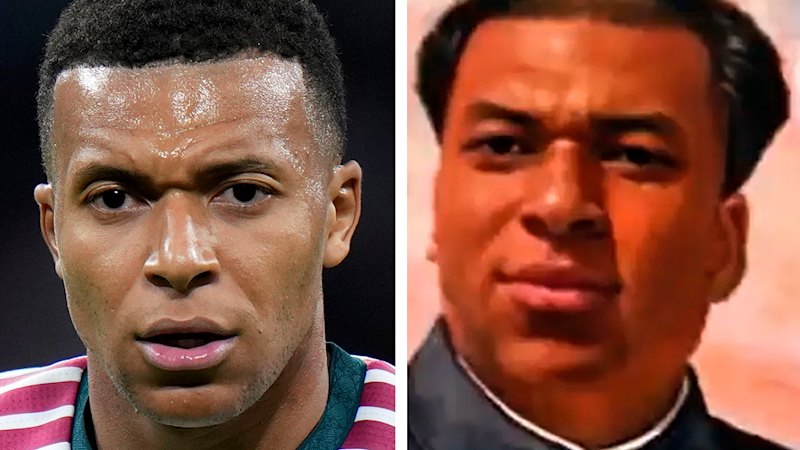
When a prominent European public figure shares an internet meme depicting Mao Zedong as a dictator, the resulting commercial fallout in mainland China follows a predictable, deterministic sequence of reputational and financial destruction. Standard entertainment reporting frames these incidents as spontaneous outbursts of online anger, using sensational headlines like "Not accepted. Not forgiven!!" to capture surface-level outrage. That framing obscures the underlying operational reality. Cross-border reputational crises involving Chinese political history are not chaotic emotional storms; they are structured market corrections driven by asymmetric information environments, state-aligned platform governance, and preemptive corporate risk mitigation.
To understand why a single social media post triggers immediate commercial exile, analysts must discard Western public relations models. In Western markets, celebrity controversy typically generates a short-term attention spike that rarely severs institutional contracts unless specific legal or moral thresholds are crossed. In the Chinese market, political-historical missteps violate foundational state narratives, converting a personal error into a systemic liability for every commercial partner associated with the individual.
The Structural Asymmetry of Digital Memes
The root cause of the friction lies in the collision between two incompatible semiotic environments. In Western digital culture, historical figures—including twentieth-century authoritarian leaders—are routinely flattened into ironized visual templates. The meme format strips the historical subject of doctrinal weight, repurposing the image for hyper-local, often trivial commentary. Within this context, the sharer operates under the assumption of satirical distance, treating the image as a benign unit of internet vernacular rather than an ideological statement.
In mainland China, historical iconography tied to the founding of the People's Republic does not exist in a flattened, ironized space. State education, media regulation, and public discourse maintain strict boundaries around the legacy of Mao Zedong. While official Party historiography acknowledges specific policy errors during the later stages of his leadership, the overarching framing remains one of foundational legitimacy and national liberation. Labeling him a "dictator" directly contradicts the official historical consensus and triggers immediate resistance across both state-affiliated media and nationalist netizen cohorts.
This creates a severe attribution gap:
- The Sender's Frame: The Western celebrity views the post through the lens of casual, low-stakes digital humor, often failing to recognize the specific historical triggers embedded in the visual template.
- The Receiver's Frame: The Chinese audience and regulatory apparatus view the post through the lens of deliberate ideological provocation, interpreting the Western origin of the sender as evidence of entrenched historical arrogance or neo-colonial condescension.
- The Translation Distortion: When external observers or automated tools translate the meme's text and context into Mandarin, the ironized Western subtext evaporates, leaving behind only the raw, unfiltered political accusation.
The Mechanics of Escalation and Platform Amplification
A social media post made on an overseas platform—such as Instagram, X, or TikTok—does not remain isolated behind the Great Firewall. Information flow across the boundary is directional and curated. Diasporic users, nationalist bloggers, and entertainment news aggregators actively monitor the overseas accounts of foreign celebrities who hold commercial value in China.
Once the offending post is identified, the escalation follows a four-stage transmission pipeline:
- Stage 1: Extraction and Framing. A monitoring account captures a screenshot of the post before it can be deleted. The screenshot is uploaded to Weibo, Douyin, or Xiaohongshu accompanied by framing text that highlights the celebrity's financial ties to Chinese consumers. This establishes the core hypocrisy narrative: profiting from the Chinese market while insulting Chinese historical figures.
- Stage 2: Algorithmic Velocity. Engagement metrics on Chinese platforms heavily reward high-arousal emotions, particularly moral indignation. As initial users comment with phrases such as "not accepted" and "not forgiven," platform algorithms classify the topic as high-velocity trending content, pushing the hashtag onto the hot search lists.
- Stage 3: Institutional Signal. If the outrage reaches sufficient volume, state-affiliated media outlets—such as the Global Times or CCTV social accounts—may publish commentary. Even a brief, measured rebuke from an official account acts as a definitive signal to the private sector that the individual has crossed an unspoken red line.
- Stage 4: Commercial Decoupling. Corporate partners initiate immediate contract termination protocols.
[Overseas Post] ──> [Screenshot Extraction] ──> [Weibo/Douyin Viral Loop]
                                                         │
[Brand Contract Termination] <── [State Media Signal] <──┘
The Corporate Risk-Mitigation Calculus
Western observers frequently misinterpret the speed with which luxury brands, streaming platforms, and domestic sponsors sever ties with controversial figures. They assume these corporations are acting out of sudden ideological alignment with angry netizens. In practice, corporate decoupling is a cold, rational exercise in expected-value preservation.
For a global luxury house or a domestic consumer brand operating in China, the revenue generated by a single celebrity endorsement represents a tiny fraction of total market value. Conversely, the downside risk of maintaining an association with a politically tainted ambassador is existential. If a brand hesitates to terminate a contract, consumer boycotts rapidly pivot from the celebrity to the brand itself.
The cost function facing a brand manager in this scenario is starkly asymmetric:
- Cost of Immediate Termination: Loss of sunk marketing expenses, minor legal friction regarding morality clauses, and temporary campaign disruption.
- Cost of Delay or Defense: Permanent loss of market share in a primary growth region, removal of products from major e-commerce platforms like Tmall and JD.com, cancellation of offline retail permits, and long-term regulatory scrutiny.
Faced with this binary outcome, corporate legal teams rely on broadly drafted "morality" or "reputational harm" clauses embedded in all modern talent contracts. These clauses allow brands to void agreements unilaterally the moment a talent's public perception threatens commercial viability, regardless of whether the talent intended harm or broke any formal laws. The phrase "not forgiven" in the public square translates directly into "uninsurable liability" inside the corporate boardroom.
The Futility of Standard Crisis Public Relations
When confronted with sudden market exile, foreign talent agencies routinely deploy standard Western crisis management playbooks. These playbooks rely on three primary tactics: silent deletion, the non-apology clarification, and the targeted regional apology. In the Chinese digital ecosystem, every one of these tactics fails or actively worsens the crisis.
The Failure of Silent Deletion
Deleting the post within hours of publication does nothing to halt the viral cycle. Because the initial extraction relies on screenshots, the primary artifact is already circulating independently inside the domestic network. Silent deletion is instead weaponized by critics as proof of cowardice and an attempt to evade accountability without genuine remorse.
The Failure of the Clarification Statement
Western publicists often draft statements explaining that the celebrity "did not understand the historical context" or "shared the image without reading the text." While factually plausible, this defense is structurally ineffective. In a high-context political environment, ignorance is not a mitigating factor; it is an aggravating one. Claiming ignorance reinforces the perception that the celebrity views Chinese history and consumers with casual disregard while actively accepting their money.
The Failure of Geo-Fenced Apologies
Issuing an apology exclusively on Weibo while remaining silent on Instagram or X is immediately detected by cross-border monitors. Netizens compare the two feeds, expose the discrepancy, and accuse the celebrity of "two-faced" behavior—apologizing in Mandarin to protect revenue while maintaining an unrepentant stance for Western audiences. Conversely, issuing a full-throated apology on Western platforms invites severe backlash from Western media and fans, who accuse the celebrity of capitulating to authoritarian censorship. The talent is trapped in a zero-sum reputational vise.
Structural Limitations of Cross-Border Talent Management
The recurrence of these incidents highlights a fundamental operational flaw in how global talent agencies and entertainment conglomerates manage international expansion. Agencies treat global fame as a frictionless, homogenous asset, assuming that popularity in Paris, London, or Los Angeles transfers seamlessly to Shanghai and Beijing.
This assumption ignores the reality of fragmented regulatory and cultural jurisdictions. No technological filter or public relations retainer can fully insulate a public figure who maintains an active, unmoderated personal presence on Western social media while simultaneously monetizing the Chinese market. The speed of cross-border screenshot extraction ensures that any historical, territorial, or political misstep will be surfaced and amplified before a crisis team can convene.
Furthermore, the geopolitical climate imposes a structural ceiling on forgiveness. Once an individual's name is linked to a major historical or political transgression in the Chinese press, the digital record becomes permanent. Even if public anger subsides after several months, corporate compliance departments maintain internal blacklists of high-risk individuals. Future brand partnerships, film distribution approvals, and concert permits become practically impossible to secure because no mid-level executive wants to assume the personal career risk of signing off on a previously flagged name.
Operational Protocol for Global Talent and Brands
Preventing irreversible market exile requires shifting from reactive crisis management to proactive risk engineering. Talent agencies and multinational brands operating across jurisdictions must implement strict structural controls before entering commercial agreements.
- Pre-Contract Digital Audits: Before signing an ambassador or launching a regional campaign, compliance teams must conduct a forensic audit of the talent's historical social media activity across all platforms, extending back at least ten years. Any archived posts referencing sensitive historical figures, territorial disputes, or political movements must be identified and evaluated for extraction risk.
- Jurisdictional Account Separation: High-value talent must surrender direct, unmoderated posting access to their primary public accounts. Personal expression must be routed through private, non-public channels, while public feeds operate under multi-factor editorial review that screens visual templates for hidden political or historical subtext.
- Asymmetric Contract Structuring: Brands must enforce strict, zero-ambiguity morality clauses that trigger automatic clawbacks of advance fees if a talent's overseas conduct causes commercial disruption in domestic markets. Talent agencies, conversely, must price the risk of sudden market exclusion into their initial fee structures rather than assuming long-term annuity revenue from volatile cross-border deals.
- Binary Crisis Resolution: If a breach occurs, management must make an immediate, binary choice within the first four hours. Either execute a total, cross-platform retraction and unambiguous apology—accepting the resulting Western reputational cost to preserve Chinese market access—or immediately write off the Chinese market entirely and issue no apology at all. Attempting to occupy a middle ground guarantees maximum reputational damage across both jurisdictions.