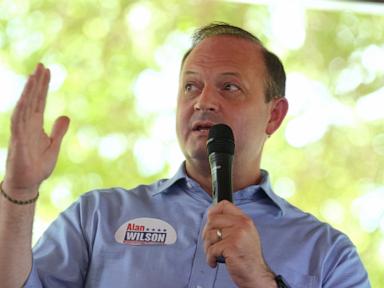
The June 23 Republican gubernatorial runoff in South Carolina reveals a fundamental shift in how national executive endorsements operate under high-competition conditions. On June 19, Donald Trump altered his initial strategy, moving from an exclusive primary endorsement of Lieutenant Governor Pamela Evette to a dual endorsement that includes State Attorney General Alan Wilson. This transition exposes the underlying mathematical and strategic calculations behind political endorsement capital maximization.
When a dominant party leader faces a high-probability risk of backing a losing candidate, the utility function of an exclusive endorsement drops below zero. To insulate political brand equity from down-ballot volatility, the leader must pivot from a "Kingmaker" strategy to an "Option-Hedging" strategy. The South Carolina runoff serves as an empirical case study of this mechanical adjustment. Don't miss our earlier coverage on this related article.
The Endorsement Utility Function and Capital Preservation
An endorsement is not merely a rhetorical gesture; it is an allocation of finite political capital. The value of this capital is directly tied to a win-loss record. In 2026, the performance metrics of the Trump executive endorsement portfolio showed heightened vulnerability, following outright defeats of endorsed gubernatorial candidates in Iowa and Georgia, alongside a forced runoff in Oklahoma.
To model the strategic decision behind a dual endorsement, we look at the interaction of two variables: the probability of a candidate winning ($P_w$) and the reputational cost of a loss ($C_l$). In a competitive runoff where internal tracking polls place the non-endorsed candidate ahead, the expected value ($EV$) of maintaining an exclusive endorsement collapses: If you want more about the context here, Al Jazeera offers an in-depth summary.
$$EV = (P_w \times Benefit) - ((1 - P_w) \times C_l)$$
When the probability of winning drops near or below 50%, an exclusive endorsement risks a net destruction of political authority. By shifting to a dual endorsement—effectively declaring that both candidates are "MAGA and America First all the way"—the endorser resets $P_w$ to 100% for the brand, completely neutralizing the cost of a loss ($C_l$). The primary objective shifts from altering the race outcome to protecting the endorser's statistical track record.
Geographic Polarization and Coalition Composition
The June 9 primary results created a highly fragmented electorate, splitting the vote across geographic and ideological lines. The runoff dynamics are governed by how the remaining two candidates capture the 45% of voters who backed eliminated contenders, primarily U.S. Representative Ralph Norman (17.1%) and U.S. Representative Nancy Mace.
The structural composition of the primary vote reflects distinct regional strongholds:
- The Pee Dee Region: Comprising approximately 15% of the total primary vote, this coastal and north-eastern border zone delivered a strong plurality to Evette. This area matches the traditional, populist base that voted heavily for Trump in the 2024 general election.
- The Central Core: Centered around Richland County (Columbia) and extending southwest, this region accounted for roughly 19% of the primary vote. Wilson achieved his maximum utility here, capitalizing on deep-rooted family name recognition—his father is long-serving U.S. Representative Joe Wilson—and a more institutional, establishment-aligned Republican base.
- The Upcountry Battleground: The industrial and high-population corridor of Greenville, Spartanburg, and Anderson counties represents the decisive theater. While Evette secured the top position here on June 9, the spread between first and third place (Norman) was less than two percentage points.
The elimination of Norman, a prominent fiscal conservative, created a critical liquid asset of unaligned voters in the Upcountry. The consolidation of this region dictates the math of the runoff.
The Institutional Consolidation Bottleneck
A secondary mechanism driving the dual endorsement was the rapid consolidation of state-level institutional power behind Wilson post-June 9. Evette's campaign faced structural friction due to two distinct institutional pressures.
The first pressure is the grassroots insurgent alignment. Despite Evette holding the initial national endorsement, local anti-establishment actors—including the state legislature's Freedom Caucus and departing Representative Norman—unified behind Wilson. This created a paradoxical situation where the national populist brand was decoupled from the local populist apparatus. Local actors framed Evette as an extension of the Columbia establishment due to her backing by term-limited Governor Henry McMaster.
The second pressure is institutional signaling. Following Trump's dual endorsement, U.S. Senator Tim Scott immediately endorsed Wilson, revealing a coordinated effort by state-level power brokers to de-risk the race for local institutional priorities. Wilson capitalized on this momentum by rolling out an operational policy platform, announcing a state government performance and efficiency audit led by state Senator Mike Reichenbach, his declared running mate. Conversely, Evette's campaign suffered an operational setback when her rumored running mate, Henry McMaster Jr., publicly declined consideration, leaving her ticket structurally incomplete during the peak transition window.
Runoff Turnout Dynamics and Partisan Constraints
The outcome of the June 23 vote depends entirely on historical turnout decay models. Under South Carolina election law, voters do not register by party, but participation in the runoff is strictly gated by primary behavior:
- Primary Participants: Voters who cast a ballot in the June 9 Republican primary are legally restricted to the Republican runoff.
- Democratic Voters: Individuals who voted in the Democratic primary are entirely barred from participating in the Republican runoff.
- Non-Voters: Registered individuals who abstained from the June 9 primary are eligible to vote in either runoff.
The historical data indicates an inevitable contraction in absolute voter volume. In the 2018 Republican gubernatorial runoff, total turnout dropped 7% relative to the primary. In 2010, the decay was 14%. More acute drops occurred in the 2022 statewide runoffs, where down-ballot races saw turnout collapses approaching 47%.
Because runoffs suffer from a structural decline in casual voter participation, the race ceases to be a test of broad ideological appeal. It becomes a highly tactical mobilization exercise targeting high-propensity voters. The candidate with the superior localized field operation, robust data analytics, and integrated phone-banking networks holds a disproportionate advantage over a candidate relying on macro-level media buys.
Strategic Forecast
The convergence of internal polling shifts, rapid institutional consolidation by state-level actors, and the neutralization of the national endorsement advantage indicates a structural advantage for Wilson in the final hours of the campaign. Evette’s strategy of leveraging outside national influence has been systematically dismantled by the dual-endorsement pivot, forcing her campaign to rely on a media-heavy approach that struggles to convert the unaligned Upcountry voters.
The victor of this runoff enters the general election against Democratic state Representative Jermaine Johnson with a clear structural path to victory, given that a Democrat has not secured the South Carolina governorship since 1998. The true downstream impact of this race lies in the immediate setup for the 2028 presidential primary cycle. The incoming governor will command the state executive apparatus during a critical "First-in-the-South" primary window, turning this local runoff into an institutional anchor for the next national executive coalition.