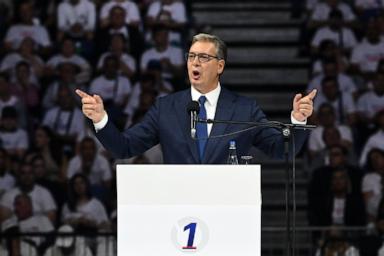
When Aleksandar Vučić packed thousands of supporters into Belgrade's largest indoor arena, the theater of inevitability was supposed to hold. It did not. The choreographed roar of loyalty inside the stadium masked a deeper fracture running through the spine of Serbian politics, a structural fatigue that months of sustained protests and administrative pressure had quietly brought to a boiling point. By stepping down from the presidency to chase a parliamentary comeback as prime minister, the populist leader attempted a high-stakes gamble to reset his political clock. Instead, he walked straight into a trap of his own making, underestimating an electorate that had grown weary of political monopoly and institutional erosion.
For fourteen years, the Serbian Progressive Party maintained an iron grip on the levers of state power. That dominance relied on a specific machinery of control: party patronage, media consolidation, and the quiet co-optation of local economic networks. Every election cycle followed a familiar script where the opposition was outspent, outmaneuvered, and out-broadcasted. Yet, power that feeds exclusively on centralizing authority eventually hollows out the state institutions meant to sustain it. When public frustration over resource allocation, controversial development deals, and democratic backsliding reached critical mass, the traditional playbook stopped working.
The immediate catalyst for the political upheaval was not a sudden ideological awakening among traditional political parties, but rather a persistent, grassroots wave driven by student-led movements and civic coalitions. Unlike conventional opposition politicians who spent years bickering over strategy, these new civic actors focused on concrete governance failures. They exposed the friction points between elite ambitions and the daily reality of ordinary citizens struggling with inflation, labor insecurity, and institutional decay. By refusing to play by the rules written in smoke-filled party rooms, the movement created a parallel narrative that resonated far beyond the urban centers of Belgrade and Novi Sad.
To understand why the arena rallies failed to save the ruling party's majority, one must examine the mechanics of political exhaustion. Political capital is not infinite. When a ruling apparatus spends over a decade suppressing internal dissent while balancing a precarious geopolitical tightrope between European Union integration aspirations, Chinese infrastructure investments, and traditional ties to Moscow, cracks inevitably appear in the foundation. Voters stopped listening to foreign policy abstractions about regional stability. They began focusing on domestic accountability, transparency, and the rule of law.
The decision to cut short the presidential term and force an early parliamentary showdown was framed by loyalists as a bold mandate renewal. Behind closed doors, it was an admission of vulnerability. Internal polling clearly indicated that waiting out the remainder of the presidential term would allow opposition momentum to solidify further. By moving the timeline forward, the administration hoped to catch its adversaries unprepared. The calculation ignored a fundamental shift in public psychology: the fear of change had finally been eclipsed by the fatigue of stagnation.
International observers watched the unfolding crisis with mounting concern. European institutions had repeatedly flagged democratic regression, media suppression, and electoral irregularities in previous cycles. Yet, external pressure alone rarely dislodges entrenched regimes. The turning point arrived when domestic civil society reclaimed public spaces, forcing the political apparatus onto the defensive. When thousands flooded the streets following the ballot counts, it was the culmination of years of quiet organizing, legal challenges, and small acts of defiance that institutional surveillance failed to stamp out.
The aftermath of the parliamentary defeat leaves the country navigating uncharted institutional waters. The victorious opposition coalition enters parliament carrying immense public expectations and severe structural hurdles. Governing a state shaped by a decade of centralized control requires dismantling complex networks of patronage without destabilizing essential public services. Furthermore, the incoming legislature must address deep-seated economic pressures while managing international expectations regarding regional diplomacy and European integration milestones.
History suggests that strongmen rarely vanish quietly into the political wilderness, nor do complex political cultures transform overnight simply because an election result upends the status quo. The machinery that sustained fourteen years of dominance remains embedded within municipal administrations, state-owned enterprises, and regional power structures. Unraveling that web demands relentless institutional persistence, far beyond the initial euphoria of street celebrations.
The arena lights in Belgrade have dimmed, and the crowds have dispersed. What remains is a sobering reality for any administration that mistakes compliance for consent. Power, once concentrated to a brittle point, shatters not from a single external blow, but from the steady accumulation of quiet truths told too often to be ignored.