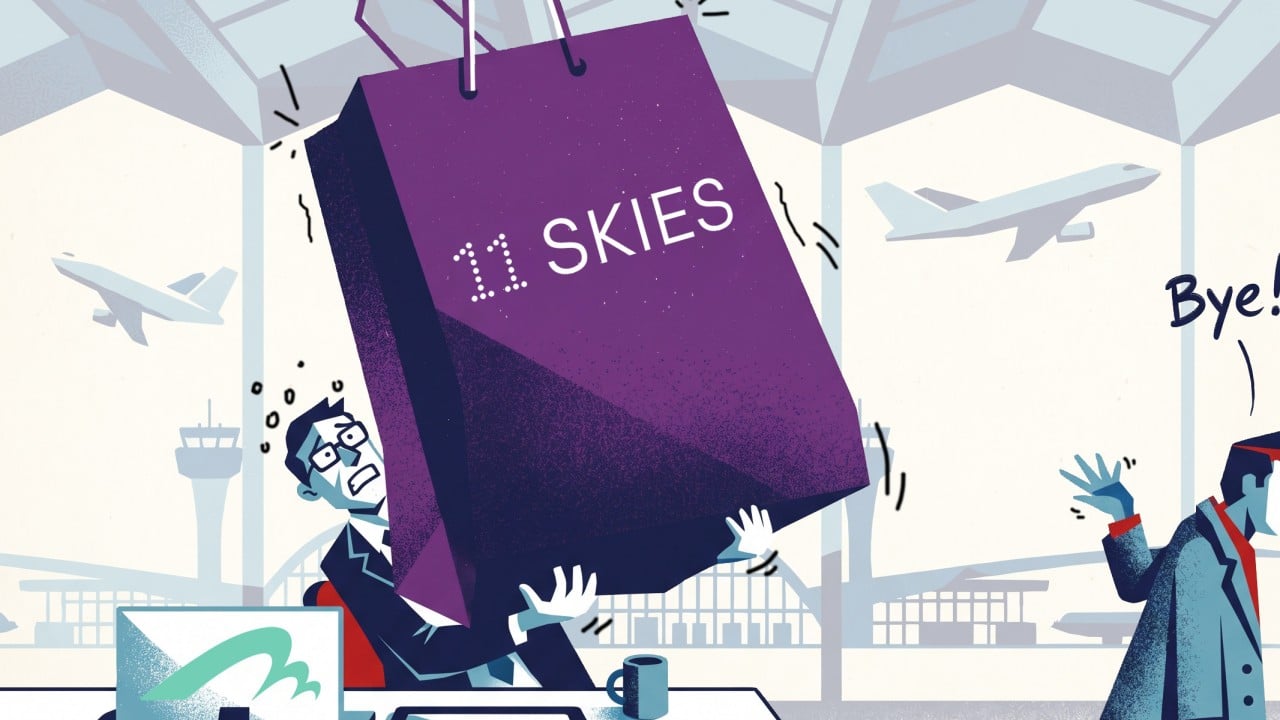
Most commentary on 11 Skies treats the megaproject's collapse as a simple story of bad timing or a struggling developer. That framing misses the structural trap built into the contract from day one: a fixed, long-duration rent obligation collided with shifting passenger dwell behavior, changing retail spending habits, and severe balance-sheet strain at New World Development.
Rather than viewing 11 Skies through generic retail headlines, a rigorous diagnostic requires separating balance-sheet distress from commercial asset economics, mapping the cause-and-effect chain behind the termination agreement, and evaluating whether the Airport Authority Hong Kong can turn the site around after scheduled handover in April 2027.
Deconstructing the Standard Narrative
Typical coverage of 11 Skies tends to blur three distinct mechanisms into one vague failure:
- Developer solvency pressure: New World Development faced heavy debt servicing and liquidity strain, turning a multi-decade lease into an immediate cash-flow burden.
- Retail and experiential demand risk: Large-scale airport commercial complexes depend on foot traffic volume, dwell time, and conversion rates that cannot be assumed purely from total passenger counts.
- Contractual rigidity: Long-term fixed commitments lock in downside exposure when revenue ramps slower than projected or capital markets tighten.
Standard commentary often treats those points as parallel complaints rather than linked variables. A developer under severe financial pressure has a much lower tolerance for negative carry during a slow lease-up. When carrying costs outpace operating cash flow, management faces a choice between draining scarce liquidity to defend a long-dated asset or paying an exit cost to stop future cash outflows.
Known Facts Versus Educated Hypotheses
Separating verified developments from analytical inference keeps the diagnosis grounded:
- Known facts: New World Development agreed to terminate its contractual agreements for 11 Skies with the Airport Authority Hong Kong effective April 1, 2027, incurring substantial impairment charges and net losses while paying a termination fee. The Airport Authority has moved to reintegrate the development into its broader Skytopia plans with phased operations targeted around 2028–2029.
- Educated hypotheses: Commercial performance at large-scale airport retail and entertainment hubs faces structural headwinds when travelers prioritize speed, convenience, or targeted experiences over sprawling mall browsing. Furthermore, transferring control back to a public or quasi-public infrastructure operator changes governance incentives, though it does not automatically solve tenant leasing or consumer footfall.
Exact tenant-by-tenant occupancy figures, detailed lease schedules, and internal construction cost breakdowns are not publicly disclosed in full. Where exact figures are unavailable, analyzing the operating mechanics—fixed versus variable costs, footfall funnels, and capital structure constraints—provides a clearer explanation than guesswork.
The Cost Function and Structural Bottlenecks
Any megaproject adjacent to a major aviation hub operates under a specific economic cost function. Total periodic cost equals fixed capital servicing and minimum lease obligations plus variable operating, maintenance, and tenant-support expenses. Revenue depends on active visitors multiplied by average spend and gross margin.
When fixed commitments are high early in the lifecycle, operating leverage works in reverse. If footfall or spend per visitor lags initial underwriting assumptions, net operating income compresses rapidly, turning a projected cash generator into a cash drain.
The First Bottleneck: Balance-Sheet Contagion
In real estate development, asset quality and parent-company liquidity are distinct concepts, yet they interact directly in distressed cycles. When a developer carries high leverage across a broader portfolio, every project is evaluated through a survival lens rather than a ten-year horizon.
A company defending its balance sheet looks at near-term cash preservation, covenant compliance, and refinancing terms. Paying a lump-sum termination settlement to eliminate ongoing fixed obligations can be economically rational for the tenant-developer even if it triggers a large accounting write-down in the current reporting period.
The Second Bottleneck: Footfall Economics and Travel Friction
Airports are high-throughput transit nodes, not conventional urban shopping districts. Travelers move along time-constrained paths shaped by security queues, gate distances, baggage rules, and flight schedules.
A conceptual example illustrates the difference between raw traffic and commercial yield. Suppose a terminal complex sees tens of millions of annual movements, but only a small fraction of passengers have both sufficient buffer time and a reason to exit their primary transit flow. Even if a visitor enters a large retail or entertainment space, high square footage dilutes foot traffic density across corridors and zones. Low density weakens tenant sales per square foot, which in turn pressures achievable rents and increases vacancy risk.
The Third Bottleneck: Anchor Mix and Experiential Conversion
Large-scale complexes combining retail, dining, and attractions face a conversion challenge. Attractions draw occasional visits, while everyday retail relies on repeat frequency. If anchor attractions open on staggered timelines or attract narrower demographics than projected, cross-shopping between entertainment and retail zones stays weak.
Rescue Mechanics Under Skytopia
Rescuing a stalled megaproject requires fixing whichever constraint actually broke the model. Reassigning the asset from a cash-strapped private developer to the Airport Authority changes the financial and strategic calculus, though it introduces new execution risks.
Realigning Capital Structure and Horizon
The Airport Authority operates with an infrastructure mandate and a multi-decade horizon tied to the wider airport ecosystem. By bringing 11 Skies into the broader Skytopia vision with target phasing stretching toward 2028–2029, the authority can treat the asset as part of an integrated aviation and destination precinct rather than a standalone retail bet.
A practical way to evaluate a rescue plan is to break it into sequential operational phases rather than a single grand opening:
- Stabilize physical readiness and safety systems: Audit completed fit-outs, mechanical systems, and common areas to prevent asset decay during the transition window.
- Redefine the zoning and tenant thesis: Match floorplate allocation to realistic passenger and regional visitor profiles instead of chasing uniform luxury or oversized retail footprints.
- Synchronize transit and terminal flows: Align pedestrian links, signage, and wayfinding with active terminal operations so movement feels effortless rather than detoured.
- Phase leasing around proven anchors: Sequence tenant handovers so early openings generate real footfall before secondary zones ramp up.
Limitations of a Public-Sector Turnaround
No rescue mechanism is free of trade-offs. Airport authorities excel at aviation infrastructure, master planning, and regulatory coordination, but commercial retail curation and experiential programming require specialized consumer marketing and agile leasing mechanics.
There is also a risk of misallocated capital if political or institutional momentum pushes premature spending before tenant demand is validated. A turnaround only succeeds if commercial discipline governs lease structures, capex phasing, and tenant mix—otherwise, the economic cost function remains imbalanced under a different owner.
The Strategic Play
For the Airport Authority and its partners, the decisive strategic play is to run 11 Skies as a phased, demand-gated precinct within Skytopia rather than forcing a single, high-risk commercial relaunch. Lock down clear transit integration first, anchor the site with high-draw experiential and dining concepts that match actual traveler and Greater Bay Area visitor dwell windows, and tie retail expansion strictly to verified footfall milestones ahead of the late-decade rollout.