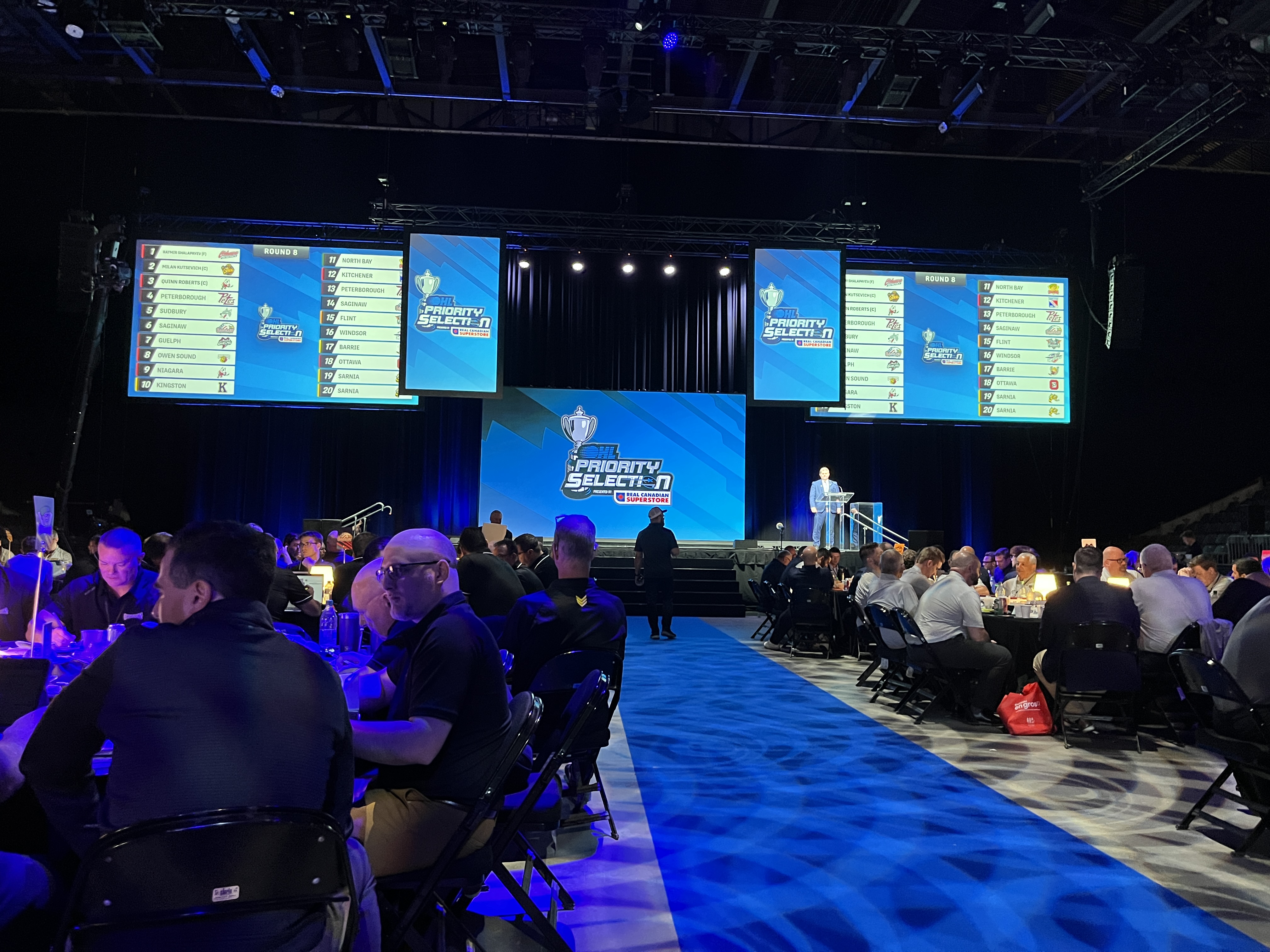
Minor hockey talent aggregation operates on predictable geographical, structural, and socio-economic feedback loops. The results of the 2026 Ontario Hockey League (OHL) Priority Selection held in Kingston demonstrate that regional production centers can institutionalize talent advantages. When more than 10 percent of draft selections possess direct development ties to a single sub-market like the London and Southwestern Ontario corridor, it is not a statistical anomaly. It is the direct consequence of structured talent-density pipelines.
The operational efficiency of regional minor hockey systems can be evaluated through a clear conceptual framework: the Talent Production Matrix. This matrix relies on three primary variables: structural coaching design, localized tier-one competition density, and high-frequency junior integration opportunities. An examination of how organizations like the London Jr. Knights (MHAO) and the Elgin-Middlesex Canucks systematically exploit these variables reveals why regional talent output remains consistently high.
The Three Pillars of Regional Talent Aggregation
To understand how a single geographic cluster repeatedly commands double-digit percentages of draft capital in a 15-round major junior draft, the ecosystem must be broken down into its three component pillars.
                  [ TALENT PRODUCTION MATRIX ]
                                |
       +------------------------+------------------------+
       |                        |                        |
[ Pillar 1: elite ]      [ Pillar 2: tier-one ]   [ Pillar 3: immediate ]
[ coaching loops  ]      [ competition volume ]   [ junior integration  ]
Pillar 1: Elite Coaching Feedback Loops
The transition from raw athletic capability to draftable major junior efficiency requires structural guidance that mimics professional systems. The London Jr. Knights organization under the technical direction of former professional players like Danny Syvret provides an objective case study.
When a program is managed by practitioners who have operated within professional development models, tactical habits are introduced significantly earlier in the athlete’s life cycle. This specialized instruction accelerates processing speed, puck-management habits, and spatial awareness on the ice. The result is a team structure that advanced to the final four of the OHL Cup showcase, signaling high team efficiency and inflation of individual player value.
Pillar 2: Tier-One Competition Volume
Talent concentration breeds further talent. Micro-markets containing highly competitive minor hockey organizations force high-velocity developmental environments. For athletes in Southwestern Ontario, the proximity of the Alliance Hockey circuit to Greater Toronto Hockey League (GTHL) exhibition loops and major US borders creates a competitive baseline.
Athletes are subjected to high-tempo game situations where time and space are constrained. This pressure accelerates physical adaptation and execution speed, separating elite prospects from average depth players well before the U16 selection cycle begins.
Pillar 3: Immediate Junior Integration
The bridge between minor hockey and major junior success depends on exposure to physically mature competition. The Southwestern Ontario ecosystem utilizes the Greater Ontario Junior Hockey League (GOJHL) as an intermediate developmental laboratory.
Allowing elite 15-year-old prospects to register games as affiliate players with Junior B organizations provides immediate feedback on physical and structural gaps in their game. This exposure ensures that top-tier prospects enter their draft-eligible seasons with an established understanding of pacing against older, stronger athletes.
Deconstructing the Draft Board: Micro-Market Case Studies
The distribution of London-area talent across the 2026 selection board reveals clear differences in how OHL franchises value specific player profiles, ranging from premium skill assets to late-round depth additions.
Elite Capital Allocation: Rounds 1 through 2
The top rounds of the Priority Selection require organizations to commit considerable draft capital based on predictive projections of elite performance.
- Drew Bate (6th Overall, Saginaw Spirit): Selected directly out of the London Jr. Knights program, Bate represents a premium talent profile. His placement at sixth overall highlights the demand for high-end processing speed and offensive generation capabilities. The selection shows that external franchises will aggressively spend early draft equity to extract talent away from a competitor's local market.
- Ryan Beaulieu (14th Overall, London Knights): A left-shot defenceman from the Jr. Knights who represents a direct local retention strategy. Beyond his individual metrics, the selection indicates a clear institutional trend where franchises utilize draft capital to secure localized legacy assets who are already familiar with the home organization's operational style.
- Roman Vanacker (23rd Overall, Brantford 99ers): A physical winger with deep family ties to the league. Vanacker's position at the end of the first round demonstrates how franchises weigh established developmental baselines and natural athletic genetics when selecting immediate impact players.
Mid-Round Institutional Drafting: Rounds 3 through 6
The middle rounds of the draft shift from projecting elite star talent toward securing specific physical profiles and high-upside positional depth.
- Finley Butler (29th Overall, Guelph Storm): An elite physical outlier, Butler entered the draft at six feet five inches and 216 pounds at just 16 years of age. A profile with this specific frame allows franchises to draft for raw physical size, assuming that technical skating and skill acquisition can be optimized later within a major junior framework.
- Wyatt Finch (5th Round, Sarnia Sting): Finch provides an objective example of the junior integration pillar. His development with the Huron-Perth Lakers was accelerated by a six-game stint in the GOJHL with the London Nationals. Sarnia's investment in the fifth round shows they valued his proven ability to generate points (a goal and an assist) against older Junior B competition as a 15-year-old.
- Keaton Van Spronsen (6th Round, Kitchener Rangers): A mobile defenceman from the Jr. Knights selected to reinforce a retooling young defensive group. This pick illustrates how teams use mid-round capital on steady, tactically reliable regional defenders to build roster depth.
Late-Round Value Extraction: Rounds 7 through 15
Late-round drafting requires a different strategy. Franchises shift away from polished prospects to search for highly specific tools, late physical bloomers, or developmental depth.
| Player | Round | Selecting Franchise | Source Program | Strategic Profile |
|---|---|---|---|---|
| Cameron Jolicoeur | 7th | Windsor Spitfires | London Jr. Knights | Depth wing option with tactical defensive utility |
| Jake Readings | 8th | Ottawa 67's | London Jr. Knights | Projectable frame optimized for depth checking roles |
| Quinn Roberts | 8th | Niagara IceDogs | London Jr. Knights | Positional infrastructure pick for defensive depth |
| Lucas Enwright | 10th | Brampton Steelheads | London Jr. Knights | Winger with junior experience via the Komoka Kings |
| Cooper Cote | 11th | Kitchener Rangers | Elgin-Middlesex Canucks | Hard-checking center selected for bottom-six depth |
| Luke McLean | 13th | Guelph Storm | Huron-Perth Lakers | Late-cycle developmental flyer on tracking metrics |
| Kaden Harper | 13th | Soo Greyhounds | Elgin-Middlesex Canucks | Goaltending depth asset evaluated on raw technical tools |
| Jace Luchanko | 13th | Brantford Bulldogs | London Regional | Bloodline asset evaluated on linear tracking models |
The Structural Mechanics of Talent Retention and Capital Drainage
A critical element missed by standard sports commentary is the structural drain that occurs when a high-density hockey market consistently produces more elite players than its local OHL franchise can legally draft. The OHL Priority Selection operates under a strict parity-driven draft order, meaning the London Knights cannot simply stock their roster exclusively with local talent.
This reality creates a talent export market. Because the local region produces a high volume of elite AAA players, independent franchises like Saginaw, Sarnia, and Windsor routinely extract top-tier players directly from London's backyard. The local minor hockey system functions as a high-efficiency development factory that supplies the entire league, rather than just serving the local OHL club.
The core limitation of this talent pipeline lies in its heavy reliance on regional economic conditions and early physical advantages. Programs built around high family financial investments and early physical maturity can occasionally suffer from diminishing returns as the rest of the draft class catches up physically between ages 17 and 19.
Tactical Recommendation for OHL Scouting Departments
To maximize draft efficiency against this regional talent concentration, competitive scouting departments must shift away from simple talent evaluation and adopt a clear, data-driven approach to regional pick allocation.
Franchises should stop spending premium first-round picks on local players whose point totals may be artificially inflated by playing on dominant AAA powerhouse teams. Instead, organizations should use their early draft picks to target elite, high-end skill profiles like Drew Bate, where the player's personal processing speed can be clearly separated from their team's systems.
For mid-to-late round picks, scouts should focus on finding under-scouted players from secondary regional programs like Elgin-Middlesex or Huron-Perth. Targeting athletes who have already logged ice time against older competition in the GOJHL allows teams to find highly resilient, physically prepared prospects without paying the draft-day premium that usually comes with players from top-four powerhouse programs. This approach turns regional talent depth into a predictable, long-term competitive advantage.