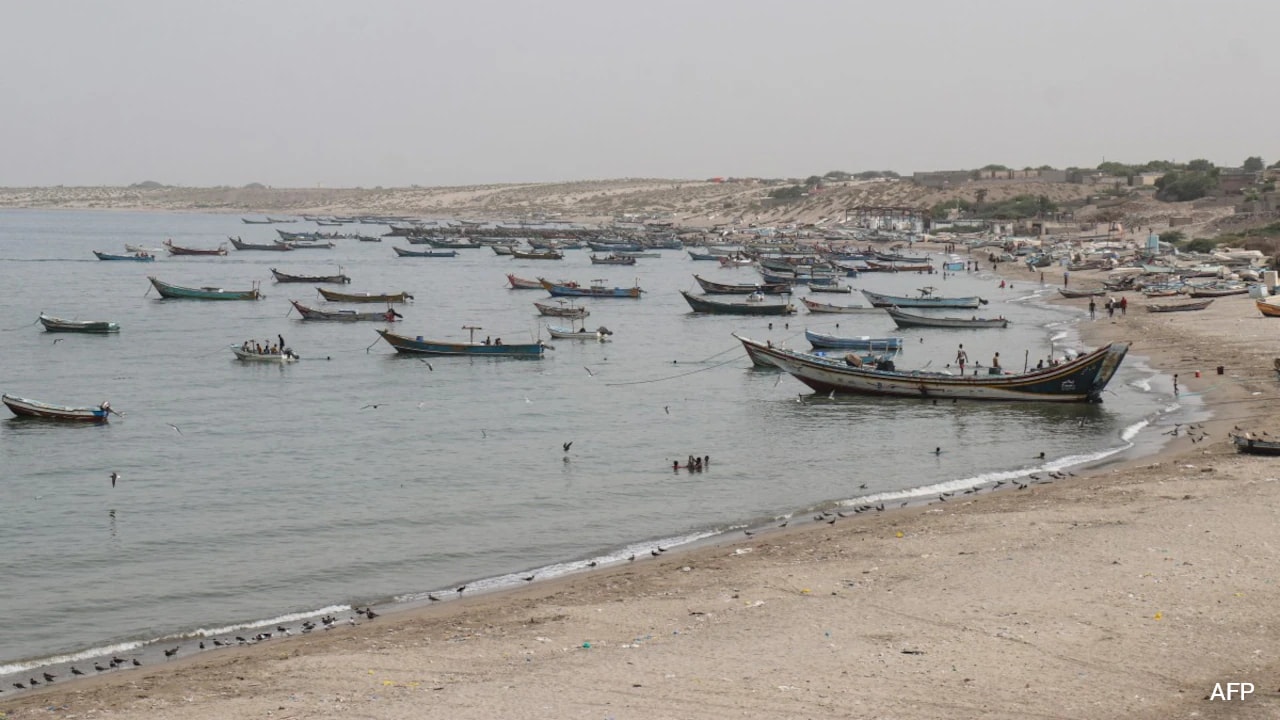
Military strikes on the Red Sea port of Hodeidah represent a deliberate shift from attrition to logistical strangulation. By targeting the primary maritime artery controlled by the Houthi movement, Saudi-led coalition operations aim to sever the group's capacity to import fuel, generate customs revenue, and receive external materiel, while immediately triggering a legal and humanitarian crisis regarding the protection of civilian infrastructure under international law.
To understand the operational logic of striking a major port, one must look past the immediate kinetic damage and examine the supply chain mechanics of northern Yemen. Standard reporting frames these events as simple tit-for-tat escalations or isolated legal disputes over war crimes. That framing misses the structural reality. Hodeidah is not merely a harbor; it is the single most critical economic and logistical node in a territory housing roughly seventy percent of Yemen's population.
The Structural Function of Hodeidah in the Houthi Economy
A modern insurgency holding territory functions like a rudimentary state, requiring continuous inflows of capital and energy to maintain territorial control. Hodeidah fulfills three distinct operational functions for the Houthi administration in Sanaa.
First, it acts as the primary fiscal engine. Import tariffs, port fees, and taxes levied on commercial vessels docking at Hodeidah provide a massive share of the liquid cash required to pay fighters and run basic administrative apparatuses. Without access to central bank reserves or international financial markets, physical control over maritime customs gates is the most reliable revenue stream available.
Second, the port serves as an energy bottleneck. Northern Yemen lacks significant domestic refining capacity. Diesel and petrol imported through Hodeidah power not only civilian water pumps and hospitals, but also the military logistics network, including transport trucks and generators used in weapons manufacturing and command centers. Restricting fuel imports creates an immediate operational drag on mobile forces.
Third, the port provides strategic cover. By co-locating dual-use infrastructure within a facility essential for humanitarian survival, the defending force forces the attacker into an asymmetric dilemma. Any strike that degrades military logistics simultaneously degrades civilian food security.
The Mechanics of Dual-Use Infrastructure and International Humanitarian Law
When the Houthi leadership labels an airstrike on Hodeidah a war crime, they are invoking the principles of distinction and proportionality under the Geneva Conventions. Under International Humanitarian Law (IHL), civilian objects—including ports, power grids, and bridges—are protected from direct attack unless they are converted into military objectives.
A civilian facility loses its protected status when it meets two cumulative criteria:
- By its nature, location, purpose, or use, it makes an effective contribution to military action.
- Its total or partial destruction, capture, or neutralization offers a definite military advantage in the circumstances ruling at the time.
This creates a severe analytical friction in asymmetric warfare. If a crane is used to offload both bulk grain for international aid agencies and disassembled missile components hidden inside commercial containers, the crane becomes a dual-use asset.
However, international law does not grant a blank check once an asset becomes dual-use. The attacking force remains bound by the rule of proportionality. This rule prohibits attacks expected to cause incidental loss of civilian life, injury to civilians, or damage to civilian objects that would be excessive in relation to the concrete and direct military advantage anticipated.
The legal battle over Hodeidah hinges entirely on this unquantifiable equation. The coalition argues that the concrete military advantage is the disruption of ballistic missile and drone supply chains targeting Saudi territory and international shipping. The opposing argument, backed by humanitarian organizations, asserts that destroying port cranes and fuel storage tanks inflicts disproportionate harm on millions of civilians dependent on food imports, effectively weaponizing starvation.
Supply Chain Cascade Effects of Port Degradation
Evaluating the strategic success of a port strike requires mapping the secondary and tertiary effects across the regional supply chain. Unlike a strike on an ammunition depot, which yields a linear reduction in firepower, damaging a port induces a non-linear collapse in logistics efficiency.
- Berth Congestion and Demurrage Costs: When cranes or quays are damaged, vessel turnaround times spike from days to weeks. Commercial shipping lines immediately price this risk into their operations via war risk insurance premiums and demurrage charges—fees charged when a ship is delayed in port beyond the agreed time.
- Inland Distribution Bottlenecks: Even if cargo reaches the shore, strikes on adjacent fuel depots or highway bridges sever the connection between the coast and the highland population centers like Sanaa and Saada. Transportation costs multiply, driving hyperinflation in basic commodity prices.
- Aid Diversion and Re-routing: Humanitarian agencies are forced to re-route shipments to southern ports like Aden, which are controlled by rival factions. Moving cargo across active frontlines introduces new layers of taxation, checkpoints, and spoilage, drastically reducing the net volume of aid reaching end-users.
This cascade effect is precisely why port infrastructure is targeted. A military planner does not need to sink every ship to achieve a blockade; they only need to raise the financial and operational friction high enough that commercial insurers refuse to underwrite voyages to the port. Once insurance is pulled, the port ceases to function commercially without a single additional bomb being dropped.
The Strategic Flaw in Kinetic Interdiction
Despite the immediate tactical disruption, relying on airstrikes against port infrastructure suffers from severe diminishing returns and operational limitations.
The first limitation is the adaptation of smuggling networks. High-value, low-volume military components—such as guidance systems, gyroscopes, and specialized fuels for drones and ballistic missiles—do not require deep-water container terminals. They can be offloaded via small dhows along hundreds of miles of unmonitored coastline or smuggled overland through porous desert borders. Kinetic strikes on major port cranes primarily penalize bulk commercial shipping and humanitarian aid, while agile, illicit supply chains route around the damage.
The second limitation is political blowback. High-profile strikes on humanitarian lifelines consolidate domestic support for the targeted group. Faced with acute fuel shortages and rising food prices, the local population frequently directs its anger at the external aggressor conducting the airstrikes rather than the local governing authority mismanaging the economy. The strike inadvertently solves a domestic legitimacy problem for the defending insurgency.
The third limitation is international diplomatic pressure. Because global supply chains and major powers monitor maritime chokepoints closely, sustained degradation of a major Red Sea port inevitably triggers diplomatic intervention. Ceasefires and international monitoring mechanisms—such as the 2018 Stockholm Agreement—are typically born directly out of the threat of a total collapse at Hodeidah. These diplomatic pauses halt offensive momentum, allowing the defending force time to regroup, fortify positions, and replenish stockpiles.
Evaluating Escalation Dominance in the Red Sea
The broader context of any strike on Hodeidah is the battle for escalation dominance across the Red Sea corridor. The Houthi strategy relies on holding high-value, asymmetrical targets at risk: Saudi oil infrastructure, desalination plants, and commercial transit through the Bab el-Mandeb Strait. Because their own economy is already degraded and decentralized, their threshold for absorbing economic pain is vastly higher than that of a capital-intensive, globally integrated economy like Saudi Arabia.
When the coalition strikes Hodeidah, it is attempting to impose a cost that forces the Houthi leadership to recalculate the price of their cross-border attacks. Yet, historical data from the conflict demonstrates that economic and infrastructural pain rarely alters the strategic calculus of ideological movements whose primary currency is resistance rather than economic growth.
To effectively neutralize the military utility of Hodeidah without triggering catastrophic humanitarian blowback or diplomatic intervention, kinetic targeting of static port infrastructure must be abandoned in favor of granular maritime interdiction. Coalition forces and their international partners must shift intelligence, surveillance, and reconnaissance assets away from fixed port facilities and concentrate them on the maritime transit lanes leading into the Red Sea. Implementing rigorous, third-party inspection regimes at regional transshipment hubs—before cargo ever reaches Yemeni territorial waters—severs the illicit supply chain at zero cost to port capacity, stripping the defending force of both its military materiel and its propaganda leverage.


