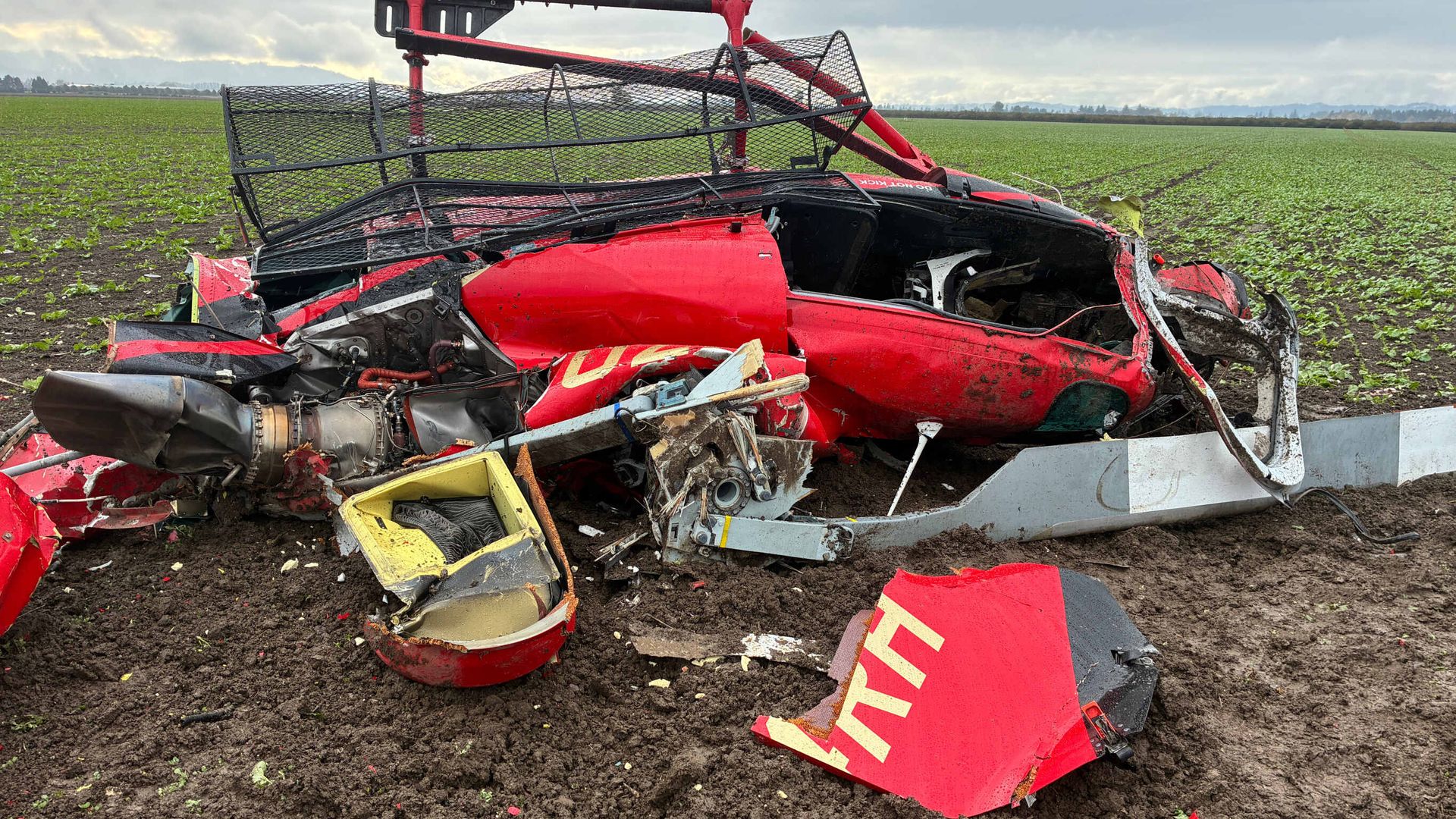
Mid-air collisions involving flight training aircraft represent a predictable failure mode within congested visual flight rules (VFR) airspace rather than statistical anomalies. When a British student pilot and two other individuals died in a mid-air helicopter collision in the United States, standard news reporting treated the event as an isolated tragedy defined by victim biographies and initial emergency response timelines. That framing obscures the systemic mechanics of primary flight training: high-density traffic patterns, physiological limitations of human visual scanning, and the economic structure of international flight academies operating in the United States.
Understanding why these collisions occur requires separating the immediate tactical failure—two aircraft occupying the same three-dimensional coordinates—from the upstream structural conditions that place student pilots in high-risk convergence zones.
The Structural Economics of International Flight Training in the United States
The presence of a British student pilot in a fatal U.S. aviation accident reflects a well-established capital and regulatory arbitrage within global pilot training. Aspiring commercial helicopter and fixed-wing pilots from the United Kingdom and continental Europe routinely train in the United States due to three converging operational advantages:
- Meteorological Reliability: Flight training throughput depends entirely on visual meteorological conditions (VMC). Regions such as Florida, Arizona, Texas, and California offer over 300 VMC days annually, compressing the time required to log the minimum flight hours mandated by the UK Civil Aviation Authority (CAA) or the European Union Aviation Safety Agency (EASA).
- Infrastructure and Fuel Costs: Aviation gasoline (100LL) and Jet-A fuel carry significantly lower tax burdens in the U.S. than in Europe. Combined with lower landing fees and fewer airspace user charges, hourly wet-lease rates for training helicopters like the Robinson R22 or R44 drop by 30% to 50% compared to UK equivalents.
- Airspace Accessibility: The U.S. National Airspace System (NAS) permits extensive operation under VFR without mandatory flight plans or continuous air traffic control (ATC) separation in Class E and Class G airspace.
This concentration of international students creates high-density training corridors. Multiple flight schools frequently share the same non-towered airports and designated practice areas. The operational result is predictable: dozens of low-time pilots executing repetitive maneuvers—autorotations, hovering, steep approaches, and pattern work—within a compressed geographic footprint.
The Failure of See-and-Avoid in Rotorcraft Operations
The foundational collision-avoidance doctrine in VFR airspace is "see-and-avoid," codified under Title 14 of the Code of Federal Regulations (14 CFR § 91.113). This regulation places the primary burden of traffic separation on the pilot's visual scan, regardless of whether the aircraft is operating under flight rules or receiving advisory services. In rotorcraft training environments, see-and-avoid degrades due to four compounding physical and cognitive bottlenecks.
1. Constant-Bearing, Decreasing-Range (CBDR) Geometry
When two aircraft are on a collision course at constant speeds and headings, the conflicting aircraft appears stationary in the pilot's windscreen. The human eye is evolutionarily tuned to detect relative motion against a background; an object with zero angular velocity fails to trigger peripheral motion detectors. Because the apparent size of an approaching helicopter remains small until seconds before impact, the target remains camouflaged against ground clutter until closure rates exceed human reaction thresholds.
2. Cockpit Blind Spots and Airframe Obscuration
Training helicopters feature distinct structural blind spots that standard scanning techniques cannot fully mitigate:
- Overhead and Aft Sectors: The main rotor mast, transmission housing, and cabin roof completely obscure the upper-rear quadrant. A helicopter descending onto another from above and behind—a common geometry when one aircraft enters a traffic pattern while another executes a climb-out—remains invisible to the lower crew.
- Instrument Panel and Door Pillars: During precision maneuvers, instructors and students divide attention between outside visual references and engine/rotor RPM gauges. Thick window posts and chin-bubble framing create localized blind zones that can mask a distant aircraft for ten seconds or more.
3. Cognitive Saturation in Dual-Instruction Environments
In a dual-instruction flight, the student pilot operates near maximum cognitive capacity. Managing collective pitch, cyclic control, and anti-torque pedals simultaneously leaves minimal spare mental bandwidth for systematic 10-degree horizon sector scans. Meanwhile, the Certified Flight Instructor (CFI) must split attention between monitoring the student's control inputs, verbalizing instruction, operating radios, and scanning for traffic. When both occupants focus inward on a simulated emergency or maneuver critique, external visual vigilance drops to zero.
4. Rotorcraft Maneuver Profiles
Unlike fixed-wing aircraft, which follow relatively linear, predictable glide paths and turn radii, helicopters operate across erratic vertical and horizontal profiles. A training helicopter may transition rapidly from a 60-knot cruise to a steep deceleration, hover-taxi across an active runway environment, or enter a high-rate-of-descent autorotation. Standard traffic pattern assumptions—such as expecting traffic to remain at a fixed pattern altitude—frequently break down when helicopters share airspace with other rotorcraft or fixed-wing trainers.
The Investigative Framework: Separating Facts from Hypotheses
Following a mid-air collision in the United States, jurisdiction splits immediately between two federal agencies: the Federal Aviation Administration (FAA) and the National Transportation Safety Board (NTSB). Standard news coverage routinely conflates their roles and treats preliminary observations as established causal findings.
- The FAA's Role: Focuses on regulatory compliance, pilot certification validity, airworthiness records, and ATC communications (if the aircraft were in contact with a radar facility).
- The NTSB's Role: Conducts the independent safety investigation to determine probable cause, analyzing wreckage distribution, radar track data, onboard avionics logs, and human factors.
In any fatal mid-air collision involving training aircraft, investigators reconstruct the event through specific evidentiary vectors rather than eyewitness speculation:
- ADS-B and Radar Track Reconstruction: Automatic Dependent Surveillance-Broadcast (ADS-B) Out data—mandatory in most controlled U.S. airspace—provides second-by-second GPS coordinates, altitude, and groundspeed. Where ADS-B is absent (common in certain Class G training areas or older airframes), primary and secondary radar returns from nearby FAA facilities establish closure angles.
- Impact Scar and Paint Transfer Analysis: Physical examination of rotor blades, skids, and fuselage deformation determines the exact relative pitch, roll, and yaw of both aircraft at the millisecond of contact. This establishes which aircraft was overtaking, descending, or converging from the right—critical variables under right-of-way rules (14 CFR § 91.113).
- Cockpit Avionics and Device Forensics: Even light training helicopters lacking flight data recorders often carry portable GPS units, tablet-based electronic flight bags (such as ForeFlight), or action cameras mounted by students. Non-volatile memory recovery frequently yields exact flight paths and audio recordings of intercom communications.
Until the NTSB releases its preliminary report (typically within 10 to 14 days) and subsequent factual and probable cause reports (often 12 to 24 months later), any attribution of fault to either crew remains an unverified hypothesis.
Limitations of Current Technological Mitigations
A persistent misconception in public reporting is that modern avionics completely prevent mid-air collisions. While electronic conspicuity has improved situational awareness, significant operational gaps remain in the general aviation fleet:
- ADS-B In/Out Asymmetry: While ADS-B Out broadcasts an aircraft's position, it does not alert the pilot to nearby traffic unless the aircraft is also equipped with ADS-B In and a cockpit display. Furthermore, in non-radar environments or at low altitudes typical of helicopter operations (below 1,000 feet AGL), ground-based Traffic Information Service-Broadcast (TIS-B) relays frequently lose line-of-sight coverage, creating blind spots on cockpit traffic displays.
- Alert Fatigue in Training Corridors: In dense flight-training airspace, traffic alerting systems trigger continuously as aircraft pass within standard practice-area separations. Instructors and students habituated to frequent audio chimes ("Traffic, 12 o'clock, same altitude") often experience alarm desensitization, diminishing their urgency when an actual collision trajectory develops.
- Lack of Active Resolution Advisories: Unlike commercial airliners equipped with TCAS II (Traffic Alert and Collision Avoidance System), which issues coordinated vertical escape maneuvers ("Climb" vs. "Descend"), general aviation traffic systems provide passive situational data only. They tell a pilot where traffic is, not how to maneuver safely to avoid it.
Tactical Protocol for High-Density Training Operations
Flight schools, chief pilots, and instructors operating in congested VFR environments cannot rely solely on regulatory minimums to manage collision risk. Mitigating mid-air exposure requires enforcing procedural discipline that compensates for the physiological limits of visual scanning:
- Mandate Active Radio Self-Annunciation on Common Traffic Advisory Frequencies (CTAF) and Practice Area Frequencies: Pilots must broadcast concise position, altitude, and intent reports at standardized geographic fixes—not merely when entering the airport traffic pattern. Eliminate non-standard phraseology and prolonged instructional chatter on shared frequencies.
- Enforce Altitude Stratification Between Arrivals, Departures, and Maneuvering Traffic: Flight schools sharing a practice area must establish formal letters of agreement (LOAs) that segregate rotorcraft autorotation corridors from fixed-wing pattern altitudes by at least 500 vertical feet.
- Institute Hard Visual-Scan Division in Dual Cockpits: During any maneuver requiring the student to reference cockpit instruments or ground targets, the instructor must explicitly assume 100% external visual scan responsibility. When both crew members look inside the cockpit simultaneously—even for three seconds—the aircraft flies blind across hundreds of feet of airspace.
- Require High-Visibility Lighting and Strobe Protocols: Pulse-light systems and high-intensity LED strobes must remain active during all daylight VFR operations within 10 nautical miles of an airport or inside designated training zones to break the camouflage effect of CBDR geometry.
- Audit Electronic Conspicuity Equipage Across Training Fleets: Operators must standardize on dual-band ADS-B In/Out transponders paired with auditory headset alerts, ensuring every training airframe broadcasts and receives position data directly rather than relying on ground-station rebroadcasts.