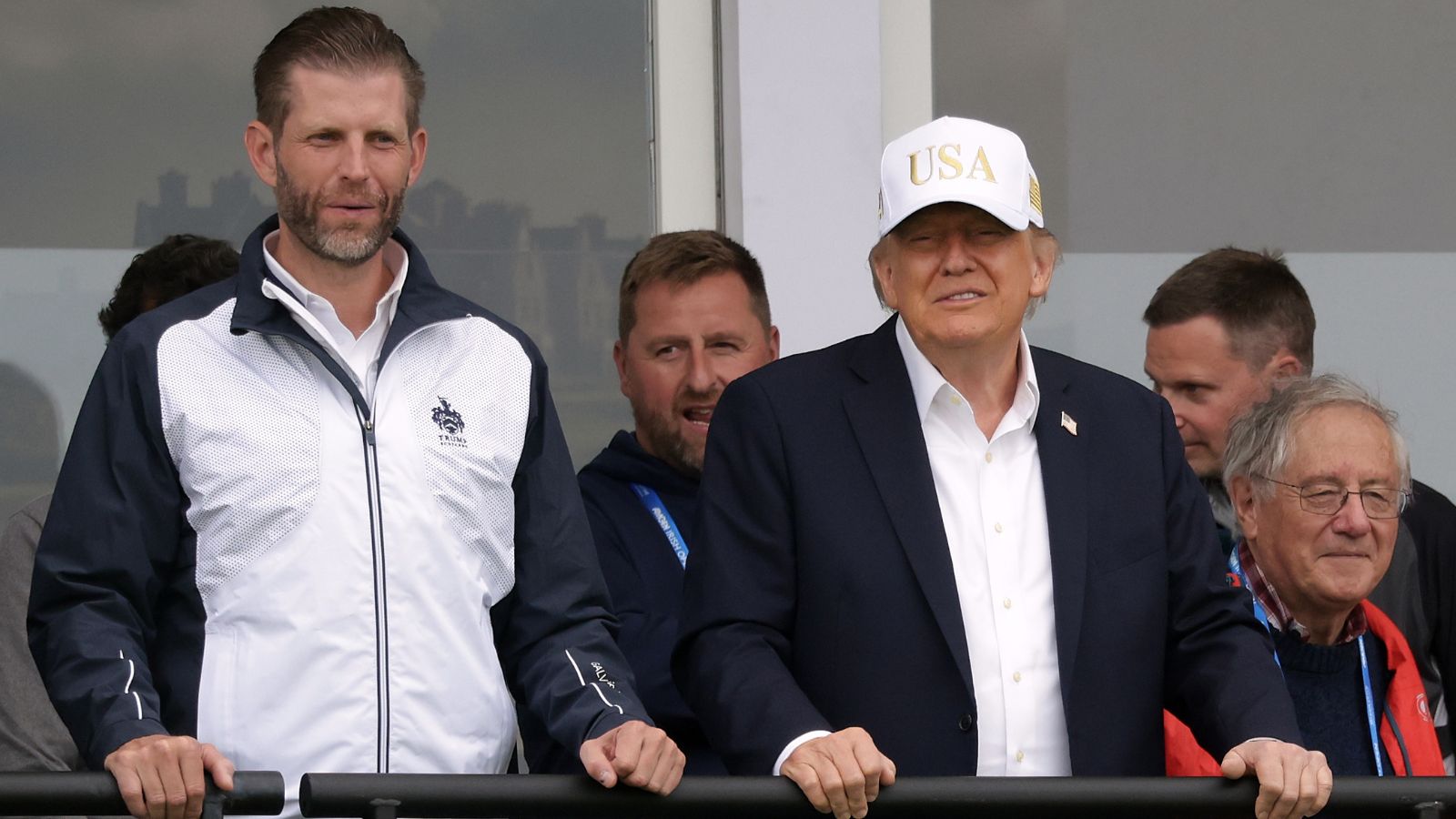
According to reporting from ProPublica, the Associated Press, and The Guardian, President Donald Trump announced in September 2026 that his eldest son, Donald Trump Jr., would reimburse Russian businessman Umar Kremlev for bankrolling hundreds of thousands of dollars in post-wedding celebrations in the Bahamas. From an operational and political risk perspective, converting a disclosed foreign gift into a retroactive reimbursement does not erase the underlying exposure; it simply alters the compliance and counterintelligence risk profile.
The Mechanics of the Transaction and Its Exposure
In May 2026, Donald Trump Jr. married Bettina Anderson in a private ceremony, followed by two nights of celebrations across private islands in the Bahamas. Investigative reporting by ProPublica established that Umar Kremlev—president of the International Boxing Association (IBA), a recipient of Russia's Order of Friendship from Vladimir Putin, and an individual sanctioned by the Ukrainian government—funded the post-wedding festivities, including private island rentals and fireworks, through an IBA-linked entity. If you enjoyed this piece, you should read: this related article.
When the arrangement became public in September 2026, three distinct narratives emerged from the principals involved:
- The Initial Framing (Gift Economics): Trump Jr. and Anderson initially characterized the expenditure as an "extraordinarily generous wedding gift" from a personal friend, explicitly rejecting the premise of any political motive or transactional agenda.
- The Executive Pivot (Retroactive Reimbursement): Speaking to reporters on September 18, 2026, President Trump defended the transaction as legally permissible and culturally normal among wealthy peers, while simultaneously stating that his son was paying Kremlev back.
- The Counterparty Confirmation (Reluctant Acceptance): At an October 6, 2026 press conference in Istanbul, Kremlev confirmed to the Associated Press that Trump Jr. had repaid the funds, though Kremlev stated the repayment was unnecessary.
In compliance and governance analysis, this sequence illustrates a classic reputational remediation loop. A high-net-worth individual accepts an off-market benefit, public disclosure triggers institutional scrutiny, and the recipient attempts to neutralize the optics by reclassifying the gift as a settled expense. For another look on this event, see the latest update from Reuters.
The Three Pillars of Foreign-Gift Risk
Standard political commentary reduces these events to partisan talking points. A rigorous risk assessment breaks the transaction down into three operational vulnerabilities: statutory compliance, counterintelligence access, and verification asymmetry.
1. Statutory Boundaries vs. Reputational Liabilities
Critics and defenders immediately clashed over whether the transaction violated U.S. law. Under the U.S. Constitution's Foreign Emoluments Clause and federal ethics statutes, restrictions apply primarily to individuals holding an "Office of Profit or Trust" under the United States. Because Donald Trump Jr. operates as a private citizen rather than an appointed White House official, direct statutory prohibitions on receiving foreign gifts do not apply to him in the same manner they apply to executive branch employees.
This legal distinction explains President Trump's assertion that the gift was "totally allowed". However, legal permissibility is not synonymous with institutional insulation. When a private citizen sits within the immediate decision-making orbit of a sitting president—particularly during active geopolitical negotiations involving Russia and Ukraine—financial entanglement with a Kremlin-linked actor creates an acute conflict-of-interest vector. Even without a formal government title, proximity functions as an informal asset.
2. Counterintelligence and Access Economics
In intelligence doctrine, financial transfers from state-aligned oligarchs rarely operate as immediate quid pro quo bribes. Instead, they function as access-acquisition mechanisms. By underwriting a lavish event, the benefactor achieves three strategic objectives without ever requesting a specific policy favor:
- Physical Proximity: ProPublica reported that Kremlev and a Russian-speaking entourage attended the roughly 50-person gathering, standing alongside senior figures such as Jared Kushner and Eric Trump. In high-security environments, unvetted physical access to principals is a primary intelligence-gathering vector.
- Reciprocity Conditioning: Behavioral economics demonstrates that large, unprompted favors create psychological obligations. Even if no explicit agreement exists, the recipient is socialized to view the benefactor favorably.
- Network Normalization: Subsequent reporting by the Financial Times revealed that Trump Jr. spent time with Kremlev on an August 2026 hunting trip in Mongolia, following an earlier September 2025 IBA event in Istanbul. The wedding expenditure was not an isolated anomaly; it was an accelerant within an ongoing relationship-building trajectory.
3. Verification Asymmetry
The core limitation of any retroactive reimbursement strategy is verification asymmetry. When a government agency or publicly traded corporation unwinds a conflicted transaction, the remediation generates an auditable paper trail: wire transfer receipts, independent third-party valuations of the goods or services rendered, and tax filings confirming no below-market discount occurred.
In private-citizen transactions, none of these verification mechanisms are publicly enforceable. While both President Trump and Umar Kremlev stated publicly that repayment occurred, no independent financial documentation has been released establishing the exact dollar amount paid, the valuation methodology used to price a private-island buyout and fireworks display, or the specific accounts involved. Without an audited ledger, the market—in this case, Congress and the electorate—cannot distinguish between a full-value reimbursement and a nominal token payment.
The Bipartisan Oversight Convergence
The structural weakness of the reimbursement defense is evidenced by the rapid formation of bipartisan congressional inquiry tracks. Following the ProPublica report, House Oversight Committee Ranking Member Robert Garcia initiated a Democratic inquiry requesting records on Kremlev, the IBA-linked payments, and White House communications. Concurrently, Representative Jim Himes raised counterintelligence concerns directly with the FBI.
More significantly, the episode breached partisan defenses in the Senate. On September 22, 2026, Republican Senator John Curtis formally requested that Senate Judiciary Committee leaders Chuck Grassley and Dick Durbin scrutinize the wedding payments alongside Trump Jr.'s broader international business dealings, explicitly comparing the need for oversight to Republican investigations into Hunter Biden. Senators John Cornyn and Thom Tillis similarly expressed support for examining the matter.
This convergence highlights a fundamental rule of political risk management: precedent weaponization. Once a political coalition establishes an aggressive oversight standard for the family members of an opposing administration—such as the extensive subpoena campaigns targeting Hunter Biden's foreign business ties—that exact evidentiary framework remains active and available to be turned back against the coalition's own principals.
Why Retroactive Repayment Fails as a Containment Strategy
To understand why paying Kremlev back failed to close the story, analysts must apply the Streisand-Compliance Paradox. In crisis management, executing a corrective action after media exposure implicitly validates the critics' premise that the original transaction was improper.
If the expenditure had been a routine, benign wedding gift between peers—as Trump Jr.'s representatives initially argued—reimbursement would be irrational. Kremlev himself highlighted this logical contradiction in Istanbul when he remarked that he did not understand why Trump Jr. decided to pay him back for a present. By reimbursing the funds only after investigative journalists exposed the financial link, the Trump family inadvertently signaled that the optics were unsustainable, thereby validating congressional demands for subpoenas and financial records.
Furthermore, repayment addresses only the financial transfer; it does nothing to unwind the informational or relational exposure. Returning money does not erase the conversations held in the Bahamas, Istanbul, or Mongolia, nor does it alter the fact that a Putin-aligned official gained direct access to the president's inner circle during an active European land war.
Strategic Governance Protocol for Politically Exposed Persons
For family offices, legal counsel, and advisors managing Politically Exposed Persons (PEPs), this episode serves as a textbook failure of pre-transaction vetting. President Trump noted in his September remarks that no background check was conducted on the gift arrangement. Operating without pre-clearance protocols exposes high-profile principals to asymmetric reputational damage.
To eliminate this vulnerability, advisory teams managing non-governmental family members of senior officials must enforce four strict operational controls:
- Mandatory Counterparty KYC (Know Your Customer): Any third party underwriting travel, hospitality, or events exceeding a strict de minimis threshold (typically $5,000) must undergo beneficial-ownership screening. If funds trace back to state-owned enterprises, sanctioned individuals, or foreign sovereign-adjacent entities like the IBA, the transaction must be blocked prior to execution.
- Upfront Market-Rate Escrow: When a PEP attends an event hosted by a foreign national, the PEP's family office should calculate the fair market value of accommodations and hospitality in advance and wire payment directly to the commercial vendors rather than routing funds through the host's entities.
- Audit-Ready Documentation: In the event an unvetted benefit is inadvertently accepted, remediation requires more than a verbal statement to the press. Counsel must commission an independent accounting valuation and retain itemized wire receipts capable of withstanding a congressional subpoena.
- Physical Perimeter Segregation: Security details and event planners must enforce strict guest-list compartmentalization at private social gatherings to prevent unvetted foreign delegations from using social proximity to bypass formal diplomatic and national security vetting channels.
The political and investigative fallout surrounding the Bahamas wedding demonstrates that in modern geopolitical environments, private social capital and public national security interests cannot be cleanly separated. When the immediate family of a head of state accepts off-book hospitality from foreign state-aligned actors, retroactive reimbursement is an inadequate patch for a structural failure in pre-transaction due diligence.
To examine the primary reporting and official statements on the reimbursement, see Trump Says His Son Repaid Russian Businessman for Wedding Afterparty, which covers President Trump's initial public remarks defending the arrangement while confirming the repayment plan.