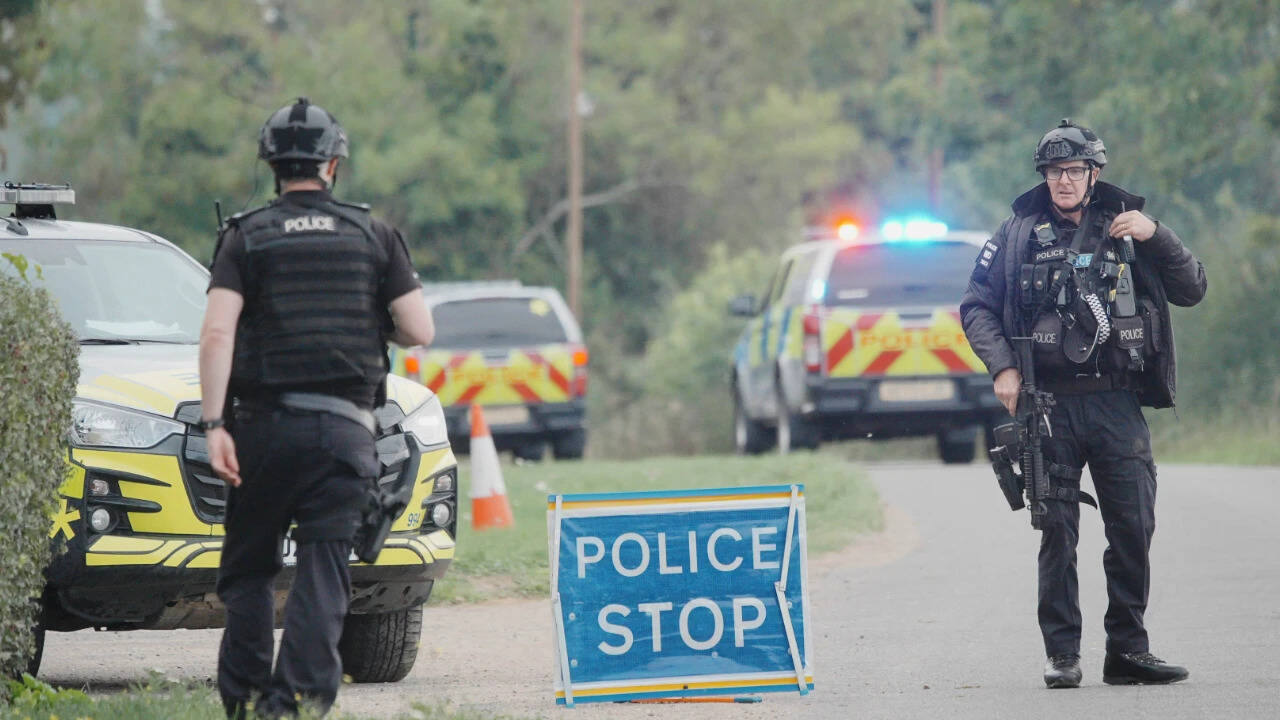
The security incident at Royal Air Force Fairford in Gloucestershire disrupted the routine of a quiet rural corner of southwest England and laid bare the complex vulnerabilities inherent in defending strategic military assets. When Gloucestershire Constabulary declared a major incident following the discovery of suspicious vehicles near the perimeter fence, the immediate public narrative focused on domestic bomb plots and localized evacuations. Beneath the surface of police cordons and bomb disposal robots, however, the event revealed a sophisticated intersection of counter-terrorism policing, foreign intelligence operations, and the physical security pressures facing installations shared by the Royal Air Force and the United States Air Force.
The Operational Trigger And Response Mechanics
To understand the mechanics of the Fairford alert, one must examine the friction points between civilian emergency response systems and specialized counter-terrorism architecture. The initial trigger was not a high-level intelligence intercept generated by signals intelligence agencies or deep-cover surveillance, but rather ground-level civilian observation combined with direct reporting. Reports of three suspicious vans moving through the village of Whelford, accompanied by unusual group behavior near the base perimeter, forced local law enforcement into a rapid decision-making cycle. If you found value in this post, you might want to read: this related article.
When local police forces declare a major incident, they initiate a rigid protocol designed to contain catastrophic risk before forensic verification is complete. This operational posture prioritizes worst-case containment over immediate certainty. Consequently, the establishment of a four-hundred-meter cordon, the deployment of the British Army’s Explosive Ordnance Disposal unit, and the evacuation of eighty-four households to a nearby leisure center represented standard risk-aversion protocols.
The threshold for displacing civilians living adjacent to critical defense infrastructure is exceptionally high, reflecting the gravity of potential explosive hazards. Yet, this protective reflex creates immediate societal friction. Local residents experienced sudden displacement without granular operational explanations, highlighting the communication gap that typically characterizes active counter-terrorism operations in their initial hours. Within hours, command authority transferred from Gloucestershire Constabulary to Counter Terrorism Policing, signaling that local suspicious vehicle reports had intersected with broader national security databases and intelligence indicators. For another perspective on this development, refer to the latest coverage from USA Today.
Forensic Realities Versus Initial Apprehension
A critical analytical challenge in modern security incidents involves reconciling early public panic with subsequent forensic findings. Initial media reports and emergency dispatches frequently conflate suspected explosive offenses with active device deployment. In the Fairford investigation, subsequent searches of the vehicles and associated properties revealed a notable absence of manufactured military or improvised explosive materials. Instead, forensic teams recovered quantities of petrol and large plastic containers.
This material footprint shifts the analytical assessment of the threat profile. Petrol stored in bulk containers within utility transport vehicles points toward potential arson, tactical sabotage, or chemical accelerant deployment rather than sophisticated bomb-making operations. In the calculus of infrastructure protection, an accelerant-based plan targets mobility, support logistics, or psychological disruption rather than catastrophic structural demolition.
The tactical utility of petrol-based disruption against an air base lies in creating localized chaos, interfering with gate access, or generating high-visibility security alerts that force defensive posture adjustments. The suspects, a group of young men primarily from London including British nationals and a dual British-Iranian national, fit a recurring pattern observed across European counter-terrorism investigations: decentralized cells recruited or directed to perform low-tech, high-impact reconnaissance or preparatory sabotage tasks for foreign paymasters.
The Geopolitical Dimension And State-Sponsored Proxies
While initial arrests were executed under the Explosives Act, the trajectory of the legal proceedings shifted decisively toward the National Security Act 2023, specifically focusing on offenses related to assisting a foreign intelligence service. This legal pivot reflects a fundamental evolution in how Western security agencies categorize domestic threats linked to hostile nation-states.
RAF Fairford functions as a vital strategic node for United States Air Force heavy bomber deployments, including B-1 Lancers and B-52 Stratofortresses. These platforms project global power and have historically supported missions relevant to escalating tensions in the Middle East. Public threats issued by entities such as Iran's Islamic Revolutionary Guard Corps regarding foreign bases hosting operations directed against their interests establish a clear strategic motive.
Hostile intelligence services frequently employ a proxy model to distance themselves from direct operational exposure. Rather than utilizing trained military operatives, these services recruit individuals through online channels, criminal networks, or ideological alignment to conduct surveillance, transport supplies, or execute localized disruptions. This compartmentalized structure provides plausible deniability for the sponsor state while insulating the primary intelligence apparatus from immediate attribution.
For investigators, proving this linkage requires tracing financial transactions, digital communications, and operational instructions through encrypted channels. The decision by Counter Terrorism Policing to release suspects on police bail initially, followed weeks later by formal charges under the National Security Act against specific individuals, illustrates the painstaking evidentiary burden required to connect low-level operatives to foreign handlers. Premature arrests are often necessary to disrupt immediate physical threats, but transforming those operational disruptions into sustainable criminal convictions demands meticulous digital and financial forensics.
Structural Vulnerabilities In Open Perimeter Architecture
Strategic air bases like Fairford present unique architectural and geographical defense challenges. Unlike deeply subterranean nuclear command bunkers or highly isolated island facilities, active tactical airfields require extensive perimeter boundaries intersecting public roads, agricultural land, and civilian residential zones.
The physical security of these installations relies on a defense-in-depth model combining perimeter fencing, electronic surveillance, Ministry of Defence Police patrols, and rapid-response agreements with local constabularies. However, the spaces immediately outside the wire remain civilian environments. This proximity allows hostile actors to conduct surveillance, test response times, and stage operational equipment without directly breaching federal or military property lines.
The Fairford incident demonstrates how external civilian spaces can be weaponized against a base's operational readiness. Even if an adversary cannot penetrate the flight line, forcing a major security lockdown, diverting police resources, and compelling military commanders to elevate threat conditions achieves a disruptive objective. It imposes an operational cost on the installation without requiring a successful kinetic attack.
Strategic Adjustments And The Deterrence Calculus
The downstream consequences of the Fairford security scare extend far beyond the courtroom outcomes for the individuals charged. Military planners operate on risk-management principles where the probability of a threat must be weighed against the consequence of failure. When an installation supporting high-value strategic assets experiences a verified intelligence warning and a localized counter-terrorism operation, headquarters reassess their regional posture.
In the weeks following the incident, reports emerged detailing the repositioning of certain US military aircraft assets from British bases to alternative European locations. While political leaders and military spokespersons frame asset dispersal through the lens of routine operational flexibility, it functions as a rational defensive adaptation. By scattering high-value strategic bombers and refueling tankers across multiple dispersed locations, command structures reduce the vulnerability profile of any single hub.
This tactical shift alters the strategic calculus for state adversaries. If an adversary seeks to disrupt or deter the operational output of allied air power through intimidation or proxy sabotage, the immediate result—asset dispersal—complicates their targeting matrix. Rather than consolidating targets at premier historical bases like Fairford or Mildenhall, Western air forces validate the utility of agile combat employment models.
The Fairford incident serves as a case study in modern asymmetric friction. It highlights the vulnerability of open-perimeter military infrastructure to low-tech proxy interference, the operational friction between civil and military authorities during active threat responses, and the direct link between regional geopolitical conflicts and domestic security enforcement. As intelligence services adapt to decentralized, proxy-driven sabotage campaigns, the primary defense relies not just on reinforced perimeter fences, but on the speed of digital attribution and proactive counter-intelligence disruption before operatives reach the wire.