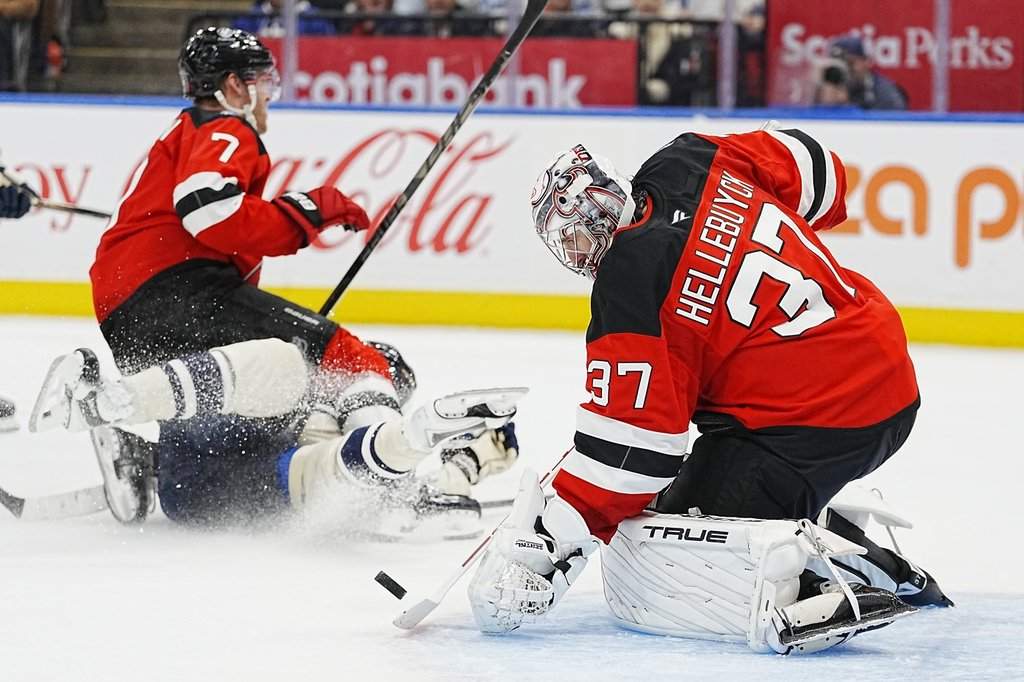
A 4-0 shutout victory driven by an elite netminder like Connor Hellebuyck and a high-volume power forward like Timo Meier is rarely a simple tale of superior effort; it is the predictable outcome of asymmetric resource allocation on the ice. When a structured defensive system suppresses high-danger slot access while an opportunistic forward core capitalizes on transition inefficiencies, even the most potent offensive rosters experience total scoring paralysis. Understanding how a team like the New Jersey Devils dismantles an offensive juggernaut like the Toronto Maple Leafs requires stripping away box-score clichés and examining the underlying spatial mechanics, goaltending variance, and tactical trade-offs that dictate modern NHL outcomes.
The Architecture of Defensive Suppression
Standard post-game recaps treat a shutout as an isolated triumph of willpower. In reality, preventing a top-tier offense from scoring across sixty minutes requires a deliberate geometric constriction of the defensive zone. Against a roster built around elite east-west puck movement and high-skill entry plays, the defending team must abandon aggressive neutral-zone pinching in favor of a layered 1-3-1 or passive box-plus-one structure.
This tactical posture concedes low-percentage perimeter possession to protect the central corridor—often referred to in hockey analytics as the "home plate" area extending from the faceoff dots to the goal line. By forcing the attacking team to cycle along the half-walls and execute point shots through heavy traffic, the defending skaters artificially inflate the opponent's raw shot totals while cratering their Expected Goals (xG) per shot attempt.
- Spatial Denial: Defenders prioritize stick-on-puck positioning in passing lanes rather than body checks that take them out of position.
- Rebound Clearance: Weak-side wingers collapse below the hash marks immediately upon shot release, eliminating second-chance opportunities.
- Transition Triggers: Recovery of blocked shots or perimeter dumps immediately initiates a short-pass outlet to a streaking center, bypassing the opponent's forecheck before their defensemen can pinch down.
When executed correctly, this system creates an illusion of offensive dominance for the losing side. The trailing team accumulates possession time and shot volume, yet their actual probability of beating a set goaltender remains statistically negligible.
Goaltending as a Structural Multiplier
Even the most disciplined defensive structure will surrender between six and ten high-danger scoring chances over a full regulation game due to broken plays, penalties, and skill variance. This is where elite goaltending transitions from a safety net into an active tactical weapon. A netminder operating at the level of Connor Hellebuyck alters the decision-making calculus of opposing shooters before the puck even leaves their sticks.
Elite goaltending efficiency relies on three quantifiable mechanisms:
- Depth Management and Angle Erasure: By aggressively challenging shooters at the top of the blue paint on clean entries, the goaltender reduces the visible net area to near zero. Shooters are forced to aim for extreme corners, increasing the rate of missed nets and post hits.
- Post-Save Recovery Speed: Most goals against top-tier netminders occur on lateral rebounds or backdoor passes where the goaltender must traverse the crease. Minimizing butterfly slide latency ensures the goaltender remains square to secondary threats.
- Puck-Handling Disruption: Acting as a third defenseman behind the net neutralizes dump-and-chase forechecks. When a goaltender cleanly rims the puck to a weak-side defender under pressure, the opposing team's entire offensive zone setup collapses before it begins.
When a goaltender posts a shutout against an offensive powerhouse, the psychological impact compounds the physical reality. Opposing forwards begin over-passing in prime shooting locations, looking for an empty net rather than trusting their release. This hesitation gives backchecking defenders the critical half-second required to lift sticks and disrupt entries.
Offensive Asymmetry and the Meier Archetype
While goaltending and zone structure anchor the defensive side of a 4-0 ledger, converting limited possession into a four-goal cushion demands a specific offensive profile. High-skill, perimeter-oriented teams often struggle to generate offense when space disappears; power forwards like Timo Meier thrive in that exact environment.
The offensive blueprint for breaking a high-event opponent relies on north-south velocity and net-front convergence rather than prolonged cycle play. Meier’s tactical value lies in his ability to carry the puck through the neutral zone with speed, absorb contact along the wall, and drive directly to the top of the crease. This creates immediate defensive breakdowns:
- Gravity and Space Creation: A heavy forward driving the net forces both opposing defensemen to collapse inward, opening high-slot shooting lanes for trailing centers.
- Screen Efficiency: Establishing position directly in the opposing goaltender's sightline turns routine wrist shots from the blue line into unsaveable deflections.
- Forechecking Disruption: Heavy, physical pursuit on the first wave forces opposing defensemen to rush their breakout passes, generating turnovers inside the offensive blue line where counter-attacks are most lethal.
Scoring four goals without surrendering territorial control requires high conversion rates on transition rushes. Rather than trading chances in an open-ice track meet—a scenario that heavily favors high-skill rosters—the winning side weaponizes patience. They absorb pressure, wait for the opposing defensemen to overcommit in search of an equalizer, and strike with outnumbered rushes.
The Cost Function of High-Event Offense
To understand why a team capable of scoring in bunches gets blanked 4-0, one must examine the structural vulnerability inherent to high-octane offensive systems. Teams built around dynamic puck-moving defensemen and four-forward power-play units operate on a razor-thin margin of error regarding puck management.
When trailing by one or two goals against a structured opponent, high-event teams instinctively increase their risk profile. Defensemen activate deeper into the offensive zone, pinching down the boards to keep cycles alive. While this increases offensive pressure, it simultaneously eliminates defensive depth.
The cause-and-effect chain is unforgiving:
- An aggressive pinch fails to secure a bouncing puck along the half-wall.
- The defending winger chips the puck into open neutral-zone ice, instantly creating a 2-on-1 or 3-on-2 odd-man rush.
- The trailing team's lone remaining defenseman is forced to concede the blue line to prevent a breakaway, granting the puck carrier an uncontested high-danger shot from the slot.
- A third goal against forces the trailing coach to pull the goaltender early or abandon defensive structure entirely, resulting in an empty-net or late-game fourth goal that seals the 4-0 margin.
This dynamic exposes the primary flaw in relying solely on outscoring defensive deficiencies. Against a disciplined defensive structure backed by elite goaltending, increasing offensive risk does not yield proportional scoring returns; it merely accelerates the rate of catastrophic turnovers.
Strategic Limitations and Analytical Blind Spots
Viewing a 4-0 victory purely as a repeatable masterclass carries significant analytical risk. Hockey remains a sport governed by high single-game variance, and several factors can mask underlying structural vulnerabilities during a shutout win:
- Shooting Percentage Spikes: Converting four goals on twenty-five to thirty shots represents a shooting percentage well above the league average of roughly 9 to 10 percent. Over an eighty-two-game schedule, regression to the mean guarantees that identical offensive performances will occasionally yield one or zero goals.
- Goaltending Workload Sustainability: Relying on a netminder to stop thirty-five or more shots—including double-digit high-danger chances—is not a viable long-term defensive strategy. Even elite goaltenders experience fatigue and mechanical drift when subjected to sustained defensive-zone pressure over multiple consecutive starts.
- Score-Effects Distortion: Once a team builds a 2-0 or 3-0 lead, tactical priorities shift entirely toward clock management and risk aversion. Treating third-period shot suppression metrics from a blowout win as a baseline for neutral-state performance leads to flawed roster and tactical evaluations.
A rigorous coaching staff or front office separates the repeatable process—neutral-zone gap control, slot protection, and net-front traffic—from the volatile outcomes of puck luck and unsustainable save percentages.
Tactical Adjustments for Breaking Defensive Locks
For an offensive powerhouse looking to avoid future shutouts against structured defensive teams and elite goaltenders, the solution is not abandoning offensive identity, but modifying entry and shot-selection protocols.
- Abandon Low-Percentage Perimeter Volume: Stop firing unscreened wrist shots from outside the dots. Against an elite goaltender, an unobstructed shot from thirty-five feet is simply a controlled rebound or a whistle that allows the defense to change lines.
- Implement Royal-Road Passing: Prioritize horizontal puck movement across the invisible line connecting the two faceoff dots. Forcing an elite goaltender to move laterally across the crease before shooting drops save percentages dramatically compared to vertical north-south shots.
- Deploy Double-Layer Screens: Station one forward directly in the goaltender's eyes while a second forward occupies the weak-side post for rebound control. If the goaltender cannot see the release point, elite reflexes become irrelevant.
- Stagger Defensive Activations: Require weak-side defensemen to hold the center of the blue line until full puck possession is established below the goal line, neutralizing the opponent's primary counter-attacking trigger.
Dominating a high-scoring opponent 4-0 requires syncing elite individual execution with a ruthless tactical commitment to spatial denial. Teams that control the center of the ice, weaponize net-front physicality, and refuse to trade defensive structure for hollow possession metrics will consistently dictate terms—regardless of the offensive firepower standing across the blue line.