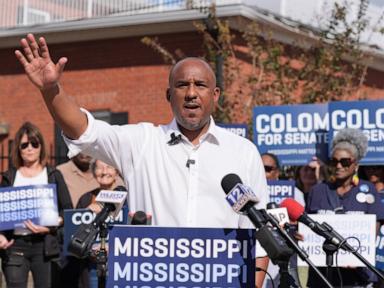
Electoral realignments in the American Deep South rarely occur through sudden ideological conversions; instead, they materialize when an insurgent campaign exploits structural vulnerabilities in turnout elasticity, coalition durability, and candidate localization. Democrat Scott Colom’s victory in flipping a Mississippi Senate seat provides a textbook case study in overcoming a heavily entrenched partisan baseline through operational discipline and asymmetric voter mobilization. To understand how a Democratic candidate breached a traditionally reliable Republican stronghold, analysts must strip away surface-level partisan narratives and examine the underlying mechanics of coalition assembly, cross-pressured voter persuasion, and precinct-level turnout differentials.
The Structural Baseline and Electoral Math
Mississippi’s statewide electoral architecture operates on a high degree of racial polarization, which historically creates a predictable ceiling for Democratic candidates unless specific demographic and turnout conditions are met. In a standard statewide cycle, Republican candidates rely on an overwhelming consolidation of white rural and suburban voters, while Democrats depend on maximizing turnout among Black voters—who comprise roughly 38 percent of the state's population—paired with a narrow slice of white moderates and college-educated professionals.
Flipping a U.S. Senate seat in this environment requires altering at least one of three mathematical variables:
- Turnout Differential: Increasing the Black share of the electorate beyond historical mid-term or off-year averages while simultaneously depressing or holding flat Republican base enthusiasm.
- Margin Erosion: Reducing the Republican candidate's vote share among non-college-educated white voters by three to five percentage points, particularly in rural counties where economic stagnation creates friction between voters and incumbent leadership.
- Suburban Realignment: Capturing a decisive majority in high-growth suburban and exurban precincts—such as those surrounding Jackson, the Gulf Coast, and the Memphis metro spillover in DeSoto County—where demographic diversification and educational attainment shift the partisan baseline.
Without exact precinct-level validation data available in the immediate aftermath of the race, the structural mechanism of Colom’s victory points directly to a simultaneous optimization of the first and third variables, paired with strategic damage control on the second. By operating as a prosecutor—specifically serving as a District Attorney in Mississippi's 16th Circuit Court District—Colom entered the race with a pre-built brand that neutralized standard national Republican attack vectors regarding crime, law enforcement, and judicial leniency.
The Prosecutor Archetype as a Persuasion Mechanism
In state-level and federal campaigns across the South, Democratic candidates frequently suffer from nationalized brand dilution. Voters often project the policy positions of national party figures onto local candidates, creating an immediate credibility deficit on cultural and public safety issues. Colom’s background as an elected District Attorney functioned as a structural buffer against this phenomenon.
Operationalizing a law-enforcement background in a Democratic campaign achieves three distinct strategic objectives:
- Issue Ownership Neutralization: Crime and public safety are traditionally Republican-owned issues. A candidate with a verifiable record of prosecuting violent crime forces the opposition to spend capital attacking specific, localized prosecutorial decisions rather than relying on broad ideological labels.
- Institutional Credibility: Rural and moderate voters often view career legislators or activists with skepticism. An executive-style local official who manages court dockets, interacts with county sheriffs, and handles tangible community problems projects administrative competence rather than ideological rigidity.
- Cross-Pressured Voter Permission: Swing voters—particularly older, moderate white voters and conservative-leaning independents—require a rational justification to break partisan habits. Supporting a local prosecutor provides a pragmatic, non-ideological rationale for ticket-splitting.
This dynamic illustrates a core principle of political campaign management: candidate biography is not merely a messaging tool, but a structural constraint on the opponent's attack surface. When the opposition cannot credibly label a Democrat as anti-police or radical, their paid media loses efficiency, forcing them into defensive postures or awkward pivots toward national economic grievances that may lack local resonance.
Coalition Architecture and the Geography of Turnout
Winning a statewide race in Mississippi requires executing two fundamentally different campaigns simultaneously: a high-touch, culturally resonant mobilization effort in the Mississippi Delta and urban centers, and a hyper-localized, bread-and-butter persuasion campaign in the eastern and southern counties.
The Black Belt and Urban Core Mobilization
The foundation of any Democratic victory in Mississippi lies in the Delta counties, Hinds County (Jackson), and the Golden Triangle region (Columbus, Starkville, West Point). Colom’s geographic base in the Golden Triangle—specifically Lowndes County—provided a critical operational advantage. Unlike candidates anchored solely in Jackson, who often struggle to project influence into the northeastern part of the state, a candidate rooted in the 16th Circuit possesses natural organizational networks spanning both predominantly Black communities and significant white rural populations.
Maximizing turnout in these regions depends on field infrastructure rather than television advertising. Effective mobilization requires early investment in local validators—church networks, municipal officials, labor unions, and civic associations—who can drive down the cost of voter contact. When turnout in high-propensity Black precincts matches or exceeds presidential-year benchmarks during a non-presidential cycle, the statewide partisan math shifts dramatically.
The Suburban and Exurban Contestation
Historically, Republican dominance in Mississippi has been secured by massive margins in the Jackson suburbs (Rankin and Madison counties) and the northern border (DeSoto County). A Democratic challenger does not need to win these counties outright to flip a statewide seat; rather, the objective is margin compression. Reducing a 40-point Republican victory in a high-population suburban county to a 25-point victory nets tens of thousands of votes, fundamentally altering the statewide equilibrium.
Suburban voters respond primarily to governance competence, infrastructure investment, healthcare access, and educational funding. By framing the campaign around tangible state-level failures—such as rural hospital closures, infrastructure decay, and economic out-migration—a challenger shifts the electoral axis from cultural grievance to executive accountability.
Asymmetric Vulnerability and Incumbent Complacency
Electoral upsets are rarely the sole product of challenger brilliance; they are almost always accelerated by incumbent strategic errors. Long-standing partisan dominance breeds institutional atrophy within the ruling party's campaign apparatus. When a party wins statewide races consistently over two decades, its operational muscle memory for competitive persuasion atrophies, replaced by an over-reliance on base mobilization and nationalized messaging.
Three primary failure modes typically afflict entrenched incumbents in these scenarios:
- Delayed Resource Allocation: Incumbent campaigns and national party committees often misread early polling, dismissing tightening margins as statistical noise until the final six weeks of the cycle. By the time financial reinforcements arrive, early voting has commenced, and voter perceptions of the challenger have hardened.
- Message Mismatch: Relying on national culture-war talking points fails when the electorate is focused on acute local economic pain. If voters are experiencing hospital closures or stagnant wages, attacking a local prosecutor over national party platforms registers as disconnected from reality.
- Field Infrastructure Decay: Dominating a state for decades often leads a party to neglect county-level party building and year-round voter registration. When faced with a well-funded, disciplined challenger running a modern data-driven field operation, the incumbent party lacks the ground-level machinery to match late-stage ballot chasing and turnout pushes.
Limitations of the Realignment Model
While Colom’s victory demonstrates a viable pathway for Democrats in the Deep South, strategists must recognize the strict boundary conditions of this model. Treating a single Senate flip as evidence of a permanent partisan realignment in Mississippi would be an analytical error.
First, the candidate-specific variable cannot be easily replicated. Not every Democratic bench features a sitting District Attorney with a geographic base that bridges urban and rural divides. A candidate emerging from a purely activist or academic background would face a much steeper persuasion curve among ticket-splitting moderates.
Second, electoral environment elasticity plays a decisive role. Off-year or midterm dynamics often depress turnout among low-propensity voters who favor the incumbent party, creating an artificial structural opening that disappears during high-turnout presidential cycles when national partisan polarization reasserts itself.
Third, governing in a polarized environment presents immediate retention challenges. A Democrat elected from a conservative state faces an immediate structural dilemma: voting with the national party risks alienating the cross-pressured suburban and rural voters who provided the margin of victory, while breaking with the national party risks depressing the core Black electorate required for future re-election.
Operational Takeaways for Future Campaigns
For political strategists, party committees, and campaign managers operating in structurally unfavorable states, the blueprint derived from this upset dictates a strict reallocation of resources and strategic priorities.
- Prioritize Executive and Law-Enforcement Recruitment: Abandon the practice of recruiting candidates from safe, deep-blue urban legislative districts for statewide runs. Actively recruit local executives—district attorneys, sheriffs, mayors of mid-sized industrial towns, and county commissioners—whose day-to-day responsibilities insulate them from national ideological branding.
- Invest in Permanent, Non-Presidential Field Infrastructure: Shift campaign budgets away from late-stage broadcast television buys and toward early, year-round field organizing in core base counties. Turnout differentials in the Deep South are won through sustained community validation, not October ad blitzes.
- Localize the Economic Contrast: Frame every policy debate around hyper-local institutional failures—healthcare access, water infrastructure, public education funding, and workforce retention—forcing the incumbent to defend the tangible outcomes of their party's governance rather than debating abstract national politics.
- Target Suburban Margin Compression: Deploy precision digital and direct-mail persuasion targeting college-educated, ticket-splitting households in suburban ring counties, focusing exclusively on administrative competence and economic stability.
Campaigns in polarized states cannot rely on demographic destiny or national wave dynamics to deliver victories. Winning requires treating the electorate as a series of distinct operational problems, matching credible local messengers to specific geographic vulnerabilities, and executing a disciplined ground game that maximizes base turnout while systematically compressing the opposition's suburban margins.