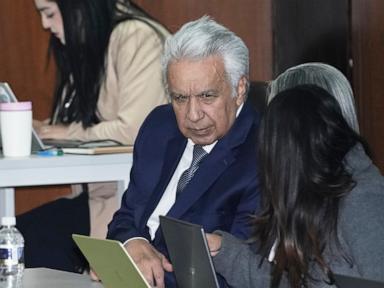
The judicial ruling against former Ecuadorian President Lenín Moreno establishes a quantitative benchmark for state capture in Latin American mega-projects. A court in Quito handed Moreno a five-year prison sentence, executed via house arrest due to physical disability, following his conviction for accepting bribes tied to the construction of the Coca Codo Sinclair hydroelectric plant. Deconstructing this conviction requires stripping away political narrative to examine the underlying financial architecture: a systematic extraction model operating on predictable economic vectors.
The Three Pillars of the Sinohydro Extraction Model
The illicit apparatus exposed by prosecutors did not function through chaotic graft, but rather via a structured corporate extraction template executed between 2008 and 2018. This network systematically monetized executive authority during Moreno's tenure as vice president under Rafael Correa.
- The Baseline Toll: Investigators established that bribes were pegged at precisely 4% of the total project valuation. With the Coca Codo Sinclair plant carrying a capitalization of approximately 2 billion dollars, the structural rent extraction totaled roughly 76 million dollars.
- The Multi-Tiered Distribution Matrix: Illicit capital did not flow directly into accounts held by primary decision-makers. Instead, the network utilized domestic and international transactions to route funds through family proxies, including Moreno's wife, daughter, brothers, and brother-in-law, who were convicted as accomplices with standardized 30-month sentences.
- The Procurement Gatekeeping: Access to the state contract was conditioned on inserting intermediary entities into the procurement chain. Sinohydro secured the engineering, procurement, and construction agreement in exchange for underwriting the financial leakage required by the political elite.
The Cost Function of Infrastructure Arbitrage
Large-scale public works in developing economies frequently exhibit structural cost-benefit distortion due to principal-agent failures. When political agents optimize for personal wealth accumulation rather than social surplus, public investment functions as a wealth transfer mechanism.
The Coca Codo Sinclair initiative illustrates the long-term drag of compromised procurement. Following its handover to the state in 2016, the facility encountered severe structural defects. Capital expenditure diverted toward kickbacks directly correlates with compromised quality control, deferred maintenance tolerances, and sub-optimal material inputs.
[Capital Outlay: $2B] ---> [Extraction Vector: 4% ($76M)] ---> [Procurement Compromise] ---> [Asset Structural Deficits]
This sequence maps the direct transmission channel from political corruption to operational failure. The financial burden is ultimately borne by the sovereign balance sheet, which services debt on a compromised physical asset while absorbing future repair liabilities.
The Mechanics of Systemic Vulnerability
Ecuadorian executive governance structures contain systemic structural flaws that incentivize rent-seeking behavior. Understanding why multiple former presidents—including Correa, Jamil Mahuad, and now Moreno—have faced corruption convictions requires analyzing institutional incentive alignment.
- Discretionary Procurement Authority: High concentration of award power within executive offices minimizes friction for illicit deal-making. Independent oversight mechanisms remain weak relative to executive administrative mandates.
- Family-Network Insulation: Utilizing immediate relatives as financial conduits creates a decentralized web of liability. While this mechanism attempts to obscure the primary beneficiary, it simultaneously broadens the forensic surface area, exposing a wider circle of actors to prosecutional targeting when political regimes shift.
- Cross-Administration Continuity: Because the corruption network spanned from 2008 to 2018, it survived administrative transitions and ideological realignments, proving that structural graft operates independently of partisan rhetoric.
Strategic Outlook for Sovereign Asset Management
The Moreno verdict establishes a legal precedent for retroactive accountability in international public-private partnerships. State attorneys general across the region are increasingly utilizing forensic accounting trails that cross international banking jurisdictions, rendering traditional offshore layering less effective at shielding illicit proceeds.
To mitigate these vulnerabilities, emerging market procurement frameworks must mandate algorithmic contract monitoring, blind bidding architectures, and independent engineering audits backed by multilateral financial institutions. Without structural redesign of the procurement gatekeeping layer, capital inflows for green energy and infrastructure will continue to serve as vehicles for institutional rent extraction.


