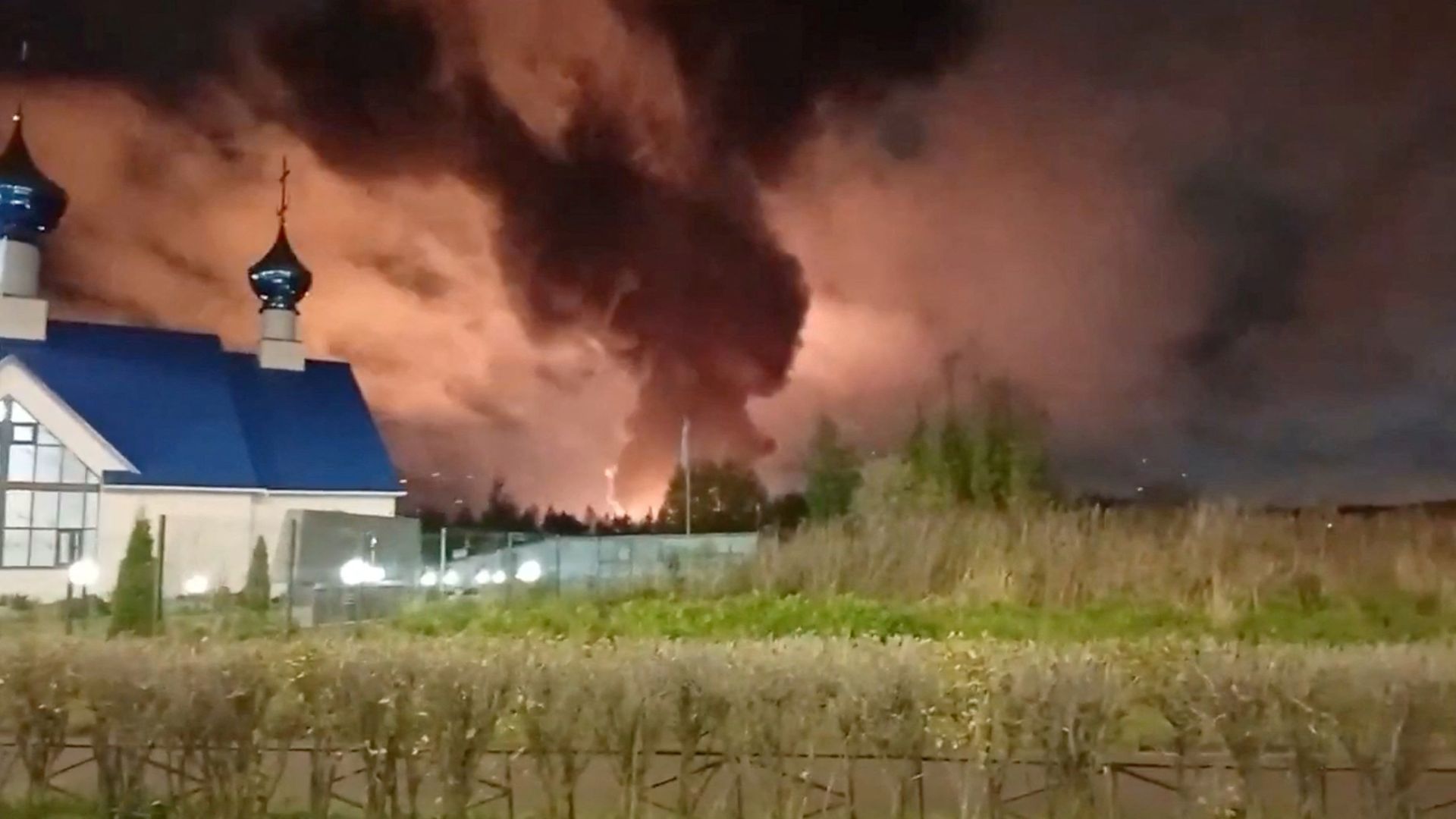
Standard war reporting treats diplomatic warnings and energy infrastructure strikes as parallel headlines rather than coupled variables inside a single strategic system. When Kyiv warns Washington against aligning with Moscow at the same time strikes hit Russian oil facilities, two separate levers of coercion are operating simultaneously: diplomatic signaling aimed at alliance cohesion and kinetic pressure aimed at war-financing capacity. This analysis establishes a four-part framework for evaluating that coupling: the Alliance Alignment Function, the Petroleum Infrastructure Cost Function, the Escalation and Market Feedback Loop, and the Strategic Constraint Matrix. Because no full competitor body text or live intelligence feed is supplied beyond the headline, exact strike counts, damage totals, and real-time diplomatic transcripts remain unknown facts; what follows models the structural mechanisms connecting them and separates verified operational mechanics from analytical hypotheses.
Deconstructing the Headline Logic
A headline pairing a warning about a "historic mistake" by the United States with attacks on Russian oil sites compresses three distinct claims into one sentence. First, it frames US policy toward Russia as a binary choice—aligning with Moscow or standing against it—rather than a spectrum of bargaining positions, sanctions enforcement, and negotiations. Second, it treats diplomatic rhetoric and physical strikes against petroleum assets as co-occurring events whose causal link is left implicit. Third, it treats "historic mistake" as a moral and strategic judgment without specifying which incentives, alliances, or long-term balances of power would be altered. If you liked this post, you should look at: this related article.
In strategy analysis, a warning of a "historic mistake" usually points to reputational spillovers and commitment credibility. If a major guarantor shifts toward accommodating an adversary that has used force to alter borders, smaller allies and partners re-evaluate the reliability of security assurances elsewhere. That re-evaluation is a mechanism, not a guaranteed outcome; whether allies hedge, bandwagon, or double down depends on follow-through in weapons supply, intelligence sharing, and diplomatic posture.
Equally important is what the headline omits: second-order feedback. Striking oil sites is not merely a subtraction from Russian revenue or fuel supply. It alters air-defense allocation, shapes global crude and refined-product risk premiums, tests partner tolerance for escalation, and changes bargaining leverage at the negotiating table. Without mapping those downstream effects, a narrative reads like a sequence of isolated shocks instead of an interacting system. For another angle on this event, check out the recent coverage from The New York Times.
The Alliance Alignment Function
Diplomatic alignment between Washington and Moscow affects Ukraine across four operational channels:
- Material and intelligence throughput: Munitions deliveries, air-defense interceptors, spare parts, and target-relevant intelligence depend directly on political authorization and bureaucratic priority.
- Sanctions and enforcement discipline: Secondary sanctions, price-cap enforcement, and export controls rely on coordinated diplomatic pressure rather than unilateral declarations alone.
- Diplomatic framing and negotiation terms: Whether talks prioritize territorial concessions, ceasefire monitoring, or security guarantees shifts the baseline from which bargaining starts.
- Deterrence signaling across other theaters: Observers in Europe and the Indo-Pacific read great-power accommodation as a clue about how security commitments behave under pressure.
From a game-theoretic perspective, a shift in great-power posture alters the payoff matrix of all three actors. If Moscow perceives reduced American opposition, its incentive to make concessions drops because time and pressure appear to favor its war aims. Conversely, if Kyiv faces uncertainty over external backing, its incentive rises to maximize self-reliant pressure—including long-range strikes on high-value economic and logistical nodes—while external support remains intact.
A critical distinction separates known fact from educated hypothesis here. It is a known structural fact of modern coalition warfare that shifts in lead-nation policy alter resupply predictability and diplomatic leverage. It is an educated hypothesis—not an established certainty—that any given diplomatic overture by Washington would lock in permanent alignment with Moscow, because domestic politics, congressional oversight, alliance pushback, and battlefield developments continually constrain executive moves.
The Petroleum Infrastructure Cost Function
Oil facilities sit at the center of a warring state's fiscal and logistical engine. In a petroleum-rich economy fighting a protracted war, hydrocarbons generate export earnings, budget revenue, and domestic fuel for military transport, agriculture, and industry. Targeting refineries, storage depots, pumping stations, or export terminals attacks conversion capacity—the ability to turn raw resources into usable fuel, hard currency, and operational mobility.
Rather than viewing strikes as an on/off switch that immediately halts a war machine, analysts evaluate them through a cost function with five main variables:
- Strike frequency and concentration: Repeated hits on the same facility prevent clean repairs and force dispersion of air defenses.
- Repair lead times and component bottlenecks: Specialized refinery equipment, pressure vessels, and control systems take longer to replace under import restrictions than simple civil structures.
- Redundancy and rerouting: Pipeline networks, alternative refineries, and maritime shipping routes allow a system to absorb localized hits by shifting flows.
- Defensive reallocation: Moving air-defense batteries to protect oil sites thins coverage over frontline troops, logistics hubs, or cities.
- Market and fiscal pass-through: Lower refining output or export bottlenecks squeeze margins, shift crude toward domestic processing or discounted buyers, and test state budget resilience.
Consider a conceptual example of how redundancy changes strike math. Suppose a region has three refineries processing crude for local military and civilian diesel. If one plant is knocked offline for six weeks, the remaining two can surge throughput or draw from regional reserves, muting immediate frontline shortages. If strikes hit storage and transport links across all three simultaneously—or keep damaging repair crews—the system crosses a threshold from manageable friction into rationing and price spikes.
In real-world operations, exact damage assessments are contested. Attackers and defenders both have incentives to overstate or understate destruction, and satellite imagery alone cannot always distinguish surface scorch marks from deep damage to critical distillation units or underground piping. Treating unverified strike claims as exact capacity losses is a classic analytical error; tracking sustained operational degradation over weeks is the more rigorous standard.
Escalation and Market Feedback Loops
Kinetic strikes on energy infrastructure create feedback loops across both the battlefield and global markets. On the battlefield, pressure on energy assets can raise the cost of sustaining mechanized operations and strain state finances over time, yet it can also prompt retaliatory strikes against power grids, energy facilities, or leadership and logistics targets on the opposing side. Escalation is rarely linear; each move changes the risk calculus of both belligerents and their backers.
Global energy markets add a second feedback loop. Even when physical supply losses are modest relative to total global oil production, risk premiums move prices when traders anticipate supply disruptions or wider conflict. Higher prices can partially offset lower export volumes for a producer in the short run, while simultaneously complicating inflation and energy policy for importing economies—including the United States and European partners.
This creates a tension that diplomatic warnings directly touch. Strikes on an adversary's oil sector can impose real economic friction while risking higher global energy prices or unwanted escalation at a sensitive diplomatic moment. When diplomatic signals suggest potential accommodation or a push toward talks, the timing of energy strikes becomes doubly charged: they can be read either as leverage to strengthen a negotiating hand or as friction against a preferred diplomatic track.
Strategic Constraint Matrix
No single lever—diplomatic alignment, economic sanctions, or deep infrastructure strikes—acts without friction. Every option carries operational limits and trade-offs.
| Lever | Primary Mechanism | Key Operational Limit | Main Side Effect or Risk |
|---|---|---|---|
| Great-Power Alignment Shift | Alters resupply confidence, sanctions enforcement, and bargaining baseline | Constrained by domestic politics, allies, and battlefield inertia | Erodes alliance credibility and strengthens adversary bargaining position |
| Deep Oil Infrastructure Strikes | Degrades refining/export capacity and forces air-defense dispersion | Limited by air defenses, payload constraints, and repair redundancy | Triggers retaliatory infrastructure strikes and energy market volatility |
| Sanctions & Export Controls | Raises transaction costs, restricts technology, and compresses revenue | Circumvention via third countries, shadow fleets, and alternative trade | Slow-acting impact; requires sustained enforcement across jurisdictions |
| Frontline Attrition & Defense | Contests territory directly and exhausts attacking forces/equipment | Bounded by manpower, ammunition stocks, and rotation capacity | High casualty and materiel costs with gradual territorial change |
In practice, these levers interact rather than operating in isolation. Sanctions make replacing specialized refinery parts slower and costlier; frontline pressure consumes munitions that might otherwise defend rear-area facilities; diplomatic posture shapes whether third-party enforcement tightens or loosens.
Limitations of This Analytical Model
A structured framework clarifies mechanisms, but it cannot substitute for granular intelligence or predict human decisions under pressure. Three limitations bound this analysis:
First, information asymmetry means outside analysts rarely have complete visibility into real-time damage assessments, repair inventories, air-defense coverage gaps, or confidential diplomatic backchannels. Second, political volatility can overturn rationalist expectations overnight; leadership decisions during war are shaped by domestic survival, prestige, and misperception as much as cost-benefit calculations. Third, non-linear thresholds mean a system may absorb nine disruptions smoothly and fail abruptly on the tenth—or adapt faster than expected through workarounds. Analysts who mistake neat models for deterministic forecasts underestimate surprise.
Strategic Recommendation
For decision-makers and analysts tracking this dynamic, the decisive move is to tie kinetic targeting and diplomatic signaling to explicit, measurable state changes rather than symbolic leverage. In practical terms, that means evaluating oil infrastructure strikes by whether they create persistent, multi-month bottlenecks in fuel supply, logistics, or fiscal capacity while keeping air-defense trade-offs and retaliatory risks inside tolerable bounds—and evaluating diplomatic moves by concrete commitments on resupply, enforcement, and security guarantees rather than rhetoric alone. Do not treat a warning of a "historic mistake" or a single wave of oil strikes as the end state; track whether the underlying balance of resupply certainty, repair capacity, and bargaining leverage shifts over the next quarter.