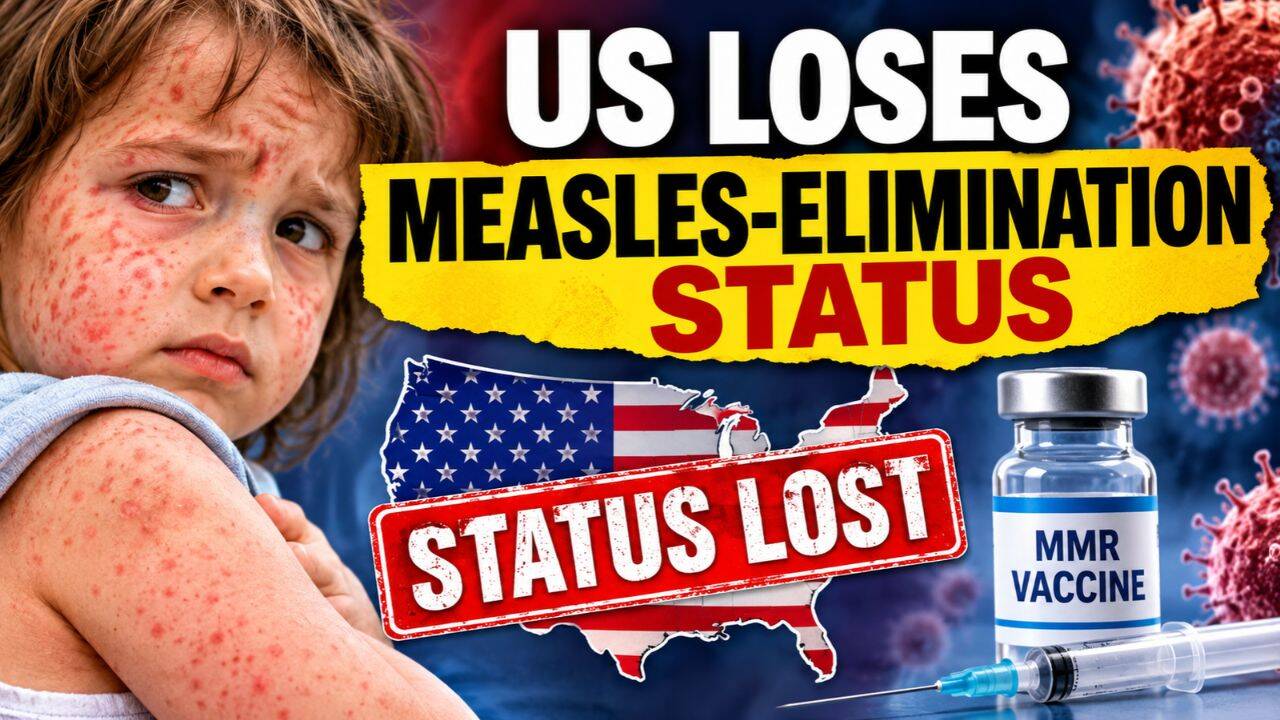
The revocation of measles-free status in the United States after twenty-six years represents a systemic failure of epidemiological containment rather than a sudden biological mutation. Achieving elimination status in 2000 required interrupting endemic transmission—defined by the World Health Organization as continuous chain transmission of a single viral strain for twelve months or longer within a defined geographic area. Reversing that milestone demonstrates that national immunity thresholds have fractured at the local level, transforming an imported pathogen into a self-sustaining domestic vector. Understanding this breakdown requires examining the mathematical mechanics of herd immunity, the behavioral economics of vaccine hesitancy, and the structural vulnerabilities of decentralized public health infrastructure.
The Mathematics of Herd Immunity Erosion
Measles operates at the extreme upper bound of human viral transmissibility. Epidemiologists measure baseline contagiousness using the basic reproduction number ($R_0$), which represents the average number of secondary infections generated by a single infected individual in a completely susceptible population. While seasonal influenza exhibits an $R_0$ between 1 and 2, and early variants of SARS-CoV-2 ranged between 2 and 3, the measles morbillivirus maintains an $R_0$ between 12 and 18.
This biological reality dictates a narrow margin for error in population-level immunization. The herd immunity threshold ($HIT$) is calculated using the standard epidemiological formula:
$$HIT = 1 - \frac{1}{R_0}$$
Substituting the conservative lower bound ($R_0 = 12$) yields a required immunity threshold of 91.7 percent. Substituting the upper bound ($R_0 = 18$) pushes that requirement to 94.4 percent. Because the two-dose Measles, Mumps, and Rubella (MMR) vaccine provides roughly 97 percent efficacy rather than absolute sterilizing immunity in 100 percent of recipients, the actual population vaccination coverage required to prevent sustained transmission hovers precisely at 95 percent.
Standard reporting often obscures this vulnerability by relying on national or state-level averages. An aggregate statewide vaccination rate of 95.2 percent appears compliant on a dashboard, yet infectious disease transmission is governed by local network topology, not macro averages. When unimmunized individuals cluster geographically, socially, or institutionally, they create localized pockets where the effective reproduction number ($R_e$) surges well above 1.0.
Within a school district or insular community where MMR coverage drops to 82 percent, the pathogen encounters dense, uninterrupted chains of susceptible hosts. Once an index case is introduced via international travel—the primary mechanism of viral entry—transmission accelerates exponentially before contact tracers can isolate primary and secondary exposures.
The Four Pillars of Containment Failure
Transitioning from isolated outbreaks to the loss of elimination status requires multiple concurrent failures across the public health apparatus. Four distinct operational bottlenecks drive this regression.
Hyper-Local Clustering and Non-Medical Exemptions
State-level policy shifts allowing philosophical or expanded religious exemptions directly correlate with geographic clustering. Unlike medical exemptions, which are distributed somewhat randomly across a population based on genetic or clinical contraindications, non-medical exemptions concentrate along ideological and social networks. Schools with exemption rates exceeding 5 percent act as epidemiological amplifiers, incubating outbreaks that subsequently spill over into adjacent communities, affecting infants too young for their first MMR dose (typically administered at 12 to 15 months) and immunocompromised individuals who rely entirely on community-level protection.Delayed Clinical Recognition
Twenty-six years of elimination created a generational blind spot in clinical diagnostics. Most practicing physicians, urgent care providers, and emergency room staff trained during the post-2000 era have never evaluated an active measles case in person. Early-stage measles presents with a prodromal phase—high fever, cough, coryza, and conjunctivitis—that mimics routine viral upper respiratory infections. The pathognomonic Koplik spots inside the buccal mucosa and the classic maculopapular rash appear days later. Because measles is airborne and remains viable in airspace for up to two hours after an infected patient departs, a single undiagnosed patient sitting in a poorly ventilated clinic waiting room generates dozens of secondary exposures before clinical suspicion triggers isolation protocols.Asymmetric Information and Risk Mispricing
Public health communication relies heavily on statistical risk reduction, a framework poorly suited to human cognitive biases. In the absence of visible disease prevalence, the perceived risk of the pathogen approaches zero. Individuals evaluating the MMR vaccine then weigh a perceived zero-risk disease against amplified, often fabricated narratives regarding vaccine adverse events. In behavioral economics, this represents severe availability bias and omission bias—preferring a passive risk (contracting a rare disease) over an active risk (administering a medical intervention). Traditional public health messaging that merely repeats population-level safety statistics fails to correct this individual risk-miscalculation.Decentralized Surveillance Latency
The United States operates a federated public health system where authority and funding are fractured across federal agencies, fifty state health departments, and over three thousand county or municipal jurisdictions. Real-time genomic sequencing and contact tracing require interoperable data pipelines. When an outbreak crosses county or state lines, manual data handoffs, incompatible electronic health record systems, and chronic underfunding of local epidemiology teams create a latency window. If contact tracing lags behind the measles incubation period (averaging 10 to 14 days from exposure to rash onset, with infectiousness beginning four days prior to rash appearance), containment shifts from proactive ring vaccination to reactive damage control.
The Economic Cost Function of Outbreak Response
Evaluating measles resurgence strictly through morbidity and mortality metrics misses the massive operational and financial drain imposed on healthcare systems. While measles carries a case fatality rate of roughly 1 to 3 per 1,000 cases in high-income nations—alongside severe complications such as encephalitis and subacute sclerosing panencephalitis (SSPE)—the immediate systemic shock is financial and logistical.
Containing a single confirmed measles case requires massive resource reallocation. Local health departments must immediately deploy investigators to map every location the patient visited during their four-day pre-rash infectious window. This entails notifying hundreds or thousands of exposed individuals, verifying immunization records, administering post-exposure prophylaxis (either the MMR vaccine within 72 hours of exposure or immunoglobulin within six days for high-risk individuals), and enforcing 21-day home quarantines for susceptible contacts.
Published health economics analyses consistently demonstrate that public health expenditures for containing even a moderate outbreak of 50 to 100 cases routinely exceed several million dollars in direct personnel hours, laboratory testing, and emergency clinic operations. Hospitals face acute staffing shortages when exposed healthcare workers without documented immunity must be furloughed for three weeks. Every dollar diverted to reactive outbreak containment is stripped from preventative primary care, chronic disease management, and routine immunization outreach, creating a negative feedback loop that further weakens baseline public health resilience.
Systemic Vulnerabilities in Current Mitigation Strategies
Standard institutional responses to declining vaccination rates—such as broad public service announcements, school exclusion mandates, and provider reminders—contain inherent structural limitations that blunt their effectiveness during an active resurgence.
- The Backfire Effect of Coercive Mandates: Tightening school immunization laws by eliminating non-medical exemptions reliably increases aggregate vaccination rates in the short term. However, without parallel community engagement, strict mandates can drive vaccine-hesitant families out of traditional public and private school systems entirely, accelerating the growth of unregulated homeschooling cooperatives. This maneuver removes children from state tracking registries while preserving the exact same physical clustering during extracurricular and social activities, rendering the epidemiological risk invisible to health authorities until an outbreak erupts.
- Limitations of Ring Vaccination in High-Density Environments: Ring vaccination—immunizing all susceptible contacts around a confirmed case—successfully eradicated smallpox because smallpox has a slower transmission cycle and patients are not infectious until the rash appears. Measles defeats pure ring vaccination strategies because viral shedding occurs four days before the rash manifests. By the time a case is diagnosed and reported, the index patient has already seeded a second generation of infections.
- Static Record-Keeping: State Immunization Information Systems (IIS) often suffer from opt-in requirements, incomplete reporting from adult pharmacies, and a lack of interstate data sharing. When an outbreak hits a transient or interstate population, clinicians cannot rapidly verify immunity status, forcing health departments to treat individuals with unverified records as entirely susceptible, multiplying quarantine enforcement costs.
Strategic Restructuring for Containment Restoration
Reversing endemic transmission and reclaiming measles-free status requires abandoning passive awareness campaigns in favor of targeted epidemiological engineering and operational reform. Public health authorities and healthcare systems must execute four specific structural interventions.
First, reporting metrics must shift from state and county averages to hyper-local, school-level and census-tract vulnerability indexing. Health departments should publish granular, anonymized immunity heatmaps that identify specific institutions falling below the 92 percent critical threshold. Resources—including mobile vaccination clinics and targeted pediatric outreach—must be allocated strictly according to localized network risk rather than per-capita population formulas.
Second, healthcare networks must hardcode diagnostic alerts into Electronic Health Record (EHR) systems. Intake triage software at urgent care centers and emergency departments should automatically flag any patient presenting with the triad of fever, cough, and conjunctivitis—particularly if paired with recent domestic outbreak proximity or international travel—triggering immediate negative-pressure airborne isolation prior to physician evaluation.
Third, states must standardize and automate Immunization Information Systems through mandatory interstate interoperability agreements and opt-out reporting frameworks. Eliminating data friction allows emergency responders to verify population immunity in real time during an exposure event, cutting quarantine overhead and focusing post-exposure prophylaxis strictly on verified susceptible hosts.
Fourth, clinical communication protocols must transition from broad statistical reassurance to motivational interviewing led by trusted local primary care providers. Data consistently shows that hesitant parents reject institutional mandates but respond to personalized risk assessments delivered by their child's pediatrician. Healthcare payers and hospital systems must reimburse clinicians for the extended consultation time required to conduct structured vaccine counseling, treating hesitancy mitigation as a billable, high-value preventative procedure rather than an uncompensated administrative burden.