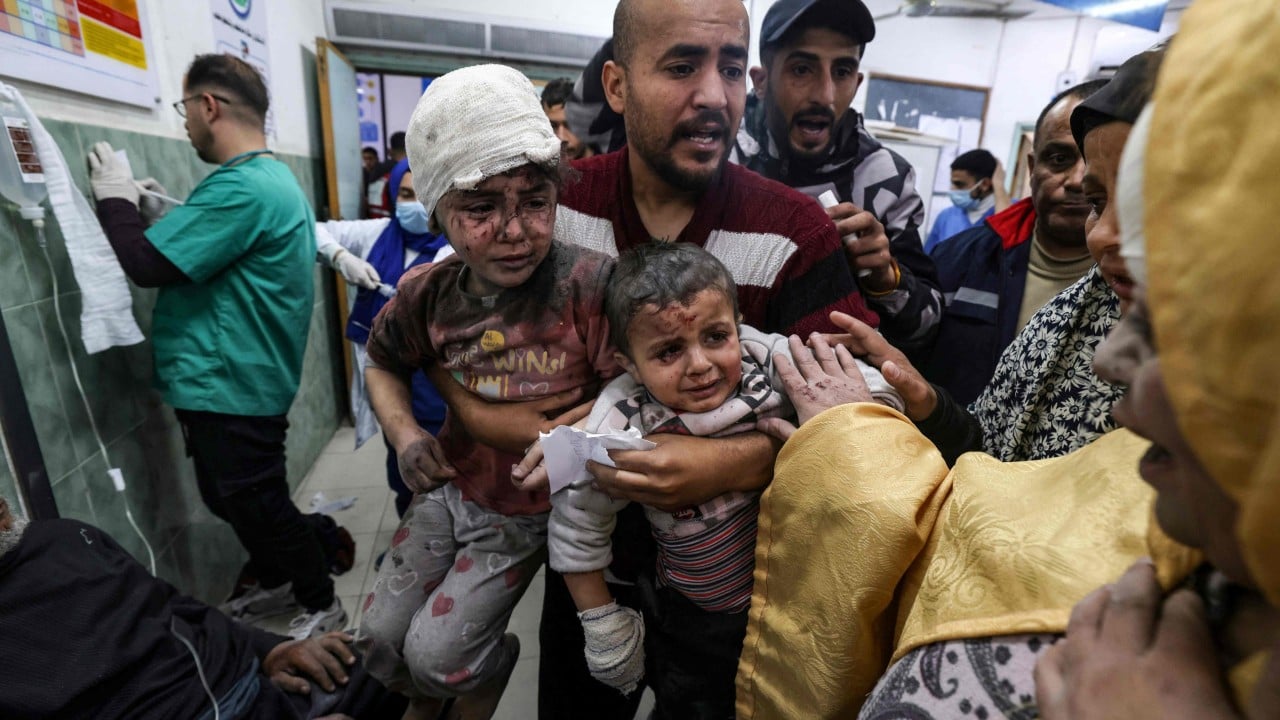
The assessment of modern urban warfare requires a shift away from qualitative rhetoric toward quantitative structural analysis. On June 23, 2026, the UN Independent International Commission of Inquiry on the Occupied Palestinian Territory and Israel released a definitive report alleging that Israeli authorities and security forces have deliberately targeted Palestinian children, defining these actions as foundational to the crime of genocide, crimes against humanity, and war crimes. To evaluate the validity of these findings, analysts must strip away political posture and examine the operational methodologies, weapon deployment choices, and demographic data that underpin the commission’s conclusions.
The core argument of the UN commission rests on an inferential bridge: that the sheer scale, proportion, and execution patterns of child casualties cannot be mathematically explained as incidental collateral damage. Instead, the report establishes a framework linking tactical choices to strategic intent. The analysis that follows unpacks the mechanisms of this conflict across three distinct analytical pillars: demographic asymmetry, kinetic weapon mechanics, and systemic infrastructural degradation.
The Micro-Targeting Framework and Tactical Injury Patterns
The first layer of the commission’s findings transitions from broad statistics to localized, tactical evidence. The report asserts that Israeli security forces directly and intentionally targeted individual children across the Gaza Strip. The critical variable in this assessment is the documented use of precision systems—specifically sniper rifles, specialized surveillance drones, and quadcopters—capable of clear visual target identification.
The mechanism of proof relies on localized injury patterns. Incidental casualties from wide-area artillery or airstrikes present as blast injuries, fragmentation trauma, or crushing injuries from structural collapse. Conversely, the commission documented a recurring pattern of precision gunfire injuries among children, including instances where individuals were shot while holding white flags, situated within designated safe zones, or gathered at humanitarian distribution sites.
From an operational standpoint, the deployment of sniper assets and low-altitude quadcopters requires a strict chain of command and positive target identification before a kinetic strike is authorized. The presence of precision-guided, small-arms trauma on pediatric populations creates a severe logical contradiction for defense frameworks that attribute all civilian deaths to the proximity of non-state combatants. When a weapon system requires visual confirmation of the target’s silhouette prior to firing, the resulting casualty profile shifts from an unintended side effect of area-denial tactics to a calculated tactical output.
Kinetic Weapon Mechanics and Demographic Density
The second pillar of the analysis examines the relationship between ordinance selection and the demographic reality of the operational environment. The UN inquiry highlights that between October 7, 2023, and October 7, 2025, at least 20,179 children were killed in Gaza, comprising approximately 30% of the overall documented death toll of over 72,800.
To determine whether these numbers indicate deliberate intent, the report establishes a historical baseline. During the military operations in Gaza in 2008–2009 and 2014, children accounted for roughly 24% of conflict-related fatalities. The 6% upward variance in the current conflict serves as a critical metric. The commission argues that this escalation is driven by a deliberate operational decision to maintain the use of high-payload munitions and wide-area effect weapons within highly congested residential zones despite a proven, compounding curve of pediatric casualties.
The physics of wide-area munitions in urban centers dictate predictable casualty distributions. When a high-explosive payload is detonated in a high-density sector, the radius of lethal overpressure and fragmentation expands across entire residential blocks. The demographic structure of the Gaza Strip features an exceptionally young median age, meaning that any non-discriminate or wide-area strike holds a mathematically high probability of striking children.
The commission uses this causal loop to establish legal intent. The operational logic proceeds as follows:
- The actor deploys a weapon with a known, fixed radius of destruction.
- The actor possesses precise demographic data indicating a high concentration of children within that radius.
- The actor executes repeated strikes over a prolonged timeline, observing an unchanging or escalating ratio of child deaths.
- The continuation of this specific weapon-target pairing, despite real-time statistical feedback of pediatric mortality, indicates that the resulting death toll is a tolerated, if not intended, structural component of the military campaign.
The report suggests that this operational tolerance stems from a collective targeting paradigm. The evidence implies that Israeli security forces operated under a framework where the civilian population as a whole was categorized as structurally associated with Hamas and other armed factions, effectively removing the tactical requirement for individual combatant verification.
Systemic Degradation of Biological Continuity
Beyond direct kinetic engagement, the UN inquiry introduces a structural model detailing how the manipulation of living conditions functions as a mechanism to compromise the long-term survival of a population group. This strategy targets what the report terms the "biological continuity and future existence" of the society.
This mechanism operates through three distinct vectors:
- Nutritional and Medicinal Blockades: The systematic restriction of incoming aid, food, and essential pharmaceuticals creates a baseline of artificial scarcity. In pediatric populations, acute nutritional deprivation triggers rapid physiological decline, leading to preventable mortality from otherwise manageable infections.
- The Destruction of Healthcare Infrastructure: Targeted operations against healthcare, maternity, and neonatal facilities directly interrupt critical reproductive and early-stage survival systems. The commission documented an escalating rate of miscarriages and neonatal mortality driven by the total lack of functional incubators, medical oxygen, and clean water supplies in targeted hospitals.
- Decoupling Educational Frameworks: The intentional destruction of more than 97% of educational facilities in Gaza systematically halts the transfer of knowledge and structural socialization, ensuring the institutional erasure of childhood long after kinetic operations cease.
This multi-faceted degradation alters the demographic trajectory of the population. The commission notes that the combination of thousands of amputees and permanently maimed minors has transformed pediatric disability into a permanent demographic feature of the society. By systematically targeting the youngest cohort, the operational framework erodes the foundational vitality and future reproductive and economic capacity of the entire social unit.
The West Bank Counter-Inquiry and Detention Metrics
The legal and analytical weight of the commission's findings is further reinforced by a comparative analysis of the occupied West Bank, including East Jerusalem. Here, the operational context differs significantly from Gaza; there are no active, high-payload aerial bombardments, yet the pattern of child targeting remains statistically consistent.
The report identifies a sharp increase in lethal force used against children in the West Bank, particularly targeting boys. According to the inquiry, Israeli soldiers routinely apply lethal force against young males based primarily on their demographic profile—specifically their gender and Palestinian identity—under a generalized label of potential combatants.
Furthermore, the documentation of systemic mistreatment inside military detention centers provides clear evidence of institutionalized policy rather than rogue behavioral variance. The inquiry compiled evidence of prolonged blindfolding, forced stripping, severe beatings, food and water deprivation, sleep deprivation, and targeted physical abuse directed at the head, face, and genitals of detained children.
Because these actions occur within controlled administrative environments—far removed from the immediate chaos or split-second decision-making of active firefights—they serve as a clear indicator of institutional intent. The standardized application of these techniques across multiple detention facilities points directly to an established administrative framework and an implicit or explicit chain of command authorizing the physical and psychological breakdown of the youth demographic.
Strategic Realities and Defense Counter-Arguments
A rigorous analysis requires evaluating the structural defenses presented against the commission's findings. The state of Israel has formally rejected the report, labeling it a defamatory, libelous sham that deliberately ignores the tactical realities of the conflict.
The core of the counter-argument rests on the doctrine of asymmetric human shielding. The Israeli military framework asserts that non-state armed groups, specifically Hamas, intentionally embed their command infrastructure, weapons depots, and defensive positions within civilian nodes—including private homes, hospitals, schools, and mosques. Under this framework, the high ratio of child casualties is defined as a direct consequence of an adversary's defensive architecture designed to exploit international legal protections.
However, the analytical limitation of the human-shielding defense lies in its application to proportionality calculations. International humanitarian law dictates that even when an adversary unlawfully positions military assets within a civilian structure, the attacking force remains bound by the rule of proportionality: the anticipated civilian harm must not be excessive in relation to the concrete and direct military advantage expected.
The UN commission’s data directly challenges the execution of this balance. If an operational strategy consistently accepts a 30% pediatric mortality rate over a multi-year timeline, the strategic value of individual tactical targets must be weighed against the cumulative structural destruction of the civilian fabric. The report's findings imply that the scale of the civilian toll effectively invalidates the defense of localized proportionality, indicating that target selection and risk-tolerance parameters were calibrated to achieve broader, non-military demographic outcomes.
Geopolitical Implications and Policy Deficits
The publication of this inquiry alters the international legal and diplomatic landscape. While the commission does not possess direct enforcement powers, its findings serve as an authoritative repository of verified evidence designed to feed directly into international judicial mechanisms, including the International Criminal Court and the International Court of Justice.
For external state actors, particularly western security partners providing material military assistance, these findings create a severe compliance bottleneck. The documentation of systematic child targeting and structural genocidal intent triggers domestic and international legal obligations regarding arms transfer controls. Continued provision of high-payload munitions or precision tracking technologies in the face of documented, systemic violations exposes supplier states to credible accusations of legal complicity in war crimes.
Consequently, diplomatic containment strategies that rely on calling for internal military investigations are losing structural viability. The systemic nature of the findings—ranging from sniper activity in designated safe zones to administrative torture in detention camps—points to a centralized policy rather than isolated tactical failures. This reality will force international actors to shift from passive monitoring to active economic and legal interventions to decouple their supply chains from verified violations of international law.


