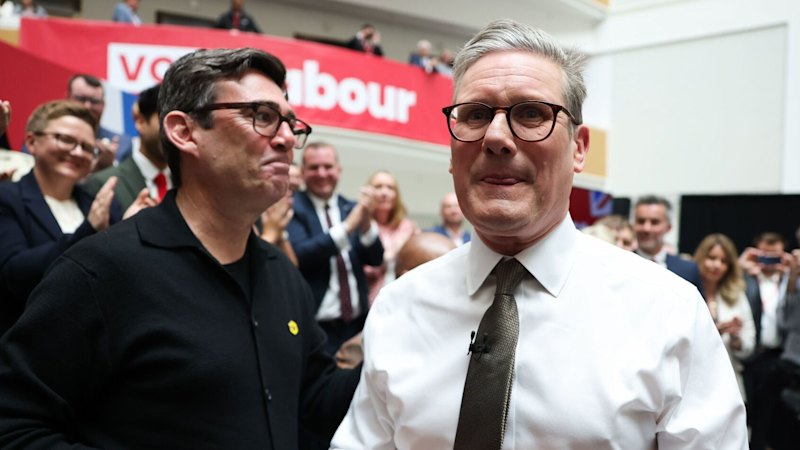
Keir Starmer didn't just pack his bags and slip out the back door of Downing Street. He left a ticking time bomb on the desk for his likely successor. As Andy Burnham prepares his pitch to take over a fractured Labour Party and a country exhausted by a revolving door of prime ministers, he isn't walking into a fresh start. He is walking straight into a meticulously constructed political corner.
Starmer’s sudden resignation has thrown British politics into another tailspin. If Burnham takes the crown, he inherits a poison pill masquerading as a legacy project. It’s a double-edged trap. On one side, Starmer’s eleventh-hour Defence Investment Plan binds the next government to massive spending commitments that Burnham's traditional left-wing allies despise. On the other side, Donald Trump is already waiting in the Oval Office, sharpening his knives and labeling the prospective British leader "extremely liberal" before Burnham has even won a Westminster seat.
Burnham thinks he can rebuild Britain from the regions up. The reality is that his premiership might be broken by global forces before it even begins.
The Defense Spending Noose Left by Starmer
Before announcing his exit, Starmer spent his final days ensuring his vision for national security couldn't easily be undone. The Defence Investment Plan wasn't just a routine policy update. It was a deliberate effort to lock down the UK's military trajectory at a time when the treasury is running on fumes.
By locking in strict defense commitments, Starmer did something clever and brutal. He protected his own legacy as a leader who stood firm on national security, especially after the bruising fallout from the recent conflict in Iran. But for Burnham, this plan is a fiscal straitjacket.
If Burnham keeps the plan, he starves the domestic projects that form the core of his political identity. His brand is built on radical devolution, fixing public transport, and rescuing the National Health Service. You can't fund a regional renaissance when billions are legally locked into military procurement. If he scraps or scales back the defense plan, he looks weak. The right-wing press will tear him apart, and he will immediately alienate the armed forces faction within his own party. Al Carns, the former armed forces minister who resigned over defense spending concerns, represents a faction that is ready to rebel if Labour softens its stance on military funding. Burnham is trapped between satisfying his domestic base and maintaining the state's core security commitments.
Trump Is Already Setting the Terms of the Showdown
While Burnham tries to navigate the internal wreckage in London, the real threat is watching from across the Atlantic. Donald Trump didn't waste any time making his feelings known. Speaking from the Oval Office alongside NATO Secretary General Mark Rutte, Trump gave a scathing assessment of Britain’s prospective leader.
Trump claimed he heard Burnham is "extremely liberal" and immediately weaponized the UK's energy policy. The US president made it clear that he expects Britain to open up the North Sea for aggressive oil and gas drilling. Starmer's refusal to do so had already soured relations with Washington, with Trump posting on Truth Social that Starmer had failed badly on energy and calling him "no Winston Churchill."
Now, Trump is projecting that same hostility onto Burnham. The relationship between a Burnham-led UK and a Trump-led US starts in the negatives. Burnham has a history of speaking out against the current American president. Back during the Capitol riots in 2021, Burnham stated online that any British politician who gave Trump the time of day should be ashamed. Last year, he openly criticized Trump for bringing instability to the world.
You can't erase those statements when you're sitting opposite the most vindictive president in modern history. Trump views international relations through a lens of personal loyalty and transactional politics. He already views Burnham as an adversary.
The North Sea Energy Dilemma
The first major flashpoint won't be diplomatic small talk. It will be the North Sea. Trump’s obsession with fossil fuels clashes directly with the green transition goals that the Labour mainstream has championed.
Burnham has spent years cultivating an image as a politician who listens to working-class communities, many of which rely on traditional industrial jobs. Recently, he started shifting his stance, signaling that he doesn't have a fixed position on North Sea oil and gas production. It was a pragmatic move to avoid being completely boxed in by Trump’s demands.
But playing both sides won't work for long. If Burnham bows to Washington's pressure and greenlights massive new drilling projects, he faces an immediate mutiny from the climate-conscious wing of the Labour Party. If he stands firm and blocks the drilling, Trump has plenty of ways to make Britain pay. A US-UK trade deal is already dead in the water, and Washington can easily deprioritize intelligence sharing or economic cooperation. Britain's economy is fragile. A prolonged economic cold war with its biggest ally is a luxury the country simply can't afford.
Can the King of Devolution Rule Westminster
Burnham's entire modern political identity is tied to being the King of the North. As Mayor of Greater Manchester, he successfully ran a campaign of being the outsider fighting against a broken, London-centric elite. He even co-wrote a book arguing that British politics has become polarized and poisonous because Westminster neglects ordinary communities.
Shifting that outsider energy into Downing Street is an entirely different game. When you're the prime minister, you are the elite. You can't blame Whitehall for your problems when you hold the keys to the building.
Burnham’s plan to shift parts of Number 10’s operations to Manchester sounds great on paper. It plays well with voters who feel left behind. In practice, it threatens to alienate the traditional civil service mechanisms required to run the country during a time of international crisis. You can't manage a volatile diplomatic standoff with Washington or handle the fallout from the Iran war if your administration is fragmented geographically and culturally.
The Broken Relationship with NATO and Washington
The geopolitical reality facing the next prime minister is grim. The US administration is deeply disappointed with its European allies. Trump and his Defense Secretary, Pete Hegseth, have openly scolded European nations for their lackluster support during the Iran conflict, calling their refusal to allow US access to joint military bases shameful.
Starmer managed to keep a lid on total diplomatic collapse by keeping his head down and avoiding public spats. Burnham doesn't have that luxury. He inherits a relationship that is fundamentally fractured. NATO is under intense pressure, and Trump is using every opportunity to demand that European nations pay up or lose American protection.
Burnham will have to face a White House that doesn't care about his domestic social programs. If Trump demands British military compliance or specific economic concessions, Burnham’s instinct to protect local communities will collide with the harsh demands of global realpolitik. He cannot afford to look like an American puppet to his voters, yet he cannot survive as an international outcast.
How Burnham Can Navigate the Minefield
The path ahead is incredibly narrow, but it isn't completely impossible. If Burnham wants to survive his first six months in office, he needs to drop the idealistic outsider rhetoric and adopt a cold, transactional approach to governing.
First, he has to address the defense spending trap. Instead of fighting Starmer’s investments, he needs to reframe them. He should tie military manufacturing directly to his regional economic plans. If defense billions must be spent, they should be spent building naval ships in Scottish yards or manufacturing armored vehicles in the North of England. That satisfies the security hawks while delivering the domestic jobs he promised.
Second, he needs a strategy for Trump that goes beyond ideology. Trump respects strength and transactional benefits. Burnham should stop apologizing for past comments and instead focus entirely on sectors where the US needs British cooperation, such as artificial intelligence regulation and Atlantic security policing. He needs to find a middle ground on the North Sea, perhaps allowing limited extraction under the guise of national energy security while keeping long-term green targets intact.
The honeymoon period for the next prime minister will last about five minutes. Starmer’s parting gifts and Trump’s early hostility mean that Burnham will be fighting for his political survival from day one.