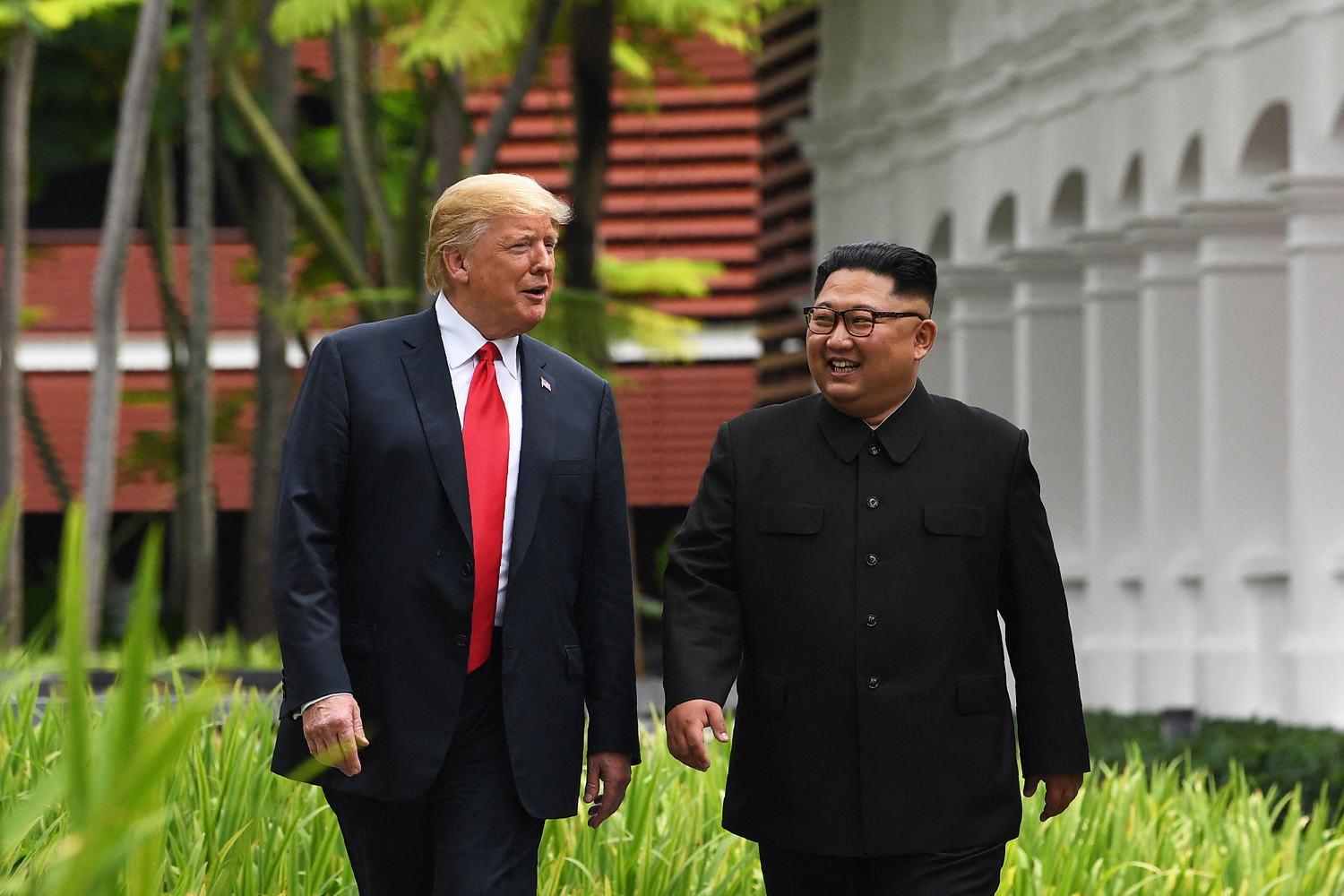
Foreign policy pundits love a good photo-op. The lazy consensus in Washington and Seoul is that personal chemistry solves geopolitical standoffs. If Donald Trump sits across a mahogany table from Kim Jong Un again, the narrative goes, we will somehow rewind to the Singapore or Hanoi summits and magically unlock a breakthrough on denuclearization.
It is a comforting delusion for diplomats who prefer optics over outcomes.
I have watched decades of bureaucratic hand-wringing fail to shift the needle on the Korean peninsula by even a millimeter. Every time a leader floats a high-level summit as a quick fix, the foreign policy establishment falls over itself analyzing tie lengths, handshake angles, and venue aesthetics. They miss the brutal reality. Pyongyang does not care about your charm offensive. They care about survival, sanction relief, and cementing their status as a de facto nuclear weapons state.
Another summit right now would not be a bold diplomatic stroke. It would be a catastrophic strategic gift to the Kim regime.
The Myth of Personal Diplomacy
We need to dismantle the core myth driving this entire conversation. The belief that Donald Trump and Kim Jong Un share a special bond capable of bypassing decades of structural hostility is pure fantasy. Personal rapport does not alter state incentives.
Look at what happened after the 2018 Singapore summit. The handshake happened. The joint statement was signed. The cameras flashed. And what did North Korea actually give up? Exactly zero warheads. Zero grams of enriched uranium. Zero inspection rights.
Instead, the Kim regime gained something infinitely more valuable than material concessions. They secured international legitimacy. They got a US president to treat the supreme leader of an isolated, impoverished pariah state as an equal across a global stage. Dictators trade on imagery. By showing up to these summits without prior, verifiable working-level agreements, Washington handed Pyongyang a massive propaganda victory for domestic consumption.
Diplomacy without preconditions is not strength. It is desperation. When you chase a meeting for the sake of the headline, you signal to your adversary that you want an agreement more than they do. That is negotiation suicide.
What the Pundits Get Wrong About Leverage
The mainstream media framing always centers on a simple question: Will Trump agree to meet Kim this year?
That is the wrong question entirely. It assumes that the primary friction point in US-North Korea relations is executive willpower. It frames the lack of talks as a failure of imagination or courage on the part of American leadership.
The real question is entirely different. What leverage does Washington retain after years of maximum pressure, strategic patience, and high-stakes summits, and how can any future meeting extract actual concessions rather than empty promises?
The hard truth is that our leverage has eroded. North Korea’s nuclear program is vastly more advanced today than it was a decade ago. They have perfected miniaturized warheads, diversified their delivery systems with solid-fuel intercontinental ballistic missiles, and deepened strategic military ties with Moscow and Beijing. Pyongyang is no longer isolated in the same way. They have a sanctions-evading economic lifeline running right through Russia and China.
When your adversary has a geopolitical safety net and an expanding nuclear arsenal, a summit does not pressure them. It rewards them.
The Nuclear Reality Check
Let us define terms precisely, because the political discourse is drowning in fuzzy language.
Denuclearization does not mean a freeze on future testing. It does not mean a moratorium on long-range missile launches while short-range capabilities keep expanding. Real denuclearization means complete, verifiable, and irreversible dismantlement of the entire nuclear infrastructure.
North Korea has made it explicitly clear through constitutional amendments and public statements that they will never give up their nuclear weapons. Their entire national security doctrine is built around the deterrent value of the bomb. They watched what happened to Muammar Gaddafi in Libya after he surrendered his nuclear program. They drew the obvious conclusion.
If you walk into a summit pretending that Kim Jong Un is one good conversation away from abandoning the cornerstone of his dynasty’s survival, you are either dangerously naive or willfully blind.
Imagine a scenario where Trump flies to Panmunjom or Pyongyang tomorrow, signs another vague framework agreement, and declares victory. North Korea pockets the PR win, agrees to freeze a secondary facility they can easily rebuild in secret next month, and pockets sanctions relief in the process. Meanwhile, our regional allies in South Korea and Japan are left exposed to an emboldened nuclear state that has successfully decoupled bilateral engagement from actual security guarantees.
The Cost of the Photo-Op
There is a severe opportunity cost to high-level vanity diplomacy. Every hour spent prepping for a summit that yields no structural disarmament is an hour diverted from actual, grinding security management.
Real deterrence is boring. It looks like integrated air defense exercises with Seoul. It looks like naval deterrence patrols in the Sea of Japan. It looks like rigorous, unglamorous enforcement of maritime sanctions by multi-national coalitions interdicting ship-to-ship transfers in the dark of night.
It does not look like reality television diplomacy.
My contrarian approach has a massive downside: it is deeply unpopular with voters and leaders who crave immediate, cinematic resolutions. People want to believe that a single strongman can wave a magic wand and solve a seventy-year geopolitical knot over dinner. Admitting that some problems cannot be solved with a charismatic handshake requires a tolerance for chronic, low-grade tension that modern political cycles simply cannot stomach.
We need to stop treating summits as a strategy. A summit is the result of a successful strategy, not a substitute for one. Until working-level negotiators can hammer out verifiable, step-by-step concessions in secret, any leaders' meeting is just expensive theater.
Stop pushing for the handshake. Start demanding the inventory.