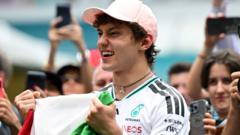
Kimi Antonelli did not "step up" in any meaningful sense. He simply stopped drowning.
The racing media is currently obsessed with a narrative of redemption and rapid evolution. They see a teenager winning a couple of races in Formula 2 and scramble to declare him the second coming of Max Verstappen. It is a predictable cycle. The "lazy consensus" dictates that if a protégé struggles and then wins, they have undergone a profound internal transformation. They haven't. They’ve just finally encountered a set of variables that didn't actively sabotage them.
The truth about Antonelli’s season is far more cynical and much more interesting than the "hero’s journey" fluff being peddled by broadcasters. We are witnessing the byproduct of a broken feeder system and a Mercedes junior program that is gambling its entire reputation on a single roll of the dice.
The Myth of the "Level Up"
In high-performance motorsport, drivers do not suddenly find half a second per lap because they "believed in themselves" more on a Sunday morning. Speed is a constant; access to that speed is the variable.
When you look at the data from the early rounds of the season, Antonelli wasn’t slow. He was busy. He was skipping the traditional ladder, jumping from Formula Regional (FRECA) directly into a turbocharged, high-degradation tire environment in F2. The car was new to everyone, but the Prema team—traditionally the powerhouse of the paddock—completely missed the setup window for the first third of the year.
To say Antonelli "stepped up his level" implies the deficit was his fault. It wasn't. The car was a tractor. When the engineering staff finally stopped chasing their tails and gave him a platform that didn't overcomplicate every corner entry, the natural pace reappeared. That isn't a "dramatic step up." It’s the restoration of the status quo.
The Verstappen Comparison is Poison
Everyone is looking for the next lightning strike. Because Max Verstappen jumped from F3 to F1 and succeeded, the industry has convinced itself that this is the only way to identify "elite" talent.
This is a survivorship bias at its most dangerous. For every Verstappen, there are ten drivers whose careers were incinerated because they were pushed into the kiln before they were dry. By skipping F3, Antonelli missed a year of learning how to manage complex aerodynamics without the overwhelming weight and power of an F2 car.
Mercedes isn't doing this because they think it's the best way to develop a driver. They are doing it because they missed out on Verstappen years ago and the FOMO (Fear Of Missing Out) is driving their technical department. They are trying to manufacture a prodigy to soothe a decade-old bruise.
If you want to know why the feeder series feels so volatile right now, look at the pressure. When a team principal like Toto Wolff mentions a kid's name in every second interview, the objective isn't development. It's marketing.
The Prema Problem
We need to talk about the "Prema tax." For years, winning with Prema was the baseline. If you didn't win there, you were a bust.
This year, the field leveled out. The new chassis (F2 2024) stripped away the legacy data advantage that the big teams relied on. Suddenly, the "superstars" looked human. The fact that Antonelli struggled early on proves that his previous dominance was at least partially a result of being in the best seat in lower categories.
When the equipment advantage vanished, he looked like what he is: a very talented, very green sixteen-year-old. The recent "uptick" in performance coincided exactly with Prema finding a proprietary dampening solution that smoothed out their ride quality. Is it Antonelli "finding another gear," or is it just the engineers finally reading the manual?
The Data Doesn't Lie, But People Do
Look at the qualifying gaps. In the rain—the great equalizer—Antonelli is exceptional. That is raw talent. Nobody disputes that.
But look at the tire management in the long runs during the mid-season. He was still hemorrhaging time to veterans like Hadjar and Bortoleto. A "dramatic step up" would involve mastering the Pirelli cliff, which is the steepest learning curve in racing. He hasn't mastered it. He is still burning through his rears four laps too early because his inputs are still tuned for the lighter, more forgiving FRECA machinery.
The media ignores this because "Youngest Winner Ever" is a better headline than "Driver Still Struggles with Thermal Degradation in Sector 3."
The Danger of the Silver Arrows Seat
Let’s be brutally honest about the 2025 Mercedes seat. Putting Antonelli in that car isn't an act of confidence; it's a desperate hedge.
If he succeeds, Wolff looks like a genius. If he fails, they blame his age and "the process." Meanwhile, a driver like Carlos Sainz—a proven, consistent race winner—was left on the sidelines of that conversation for months because he isn't a "shiny new toy."
We have entered an era where "potential" is valued more than "performance." It is the venture capital-ification of Formula 1. Teams would rather overpay for a 10% chance at a unicorn than invest in a 90% chance at a workhorse.
The Actual Lesson
If you’re watching Antonelli and seeing a finished product, you’re being sold a lie. You’re seeing a raw, incredibly fast, but fundamentally unfinished driver being used as a pawn in a larger corporate narrative.
The "dramatic fashion" the competitor article mentions isn't about the racing. It’s about the optics. It’s about ensuring the sponsors stay excited while the main F1 team spends years trying to figure out why their floor keeps bouncing.
Stop asking if Antonelli is "ready." He isn't. Nobody is at seventeen. The real question is whether Formula 1 has become so obsessed with finding the next freak of nature that it has forgotten how to actually build a professional athlete.
The "step up" was a return to the mean. The real test hasn't even begun, and when the walls of a Grand Prix circuit start closing in at 200mph with 300 million people watching, "potential" won't save his front wing.
Mercedes isn't building a champion; they're stress-testing a teenager until he either turns into a diamond or cracks. Calling that a "dramatic step up" isn't journalism. It's PR.
Get used to the mid-pack finishes and the rookie errors. They are coming. And when they do, remember that the "level" everyone says he reached was just a peak in a very long, very jagged valley.
Stop buying the hype and start watching the telemetry. The car is faster. The driver is the same.