The commercial harvest of Artemia cysts in the shrinking Aral Sea is not an ecological recovery; it is an extractive arbitrage window created by terminal salinization. As river diversion strips the basin of freshwater, rising salinity eliminates native predators and triggers a temporary biological monoculture that global aquaculture supply chains currently exploit before hyper-salinity extinguishes the resource entirely.
Understanding this phenomenon requires stripping away the narrative of a "miracle" economy and examining the biochemical, economic, and thermodynamic mechanics driving the boom. When an endorheic basin loses its inflow, solute concentration increases inversely to water volume. In the Aral Sea, specifically the remnants of the South Aral Sea in Uzbekistan and the North Aral Sea in Kazakhstan, this contraction crossed a critical biological threshold. Salinity levels surpassed the tolerance limits of predatory fish, leaving behind an ecological vacuum filled exclusively by extremophile invertebrates—most notably the brine shrimp, Artemia parthenogenetica.
The Biological Mechanism of Salinity Arbitrage
To grasp why Artemia populations explode during terminal desiccation, one must look at osmoregulatory physiology and evolutionary survival strategies. Most aquatic organisms fail when ambient salinity exceeds 35 to 40 grams per liter (roughly standard seawater). Artemia, however, possess specialized salt-excreting glands in their phyllopods and gills, allowing them to thrive in hypersaline environments ranging from 60 to 250 grams per liter.
This physiological tolerance creates a two-stage biological shift:
- Trophic Release: As salinity climbs past 50 grams per liter, carnivorous fish species die off. Without top-down predation pressure, Artemia grazing rates on halotolerant microalgae (such as Dunaliella salina) go unchecked, resulting in exponential biomass accumulation.
- Cryptobiotic Encystment: When environmental conditions deteriorate further—specifically when salinity spikes past 150 grams per liter, oxygen levels drop, or temperatures plummet—female Artemia shift from ovoviviparous reproduction (birthing live nauplii) to oviparous reproduction. They produce dormant, chorion-coated embryos known as cysts.
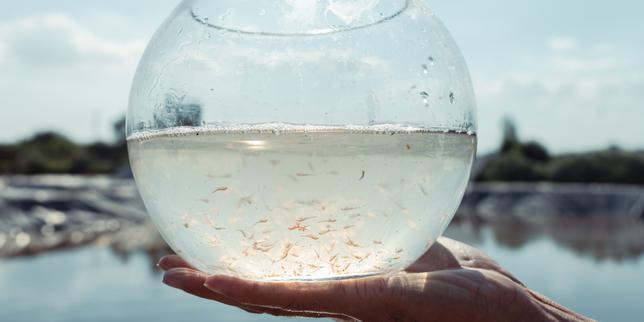
These cysts are the actual commodity driving the Aral Sea economy. In a state of ametabolic dormancy called cryptobiosis, Artemia cysts can survive complete desiccation and extreme thermal fluctuations for years. Wind and wave action concentrate these floating cysts into dense slicks along the receding shorelines, turning a complex biological survival mechanism into a low-cost, surface-level harvesting operation.
Supply Chain Economics and the Aquaculture Bottleneck
Global aquaculture relies heavily on Artemia nauplii (newly hatched larvae) as the primary starter feed for marine fish and crustacean larvae, particularly penaeid shrimp, sea bass, and sea bream. While synthetic micro-diets have advanced, they still fail to match the nutritional profile—specifically the essential fatty acid ratios like EPA and DHA—and the behavioral feeding triggers provided by live, moving prey.
This creates a rigid structural bottleneck in the seafood supply chain. Hatchery output is directly constrained by the global supply of high-grade Artemia cysts. Historically, the global market depended almost entirely on a single geographic chokepoint: the Great Salt Lake in Utah, which supplied upwards of 70 to 90 percent of global demand during peak years.
Single-source dependency introduces severe systemic risk. Environmental fluctuations, droughts, or algal shifts in Utah routinely trigger supply shocks and price spikes across Asian and European hatcheries. The emergence of the Aral Sea as a secondary production hub temporarily alleviated this concentration risk, introducing a new supply vector into a supply-constrained market.
However, the Aral Sea supply operates under fundamentally different economic mechanics than the Great Salt Lake:
- Managed Sustainability vs. Terminal Extraction: The Great Salt Lake fishery is regulated through strict biomass monitoring and quota systems designed to maintain a stable, renewable equilibrium. Conversely, the South Aral Sea is undergoing irreversible desiccation due to upstream water diversion from the Amu Darya river for cotton and agricultural irrigation.
- Zero-Sum Resource Horizon: Because water inflow is structurally diverted, the Aral Sea Artemia fishery is a classic depletable resource masquerading as a renewable biological harvest. Operators are not managing a standing stock; they are racing against complete evaporation.
The Cost Function of Hypersaline Harvesting
From an operational perspective, harvesting cysts in the Aral Sea presents a distinct cost structure compared to traditional maritime or lake fisheries. Capital expenditure (CapEx) for vessel acquisition is minimal because the shrinking, shallow waters restrict large-scale navigation. Instead, the cost function is dominated by labor, logistics, and post-harvest processing.
The extraction workflow breaks down into four distinct operational phases, each carrying specific technical failure points:
- Shoreline Collection: Workers manually scoop cyst biomass from wind-driven accumulations along the mudflats and shallow brine edges. While labor costs in Uzbekistan and Kazakhstan remain low relative to North America, the geographic dispersion of the receding shoreline increases transport friction across unpaved, salt-crusted terrain.
- Brine Washing and Density Separation: Raw harvest contains high volumes of sand, salt crystals, empty shells, and organic debris. Processors wash the biomass in saturated brine solutions to float viable cysts while heavy inorganic contaminants sink.
- Freshwater Rinsing and Dehydration: Before drying, cysts must be briefly rinsed in freshwater to remove surface salt without triggering premature hydration and metabolic activation. If moisture levels remain above 10 percent during storage, cellular respiration begins, depleting the embryo's finite trehalose energy reserves and destroying hatch rates.
- Canning and Vacuum Sealing: Dried cysts are vacuum-packed or nitrogen-flushed into oxygen-impermeable tins to prevent lipid oxidation.
The economic viability of this chain depends entirely on the hatch rate and nauplii size of the final product. Aquaculture hatcheries do not buy cysts by weight alone; they buy viable nauplii per gram. Aral Sea Artemia strains, predominantly parthenogenetic, generally exhibit larger cyst diameters and lower hatching efficiencies compared to the bisexual Artemia franciscana strains from the Great Salt Lake. To compete on the global market, Central Asian exporters must price their product at a discount proportional to its lower hatching yield, compressing profit margins when transport and processing costs rise.
Thermodynamic Limits and the Extinction Horizon
The central flaw in treating the Aral Sea Artemia boom as a long-term regional economic pillar is ignoring basic thermodynamics and water balance equations. The South Aral Sea receives negligible water from the Amu Darya during dry years. Evaporation rates in the Kyzylkum and Karakum deserts exceed 1,000 millimeters annually.
This creates an inescapable ecological trajectory. As water volume drops, salinity does not stabilize; it accelerates upward. While Artemia survive at 200 grams per liter, their reproductive efficiency collapses as metabolic energy is diverted entirely toward osmoregulation. Above 250 grams per liter, the brine approaches saturation for sodium chloride and other salts, leading to mass mortality and the complete cessation of cyst production.
Simultaneously, desiccation exposes the former seabed—now known as the Aralkum Desert—to wind erosion. Dust storms lift millions of tons of salt, heavy metals, and residual agricultural pesticides (such as DDT and lindane from Soviet-era cotton farming) into the atmosphere. When these toxic salt-dust plumes settle back onto the remaining water bodies, they alter water chemistry and degrade the quality of the microalgae Artemia consume, introducing potential bioaccumulation risks into the aquaculture feed chain.
Furthermore, the geopolitical hydrology of Central Asia offers no structural relief for the South Aral Sea. Upstream nations require water for hydropower and agriculture, while Uzbekistan's domestic economy remains tied to water-intensive crops. While Kazakhstan successfully stabilized the smaller North Aral Sea using the Kok-Aral Dam—lowering salinity enough to reintroduce commercial freshwater fish—that exact success eliminated the hypersaline conditions required for Artemia monocultures in the north. This highlights a direct operational paradox: ecological restoration destroys the Artemia business model, while continued ecological collapse destroys the physical habitat required to sustain it.
Risk Assessment for Aquaculture Procurement and Regional Investors
For aquaculture operators, feed formulators, and regional capital allocators, relying on Aral Sea Artemia supply without accounting for its terminal trajectory introduces severe operational vulnerabilities.
- Supply Volatility: Year-over-year cyst yields fluctuate wildly based on winter snowfall in the Pamir Mountains and summer evaporation rates. A single dry season can shrink water levels below the threshold required for spring nauplii blooms, reducing regional output to near zero without warning.
- Quality Inconsistency: Unlike the standardized, industrial-scale processing infrastructure in Utah, Central Asian harvesting involves fragmented local collectors and varying processing standards. Inconsistent dehydration and storage protocols frequently result in high variance in hatching percentages between batches.
- Regulatory and Export Friction: Landlocked geography forces exports through complex transit corridors across Russia, Kazakhstan, or China, exposing shipments to customs delays and temperature fluctuations that degrade cyst viability in transit.
To navigate the inevitable contraction of the Aral Sea Artemia window, aquaculture procurement teams and regional operators must execute a two-part transition immediately. Aquaculture buyers must treat Central Asian cysts strictly as a tactical, spot-market buffer to hedge against Great Salt Lake price spikes, never as a baseline contracted supply, while simultaneously accelerating hatchery trials for decapsulated cysts, rotifer enrichment protocols, and formulated micro-extruded starter diets to decouple larval survival from wild-harvested brine shrimp. Concurrently, regional operators in Uzbekistan must avoid fixed-asset CapEx tied to stationary shoreline processing plants, shifting instead to mobile, modular dehydration units that can track the receding brine line—and begin reallocating capital toward land-based, closed-loop saline aquaculture systems fed by subterranean brackish aquifers before the surface basin dries out completely.