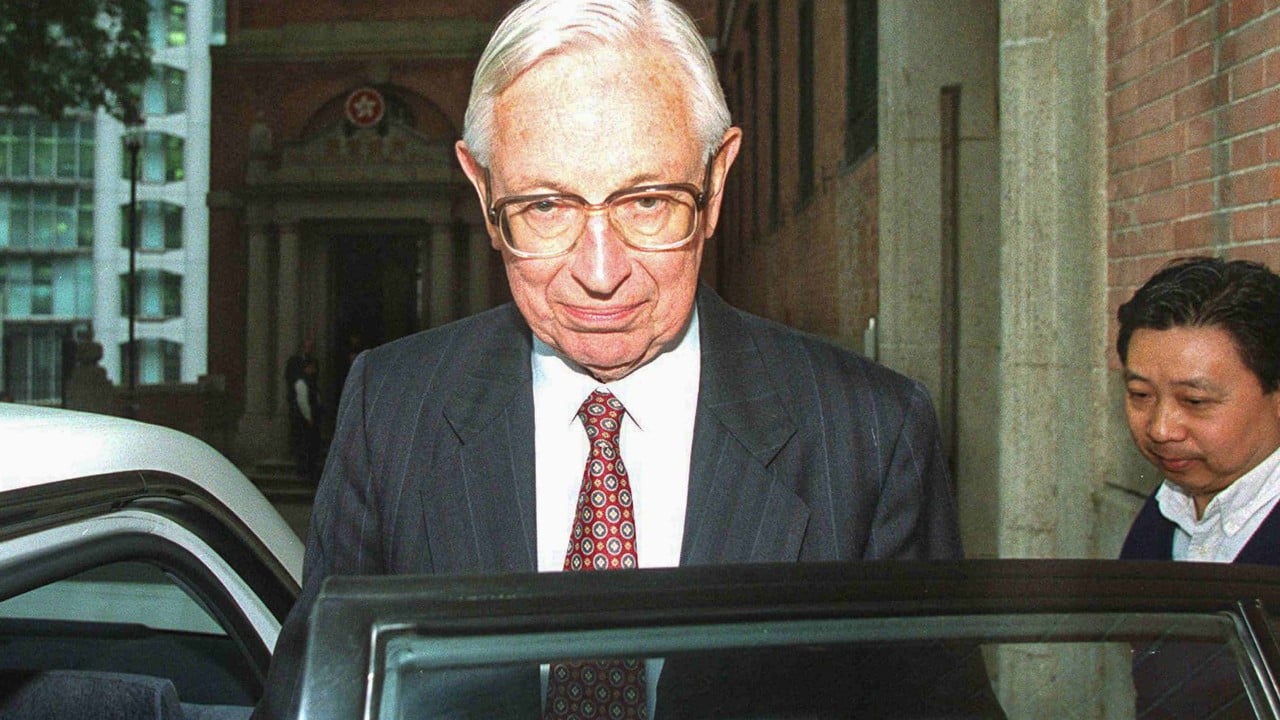
The air inside the Court of Final Appeal in Hong Kong carries a specific, heavy silence. It is the kind of quiet found in cathedrals or the moments before a storm breaks. For decades, a tall, unassuming man with an intellect like a diamond-tipped drill sat at the center of that silence. Sir Anthony Mason did not just practice law; he translated the soul of one system into the language of another.
When he passed away in early 2026, the headlines focused on his resume. Chief Justice of Australia. Non-permanent judge in Hong Kong. A "towering jurist." But those words are flat. They don't capture the terrifying tightrope walk he performed for twenty-eight years. To understand why Mason mattered, you have to imagine a bridge made entirely of glass, suspended over a chasm between two incompatible worlds. Mason was the one who calculated exactly where each bolt should go so the glass wouldn't shatter under the weight of history.
The Weight of a Promise
In 1997, the world watched a flag come down and another rise. On paper, the "One Country, Two Systems" framework was a masterpiece of diplomatic ambiguity. In reality, it was a legal nightmare. You had a British-style common law system, rooted in individual rights and judicial independence, suddenly tethered to a continental system where the ultimate power of interpretation lay with a political body in Beijing.
It shouldn't have worked. By all logic, the gears should have ground to a halt within months.
Enter the "Overseas Judges." This was a radical experiment. Hong Kong’s highest court would invite top-tier judges from other common law jurisdictions—places like Australia, the UK, and Canada—to sit on its bench. It was a signal to the international business community that the rules hadn't changed. If you had a billion-dollar contract dispute in Hong Kong, you weren't just pleading your case to a local appointee; you were pleading it to someone like Anthony Mason.
Mason wasn't just a guest. He became the anchor. He stayed long after others might have looked at the political clouds and headed for the exit. He understood that the law isn't just a set of rules in a dusty book. It is a social contract. It is the feeling a shopkeeper has that their lease is valid, or the confidence a global bank has that its assets won't be seized on a whim.
The Invisible Stakes of a Business Hub
Consider a hypothetical investor we will call Sarah. Sarah runs a venture capital firm in Singapore. In 2005, she is looking to pour hundreds of millions into a tech startup based in the Pearl River Delta, but she wants the contract governed by Hong Kong law. Why? Not because of the weather or the skyline. She chooses it because she trusts that if things go wrong, the court will act as a neutral referee.
When Sir Anthony Mason sat on a case involving commercial litigation or property rights, he was Sarah’s insurance policy. His presence meant that the "Two Systems" part of the equation was being upheld by a man who had presided over the highest court of a Western democracy. He brought a brand of prestige that money cannot buy and politicians cannot manufacture. He brought "E-E-A-T" before the internet had a name for it: Experience, Expertise, Authoritativeness, and Trust.
But the stakes weren't just financial. They were deeply, painfully human.
The law in Hong Kong often had to grapple with the rights of the individual against the state. These weren't abstract puzzles for Mason. They were questions about who belongs, who can speak, and what the limits of power truly are. He was a principal architect of the jurisprudence that defined the Basic Law—Hong Kong’s mini-constitution.
He didn't always side with the individual, and he didn't always side with the government. He sided with the logic of the law. That sounds cold, but in a world of shifting political winds, the "coldness" of the law is the only warmth a citizen has.
The Australian Influence
There is a specific flavor to Australian law that Mason exported to the South China Sea. It is pragmatic. It is less stuffy than the English tradition but no less rigorous. In Australia, Mason had already been a revolutionary. He led what became known as the "Mason Court," a period where the High Court moved away from strict, literal interpretations of the law and toward a "purposive" approach.
Essentially, he asked: "What was this law meant to achieve for society?"
When he brought that mindset to Hong Kong, he helped the local legal system find its feet. He didn't just give orders; he mentored. He showed a generation of Hong Kong judges how to stand tall. He proved that you could be respectful of the sovereign power while remaining fiercely independent in your judgment.
It was a delicate dance. At times, the Standing Committee of the National People’s Congress in Beijing would issue an "interpretation" of the Basic Law that effectively overrode a court decision. Many thought this would be the end. They thought the glass bridge had finally cracked. But Mason stayed. He believed that a partially independent court was better than no independent court at all. He believed in the incremental preservation of the rule of law.
The Quietroom Brilliance
If you ever read one of his judgments, you won't find flowery prose or theatrical outbursts. You find a relentless, logical progression. It is like watching a master watchmaker assemble a movement. Every gear fits. Every spring is tensioned correctly.
He had this uncanny ability to take a chaotic mess of facts—let’s say, a complex dispute over land rights in the New Territories involving ancient customs and modern statutes—and strip away the noise until only the core legal truth remained.
I remember speaking to a junior barrister who had once appeared before him. The young man was terrified. He expected a lion. Instead, he found a listener. Mason didn't interrupt to show off his brilliance. He waited. He poked a single, precise hole in the argument, then waited for the barrister to fix it. He wanted the best version of every argument to be on the table. He knew that a court is only as good as the dialogue it fosters between opposing sides.
Why his Departure Feels Like an Echo
The world Sir Anthony Mason left behind is vastly different from the one he entered in 1997. The glass bridge is under more pressure than ever. Many of his contemporaries from the UK have recently resigned from the Hong Kong court, citing the political climate and the implementation of the National Security Law. They reached a point where they felt their presence was no longer a safeguard, but a veneer.
Mason, however, remained a figure of continuity until his final years. His persistence raises a haunting question: When the giants who built the system leave, does the system stay standing because of the strength of its design, or was it only standing because they were holding it up?
We like to think of "The Law" as a monolithic, indestructible force. We talk about it as if it’s a natural law like gravity. It isn't. The law is a fragile, human invention. It only works because people like Anthony Mason decide to show up every day and act as if it's real, even when the world around them is screaming otherwise.
He was the ghost in the machine of Hong Kong’s prosperity. While the traders on the floor of the Stock Exchange shouted and the developers built towers that scraped the clouds, Mason sat in a quiet room, making sure the foundations of those towers were bolted into something more stable than sand.
The Legacy of the Last Centrist
There is a certain loneliness in being a centrist in a polarized age. Mason wasn't a firebrand for the opposition, nor was he a puppet for the establishment. He was a servant of the process. In his view, the process was the only thing standing between civilization and the whims of the powerful.
He leaves behind thousands of pages of text—judgments that will be cited by lawyers who weren't even born when he first took the bench. But his true legacy isn't in the citations. It’s in the fact that for nearly three decades, the bridge held.
As the sun sets over the Victoria Harbour, hitting the glass facades of the skyscrapers, you realize that those buildings are a reflection of a confidence that was meticulously curated. That confidence had a name. It had a face. It had a quiet, steady voice that spoke of precedents and statutes while the world changed outside the window.
The tall man has left the bench. The silence in the Court of Final Appeal feels a little heavier now. The bridge is still there, but the architect is gone, and the wind is picking up.
Would you like me to analyze one of Sir Anthony Mason's landmark Hong Kong judgments to show how his "purposive approach" functioned in practice?