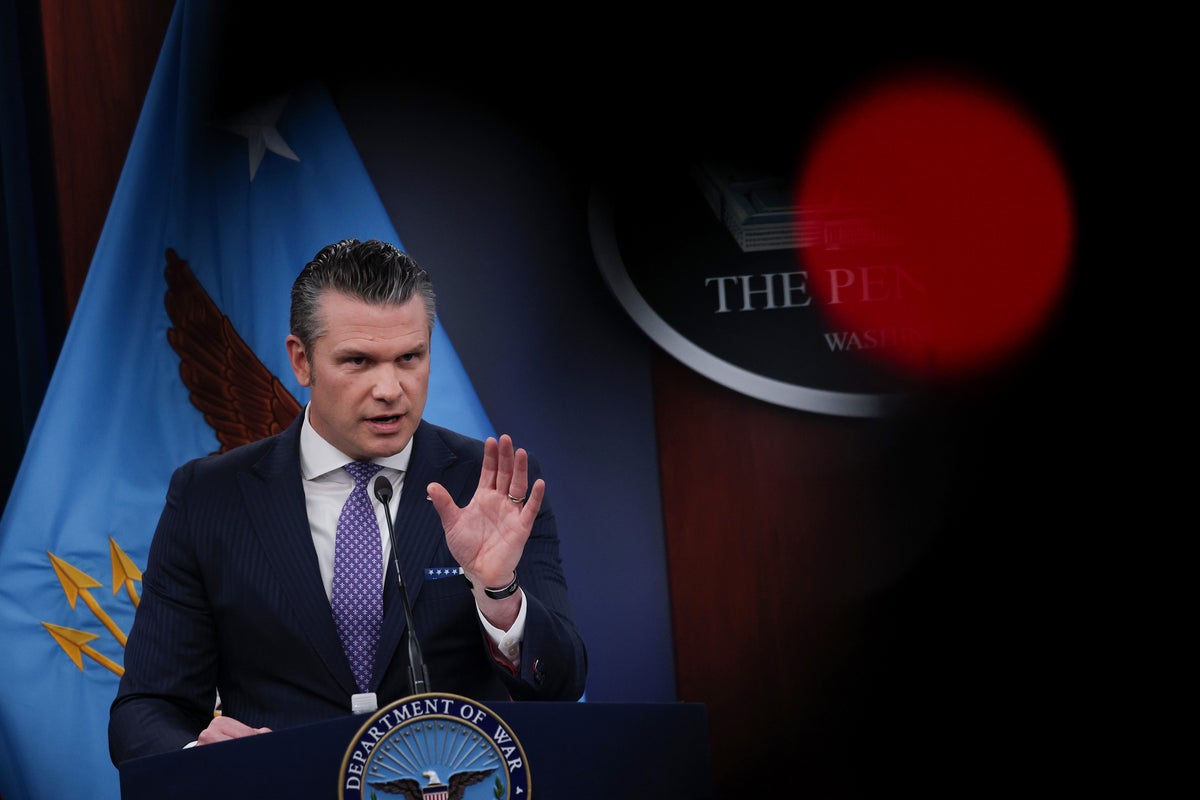
The room smells of expensive leather and air-conditioned silence. In the halls of the Pentagon, where decisions are usually wrapped in the heavy, multi-layered wool of bureaucracy and "strategic patience," Pete Hegseth represents a sharp, jagged break in the fabric. He doesn't speak the language of de-escalation. He speaks the language of the kinetic.
To understand the man who now stands at the helm of the world's most formidable military, you have to look past the suit and the television makeup. You have to look at the philosophy of the "reset." For Hegseth, the Middle East isn't a chessboard to be painstakingly managed over decades; it is a knot that has grown too tangled to untie. He wants to cut it. If you found value in this post, you might want to read: this related article.
When Donald Trump floated the idea of striking Iranian soil—a move that decades of career generals have treated as the "break glass in case of apocalypse" option—Hegseth didn't flinch. He didn't offer a PowerPoint presentation on the nuances of regional stability. He backed it. Immediately.
The Philosophy of the Blunt Instrument
War is often sold as a surgical endeavor. We use words like "precision," "surgical strikes," and "collateral mitigation" to make the act of killing feel like a medical procedure. Hegseth discards the scalpel. His worldview is built on a foundation of overwhelming, unrepentant force. He has spent years arguing that the United States has become a "paper tiger," paralyzed by its own rules of engagement and a fear of looking like the bully on the global playground. For another look on this event, check out the recent update from Associated Press.
Imagine a high-stakes poker game where every player is bluffing, but one man at the table has a hand grenade taped to his palm. That is the energy Hegseth brings to the Situation Room. He believes that the only way to keep the job—and to keep the peace—is to prove, beyond a shadow of a doubt, that you are willing to blow things up.
This isn't just about Iran. It’s about the very soul of American intervention. For the better part of twenty years, the U.S. has engaged in "gray zone" warfare—shadow boxing with proxies, funding rebels, and launching the occasional drone from a thousand miles away. Hegseth views this as a slow-motion defeat. To him, the hesitation is the poison.
The Weight of the Red Line
Consider a young lieutenant stationed in the Persian Gulf. For years, his orders have been a complex web of "ifs" and "buts." If fired upon, you may return fire, but only if the threat is imminent and only if you can identify the source without crossing this specific longitudinal line.
Now, the messaging from the top has shifted. The new Secretary of Defense isn't interested in the "buts." He is interested in the "if."
The risk of this approach isn't hidden; it’s the point. By signaling a hair-trigger willingness to attack Iran, Hegseth is betting that the threat of total destruction is a better deterrent than the promise of a seat at the negotiating table. It is a gamble with the lives of millions. If he’s right, the enemy retreats in fear. If he’s wrong, the sky turns orange.
The statistics of war often fail to capture the visceral reality of what "blowing s*** up" actually means. It means the destruction of infrastructure that takes decades to build. It means the displacement of families who have nothing to do with the nuclear ambitions of their leaders. It means the potential for a global energy crisis that could shutter factories in Ohio and leave families in Berlin shivering in the dark.
Hegseth, however, sees a different set of numbers. He looks at the billions of dollars spent on "nation-building" and sees a sinkhole. He looks at the lives lost in "forever wars" and sees a failure of nerve. His logic is simple: if you’re going to fight, win. If you’re going to win, do it fast. If you’re going to do it fast, you have to be willing to be the monster the world is afraid of.
The Culture War in Camouflage
There is a domestic angle to this bellicosity that cannot be ignored. Hegseth isn't just fighting Iran; he is fighting the Pentagon itself. He views the modern military establishment as "woke," bloated, and more concerned with diversity seminars than with lethality.
His quick endorsement of Trump’s most aggressive impulses acts as a litmus test. It separates the "warriors" from the "bureaucrats." By advocating for the most extreme version of American power, he is signaling to the base—and to the Commander-in-Chief—that the era of the cautious general is over.
The invisible stakes here aren't just about a potential war in the East. They are about the transformation of the American military into an extension of a specific political identity. When the Secretary of Defense speaks about "blowing things up" to keep his job, he isn't just talking to Tehran. He’s talking to the voters. He’s telling them that the "tough guys" are back in charge.
But toughness is a fragile thing. True strength often lies in the restraint required to keep the sword in its scabbard. Hegseth’s critics argue that he confuses motion with progress and violence with victory. They worry that he doesn't understand the difference between a skirmish and a conflagration.
The Ghost of 1914
History is littered with men who thought a "quick, decisive strike" would solve their problems. In 1914, the leaders of Europe thought the boys would be home by Christmas. They weren't. They were buried in the mud of Verdun and the Somme.
The Middle East is a landscape of ancient grudges and modern explosives. It does not respond well to blunt force. Every time a bomb falls, it creates a vacuum. Something always fills that vacuum, and it is rarely a friend of the United States.
Hegseth’s rapid-fire support for attacking Iran assumes that the Iranian regime will simply fold. It assumes that their proxies—Hezbollah, the Houthis, the various militias in Iraq—will sit on their hands while their patron is dismantled. It is a leap of faith taken from a very high cliff.
The Human Cost of Certainty
We often talk about these shifts in policy as if they are weather patterns—something we observe from a safe distance. But policy is made of flesh and blood.
There is a mother in Tehran who worries about the price of bread. There is a sailor on a U.S. destroyer who writes letters home in his head. There is a drone operator in Nevada who sees the world through a grainy thermal lens. These are the people who live in the gaps between Hegseth’s sentences.
The Secretary’s rhetoric is designed to project a sense of absolute certainty. In a world that is messy, complicated, and increasingly multipolar, certainty is a powerful drug. It feels good to believe that we can just "solve" Iran with a few well-placed missiles. It feels good to think that American power is an on-off switch.
But the world is not a switch. It is a circuit. You can’t just cut one wire and expect the rest of the lights to stay on.
As Hegseth settles into his role, the tension in the Pentagon is palpable. The old guard watches with a mixture of horror and fascination. They see a man who is willing to burn the manual if it means getting a result. They see a man who views the very concept of "proportionality" as a weakness.
The real test won't come in a televised interview or a social media post. It will come in the middle of the night, when the intelligence brief is messy, the options are all bad, and the President is looking for someone to say "go."
Hegseth has already made it clear what his answer will be. He isn't there to manage the fire. He’s there to provide the fuel.
In the silence of the Pentagon's deepest offices, the maps are being redrawn. The targets are being updated. The language of diplomacy is being replaced by the mathematics of destruction. We are moving away from an era of containment and toward an era of confrontation.
It is a world where the Secretary of Defense believes his job security is tied to the smoke rising from a foreign horizon. That is a heavy weight for the rest of the planet to carry.
The missiles remain in their silos for now, but the rhetoric has already been launched. It hangs in the air, a promise of what happens when the men in charge decide that the only way to save the village is to burn it down.
Deep in the desert, the sand is shifting. Somewhere, a countdown has already begun, not in seconds, but in the hardening of hearts. The tragedy of the "reset" is that you can never truly go back to the way things were before the sparks flew. Once the match is struck, the only thing left to do is watch the shadows grow.