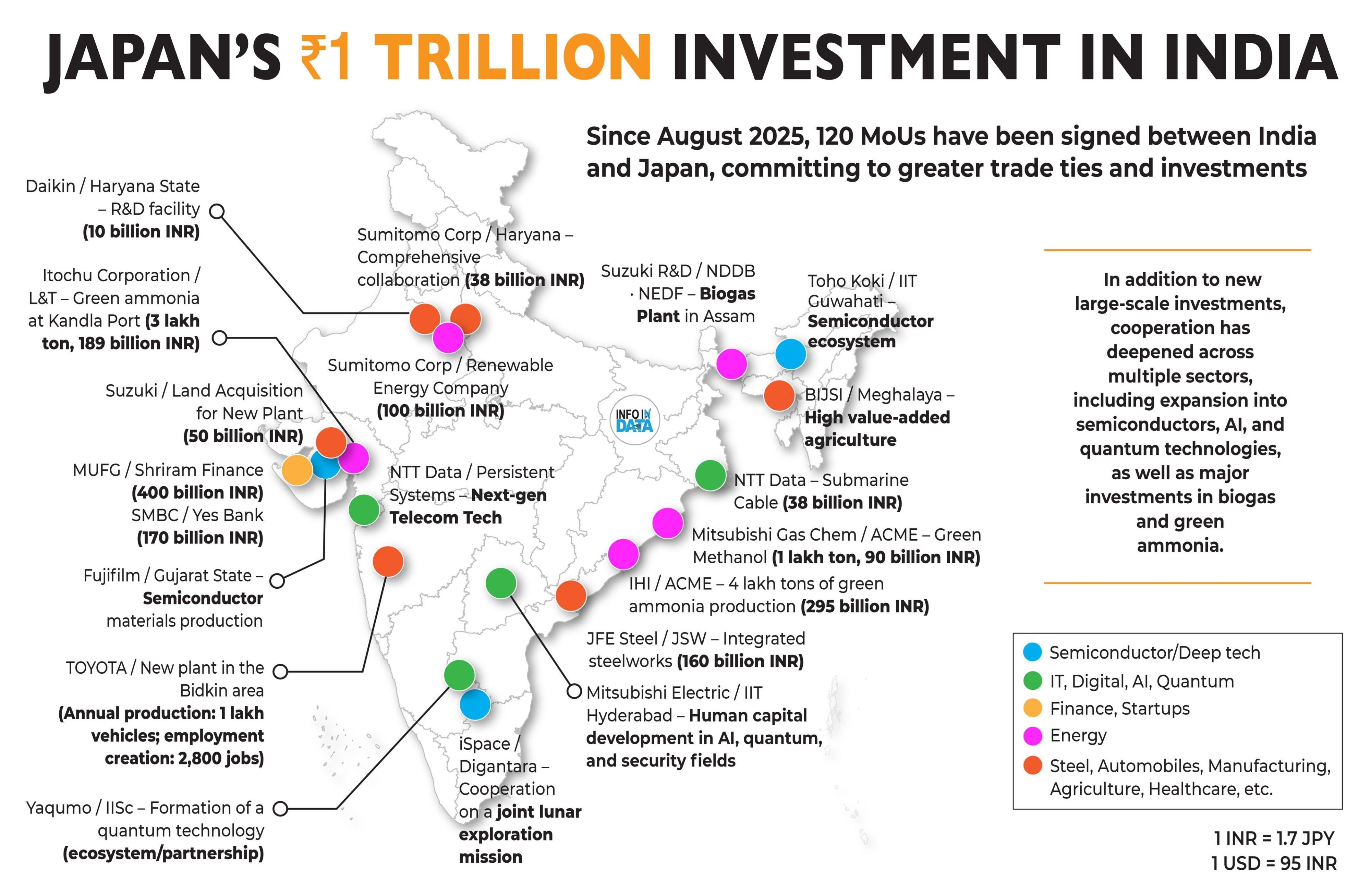
The signing of 129 Memorandums of Understanding (MoUs) valuated at approximately \text{₹}1 lakh crore (¥2 trillion or $12.4 billion) between India and Japan at the Joint Economic Forum in New Delhi establishes a critical precedent for cross-border capital flows within the Global South. While conventional analysis frequently treats these capital pledges as aggregate bilateral trade wins, evaluating their true impact requires isolating the precise operational mechanisms, structural incentives, and geopolitical hedges driving the capital allocation.
The transaction represents a front-loaded injection targeting the execution of a larger ¥10 trillion ($62 billion) decade-long investment framework. To assess the long-term viability of these agreements, the underlying strategy must be disassembled into three analytical pillars: technological asymmetric convergence, economic security infrastructure, and regional supply chain networks.
The Three Pillars of Bilateral Value Maximization
1. Technological Asymmetric Convergence
The foundational logic of this economic expansion rests on an asymmetry of operational assets. Japan faces systemic bottlenecks characterized by an aging domestic workforce and saturated domestic markets. India possesses raw demographic scale, a vast software engineering ecosystem, and localized manufacturing capacity.
The strategy systematically pairs Japan’s hardware precision and strict quality control systems with India’s algorithmic software expertise and scaling velocity. This model is engineered to address highly technical verticals:
- Advanced Compute Infrastructure: Joint execution across Artificial Intelligence frameworks and quantum computing topologies to counter Western and Chinese technology silos.
- Semiconductor Fabrication: Integrating Japanese chemical and material science components into India's emerging assembly, testing, marking, and packaging (ATMP) and wafer fabrication facilities.
2. Economic Security and Supply Chain Resilience
The current international economic landscape is highly fragmented, presenting acute supply chain vulnerabilities. The structural agreements are intentionally aligned to mitigate systemic dependencies on monolithic supply chains, prioritizing five foundational sectors:
| Sector | Operational Mandate | Strategic Target |
|---|---|---|
| Semiconductors | Material supply chain integration and design tools | De-risking East Asian concentration |
| Information & Communication Technology | Open RAN deployment and 5G/6G architecture | Establishing verified, trusted networks |
| Critical Minerals | Extraction processing and joint refining mechanisms | Eliminating dependence on near-monopoly processors |
| Clean Energy | Scale execution of green ammonia and compressed biogas (CBG) | Decarbonization and energy self-reliance |
| Pharmaceuticals | Active Pharmaceutical Ingredient (API) supply verification | Ensuring global health supply security |
The emphasis on clean energy—exemplified by large-scale green ammonia infrastructure and the newly introduced Japan-India CBG initiative—is designed to decouple industrial manufacturing from traditional hydrocarbon inputs, lowering the volatility of operating costs across both industrial bases.
3. The Cross-Border Scale Mechanism
A core differentiator of the current framework is the evolution of the "Make in India, Make for the World" thesis. Rather than utilizing India solely as an end-consumer market, Japanese enterprise strategies are shifting toward using the subcontinent as an export manufacturing hub targeting third-party markets across Africa and the Middle East.
This mechanism capitalizes on optimized unit economics. Producing highly specialized hardware components in a low-cost, high-velocity operating environment allows the combined entity to deploy infrastructure across emerging economies at price-to-performance ratios that single-nation supply chains cannot match.
The Operational Bottlenecks: A Structural Risk Assessment
A JETRO survey indicates that over 80% of Japanese corporations operating within India intend to expand local operations. This high business confidence indicates strong alignment, but the strategy faces operational limits that could impede transition from intent to actual execution.
Bureaucratic Friction and Execution Velocity
The conversion rate of MoUs into fully operationalized capital assets historically experiences friction due to regulatory asymmetry. Japanese corporate planning relies on extended due diligence timelines and predictable regulatory environments. Conversely, Indian municipal and state-level compliance structures can introduce unexpected administrative steps, lingering land-acquisition delays, and shifting tax interpretations.
Infrastructure and Energy Input Disparities
Advanced technology manufacturing, specifically semiconductor fabrication and precision engineering, demands uninterrupted, ultra-pure power grids and extensive water logistics. The immediate challenge for the Indian regulatory framework is ensuring that the specific industrial zones allocated for these Japanese investments match the physical infrastructure standards required by high-precision machinery.
The Geopolitical Cost Function
The macro-economic framework is explicitly synchronized with defense and maritime security realities. Capital cannot flow securely without physical supply corridor protection. The synchronization of Japan’s Free and Open Indo-Pacific (FOIP) vision with India’s MAHASAGAR initiative serves as a direct risk-mitigation tool against shipping lane disruptions.
[Chokepoint Vulnerability: Strait of Hormuz]
       │
       ▼ (Disruption Risk)
[Economic Security Shock: Energy & Mineral Supply Chains]
       │
       ▼ (Strategic Response)
[POWERR Asia & Bilateral Co-Development (e.g., Unicorn Naval Antenna)]
The introduction of frameworks like "POWERR Asia" and explicit defense co-development agreements—such as the joint production of the Naval Radio Antenna 'Unicorn'—directly counters systemic vulnerabilities. For instance, energy supply disruptions in critical maritime chokepoints like the Strait of Hormuz present an existential threat to both nations' manufacturing inputs. The defense integration acts as a necessary insurance policy, shielding the $62 billion economic corridor with hard security architecture.
The Strategic Directive
To capitalize on this bilateral momentum, enterprise leaders and policy architects must execute a clear two-step strategy:
- Establish Specialized Fast-Track Regulatory Corridors: State governments in India must create dedicated administrative cells for Japanese capital pools, standardizing compliance structures and pre-clearing land and environmental approvals to match the deployment speeds expected by international institutions.
- Transition from General Component assembly to Co-IP Generation: Rather than settling for contract manufacturing contracts, Indian technology enterprises should leverage the 129 MoUs to co-develop Intellectual Property in advanced fields like AI chips, green ammonia catalysts, and quantum encryption algorithms, anchoring the partnership in mutual technical dependency.
The capital layout is set. Success now hinges entirely on the structural velocity of execution.