Time leaves its fingerprints in unexpected places. On the worn brass handle of a heavy front door. On the faint indentation of an armchair cushion left vacant for just a moment too long. In Regina, inside the quiet corridors of a home where decades gather to compare notes, time does not merely pass. It accumulates.
Listen closely.
You can hear it in the rhythmic shuffle of leather-soled slippers against linoleum. You can hear it in the hesitant, triumphant strike of a piano key played by hands that once built houses, raised children, and stitched winter coats.
We talk about aging as a subtraction. We count down the years, measure the losses, and chart the gradual fading of a life. But walk through these doors on a Tuesday afternoon, and you witness the exact opposite. This is an exercise in addition.
Consider the arithmetic of survival.
One hundred years.
To hold a century inside your bones is to have witnessed the world disassemble and reassemble itself multiple times over. When the residents celebrating milestone birthdays and anniversaries in this Regina community were born, horses still hauled delivery wagons down dusty prairie streets. Radio was a novelty crackling through vacuum tubes. The horizon was vast, unbroken, and entirely unmapped by the digital ghosts that haunt our pockets today.
Margaret adjusts the collar of her cardigan. She has lived through ninety-nine winters in Saskatchewan, a climate that tests the endurance of steel, let alone human tissue. When asked about the secret, she does not offer a wellness tip or a dietary regimen. She simply laughs—a dry, paper-rustling sound full of an ancient, stubborn mischief.
"You just keep waking up," she says.
That is the unvarnished truth of it. There is no grand philosophy. There is only the stubborn refusal to stop participating in the morning.
Around her, tables are pushed together to form a long, communal highway of celebration. Cakes arrive heavy with buttercream, their frosting bearing the shaky handwriting of a baker who knows these orders carry an immense, fragile weight. Candles flicker. Not just a few candles, but dozens of them, transforming a simple dining room into a constellation of small, determined fires.
Anniversaries live here too. Sixty years. Sixty-five years.
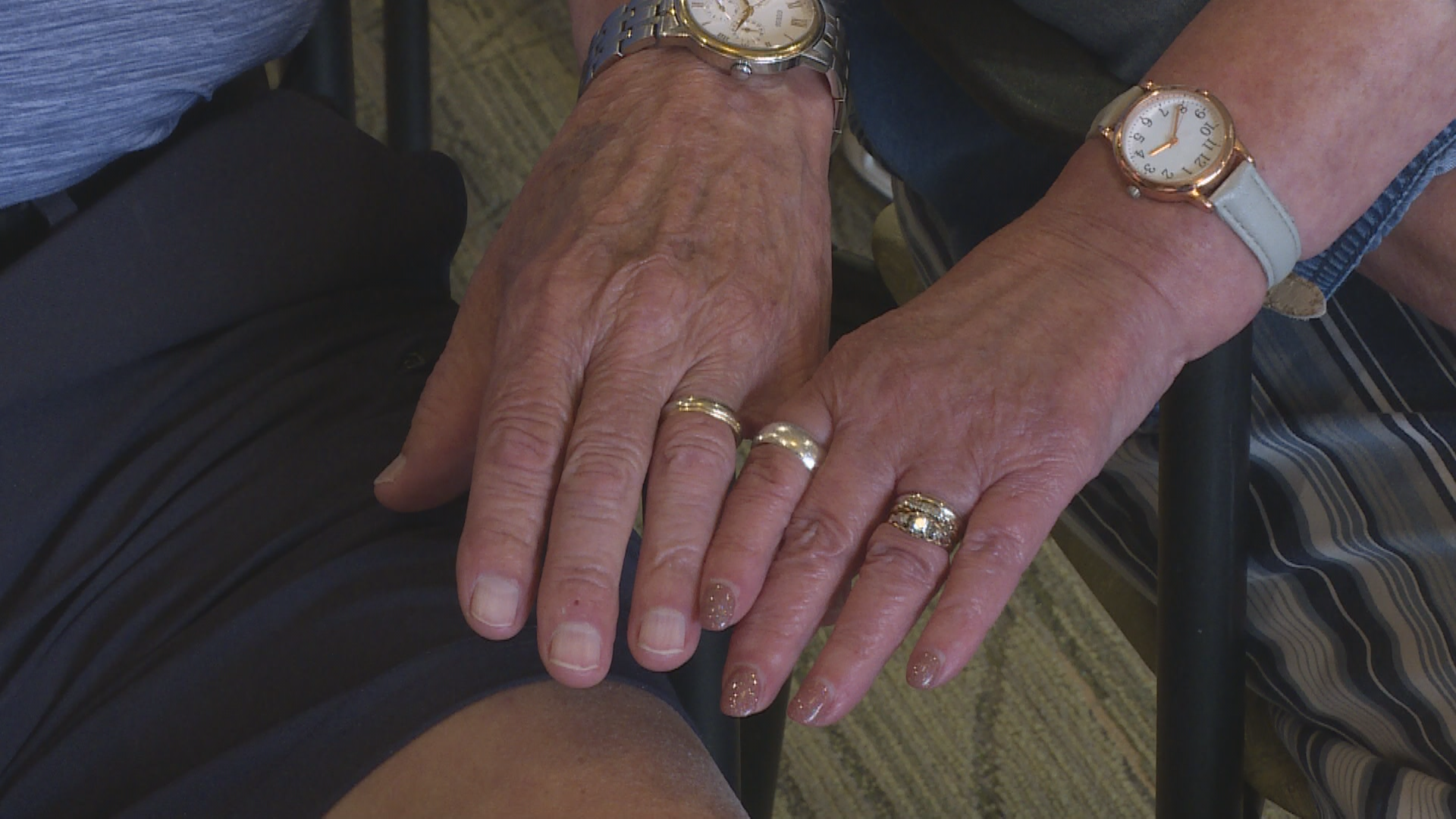
Think about that span. Six decades of sharing the same toast, navigating unspoken grief, surviving economic panics, raising children who grew up and scattered like dandelion seeds across the continent. Arthur sits beside his wife, Eleanor. Their fingers do not intertwine with the desperate urgency of youth. Instead, their hands rest near one another on the white tablecloth, knuckles swollen and proud, grazing with the casual familiarity of two people who have read the same book a thousand times and still pause at the margins.
Marriage at this stage is no longer about romance in the cinematic sense. It is archaeology. They have excavated each other's flaws, buried old arguments, and built a monument out of shared silence. When Arthur offers Eleanor a piece of cake, the gesture is so small it is almost invisible. Yet it holds more gravity than any vow ever spoken at an altar.
We often isolate our elders. We tuck them away into architectural footnotes on the edges of our cities, as if proximity to aging might somehow contaminate our own frantic rush toward tomorrow. We treat longevity as a medical statistic rather than a cultural triumph.
That is the mistake.
When a community in Regina pauses its routine to honor a room full of centenarians and diamond anniversary couples, they are not merely throwing a party. They are anchoring themselves. Without these lives, the city is an orphan—a place with no memory of its own foundation, rushing blindly into the next quarter without knowing where it came from.
The room hums with a distinct frequency. It is not the manic, synthetic energy of a modern nightclub or the hurried chatter of an office bullpen. It is the steady, resonant hum of a cello. Deep. Vibrating through the floorboards.
A daughter watches her mother from across the room. She holds a paper plate with a slice of cake she has no intention of eating. Her eyes are bright with unshed tears. It is a complicated grief, this loving someone who is slowly slipping away while still sitting right in front of you. She knows the arithmetic as well as anyone. She knows that every birthday cake now carries a sharper edge of finality.
And yet, she smiles. Because the room refuses to mourn.
Instead, someone starts an accordion tune. It is an old song, warped by memory and time, but the rhythm catches. Feet tap against the carpet. Hands clap out of sync with the bellows. For a few minutes, the distance between twenty and ninety-nine collapses entirely.
This is what we miss when we view senior care through the cold lens of institutional efficiency. We look at charts, bed counts, and care plans. We measure output and mobility scores. We forget that inside these brick walls, fierce, beautiful human dramas are still playing out to their final, magnificent acts. Friendships are forged over afternoon bingo. Rivalries flare up over crossword puzzles. Hearts break softly when a familiar face is missing from the dining hall.
Life does not end when it slows down. It concentrates. It becomes purer, distilled to its most essential elements. Kindness matters more. A warm hand on a shoulder carries the weight of an entire language.
The afternoon sun dips lower, casting long, amber stripes across the hardwood floor of the common room. The cake is gone, reduced to smears of frosting on empty plates. The accordion player packs up his instrument, the metal snaps clicking shut with a sharp, final sound.
The residents begin to drift back to their rooms. Some walk with purpose, others lean heavily on aluminum walkers that squeak with every step, a mechanical heartbeat keeping time with the fading day.
Margaret remains by the window, watching the shadows stretch across the manicured lawn outside. The prairie wind rattles the glass, a familiar sound, cold and vast. She pulls her cardigan a little tighter around her shoulders, her gaze fixed on the horizon where the sky bleeds from gold to bruised purple.
She is not afraid of the dark coming on. She has seen it fall ten thousand times, and every single morning, without fail, the light has found its way back.