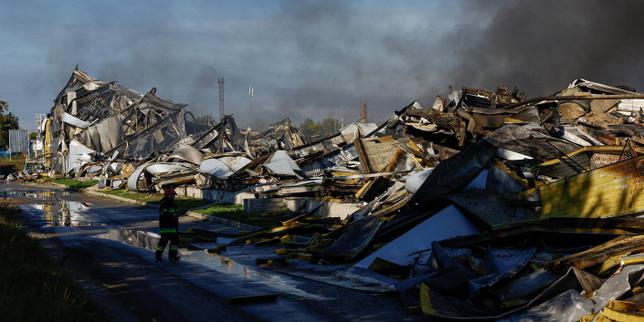
Modern military campaigns increasingly bypass traditional attrition models, shifting their operational vector toward the systemic degradation of information nodes and logistical choke points. The strategic targeting of data centers in metropolitan centers like Kyiv, paired with simultaneous kinetic strikes on maritime export hubs such as the port of Kilia, demonstrates a convergence between cyber-electronic warfare and physical asset destruction. Understanding this operational shift requires deconstructing the mechanics of infrastructure targeting, the cascading dependencies of digital architecture, and the long-term economic friction these strikes introduce into regional supply chains.
The Triad of Infrastructure Vulnerability
To evaluate the impact of kinetic strikes on high-density information environments, one must isolate the structural dependencies of modern state architecture. Urban data centers are not merely real estate containing server racks; they function as critical nerve centers governing communications, financial clearing houses, and governmental telemetry.
The first vulnerability lies in spatial centralization. High-capacity data processing demands substantial electrical substations and cooling networks, making these facilities conspicuous physical targets that cannot easily be concealed or rapidly decentralized.
The second vulnerability is power dependency. Digital infrastructure operates on razor-thin margins of electrical continuity. Kinetic strikes directed at adjacent power grids or cooling infrastructure inflict functional paralysis even when the server hardware itself survives the initial kinetic impact.
The third vulnerability involves supply chain friction for replacement hardware. Unlike software redundancy, which can be dynamically rerouted across distributed cloud instances, specialized processing units and enterprise-grade power regulation hardware face severe procurement bottlenecks under wartime blockades.
The Logistics of Maritime Choke Points
Parallel to the disruption of digital nodes, strikes against maritime logistics hubs like the port of Kilia reveal an explicit intent to compress export capacity and degrade economic output. Kilia, situated along the Danube delta, serves as a vital artery for alternative trade routes when traditional Black Sea corridors face active blockades or mining.
When military doctrine dictates the targeting of such ports, the objective extends beyond the immediate destruction of physical docks or storage terminals. The strategy targets the insurance risk profile and vessel turnaround time. Every localized explosion increases maritime insurance premiums, forces vessels to idle in contested sectors, and creates cascading delays throughout European grain and mineral supply channels. The economic damage is therefore calculated not by the square footage of destroyed concrete, but by the exponential rise in transactional friction imposed on international trade partners.
Asymmetric Feedback Loops in Electronic and Kinetic Operations
The interplay between cyber operations and physical infrastructure strikes creates complex feedback loops. When regional data processing centers suffer physical degradation, command-and-control networks must fall back on decentralized, lower-bandwidth tactical channels. This fallback introduces latency into battlefield communications, reduces situational awareness, and forces military planners to rely on less secure or less efficient transmission protocols.
Conversely, the destruction of digital infrastructure forces civil-military convergence. State entities must commandeer commercial cloud resources and consumer telecommunications networks to maintain basic administrative functions. This convergence increases the attack surface for electronic intelligence operations, as civilian networks rarely match the hardening standards of dedicated military installations.
Strategic Outlook and Operational Forecasts
The systematic targeting of dual-use infrastructure—facilities that simultaneously support civilian economic activity and state communications—signals a permanent evolution in high-intensity conflict. As long as modern economies remain dependent on concentrated data processing and localized transit hubs, asymmetric campaigns will continue to exploit these structural concentrations. Future defensive postures will require a fundamental redesign of state architecture, moving away from centralized urban data hubs toward micro-distributed, mobile edge-computing units supported by hardened, decentralized power micro-grids.
This video provides additional context regarding the vulnerability of data centers and digital infrastructure to kinetic and cyber attacks.