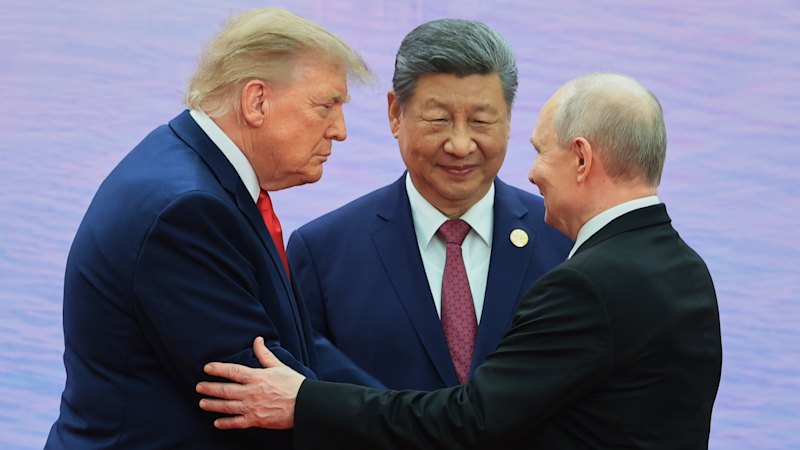
Diplomacy is rarely about the handshakes captured by network cameras. Beneath the surface of high-level summits involving Donald Trump, Vladimir Putin, and Xi Jinping lies a continuous exercise in domestic signaling and strategic positioning. When foreign policy analysts reduce these encounters to simple wins and losses, they miss the machinery of statecraft that governs modern international relations.
For decades, the triangular dynamic between Washington, Moscow, and Beijing has defined global stability. Every meeting, tariff threat, and joint communique serves multiple audiences simultaneously. A concession made in a closed-door bilateral session is often designed to appease domestic critics or secure economic leverage thousands of miles away. Understanding the recent interactions between these leaders requires looking past the immediate media narratives and examining the structural pressures each figure faces at home.
The Domestic Imperative Behind Foreign Policy
Foreign policy is domestic politics pursued by other means. A leader facing sliding poll numbers or legislative gridlock frequently turns the nation's attention outward. This phenomenon is not unique to any single political system.
When American administrations negotiate with autocratic powers, the constraints are transparent and noisy. Public debate, congressional oversight, and media scrutiny mean that every diplomatic maneuver is picked apart in real-time. Conversely, leaders in Moscow and Beijing operate within centralized information ecosystems. They can project an aura of unshakeable strength even when economic sanctions or demographic realities constrain their actual leverage.
The divergence in governance models creates a fundamental asymmetry at the negotiating table. An American president must constantly manage the perception of weakness in a hyper-partisan environment. Russian and Chinese counterparts exploit this vulnerability, framing diplomatic compromises as necessary concessions while pocketing tangible gains.
Economic Realities Versus Public Rhetoric
Trade balances and energy corridors dictate long-term strategic alignment far more effectively than rhetorical declarations. While public statements focus on diplomatic breakthroughs or diplomatic slights, the movement of commodities tells the real story.
The economic partnership between Moscow and Beijing deepened significantly following Western sanctions. Energy flows shifted eastward, altering supply chains that had stood for half a century. When Washington attempts to disrupt these arrangements through secondary sanctions or tariff barriers, the results are rarely binary. Markets adapt. New financial plumbing emerges to bypass traditional Western-dominated institutions.
A critical error made by many commentators is assuming that economic statecraft yields immediate compliance. Major powers absorb economic shocks through state intervention and alternative trading partners. Consequently, measures designed to isolate a competitor often end up accelerating the fragmentation of the global economy into distinct blocs.
The Myth of the Definitive Diplomatic Victory
In modern media coverage, every summit must produce a clear winner and loser. This framing simplifies complex negotiations into sports commentary, ignoring the incremental nature of geopolitical strategy.
Real diplomacy resembles trench warfare rather than a chess match. Positions are fortified, abandoned, and contested over years. A joint statement that appears toothless to television pundits may contain vital backchannel understandings that prevent military escalation in a contested region. Conversely, a celebrated treaty can unravel within months if domestic political shifts invalidate the underlying commitments.
Evaluating the legacy of Trump’s engagements with Putin and Xi requires examining the systemic shifts they accelerated rather than the immediate headlines. The normalization of aggressive tariff policies, the reassessment of traditional alliance commitments, and the acceleration of decoupling strategies all altered the baseline of international relations.
The Path Ahead for Global Stability
The friction between the world's primary economic and military powers shows no sign of abating. As technological competition expands into artificial intelligence, semiconductor manufacturing, and space infrastructure, the traditional metrics of geopolitical power are evolving.
Navigating this fractured environment demands realism rather than wishful thinking. Leaders who mistake tactical optics for strategic dominance invariably find themselves reacting to crises rather than preventing them. The underlying structural pressures—resource scarcity, demographic shifts, and technological disruption—will continue to test the resilience of global institutions, rendering short-term diplomatic posturing largely irrelevant to the long arc of history.