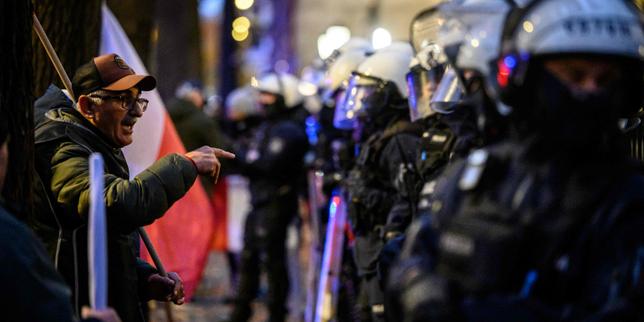
Five British far-right activists walk onto the beaches near Dunkirk to harass migrants, get arrested by French police, and every mainstream newsroom in Europe pops the champagne. Problem solved. Law and order restored. Move along.
That narrative is dangerously naive.
When French authorities detained five British nationals near Dunkirk for "acts of intimidation" against migrants attempting to cross the English Channel, the press treated it like a decisive victory against extremism. They framed it as an isolated skirmish between rogue foreign agitators and a competent state apparatus.
Both sides of that framing miss the entire structural reality of the northern French coast. Treating cross-border vigilante tourism as a simple policing triumph ignores the exact vacuum that invited them there in the first place. Worse, the theater of their arrest acts as free marketing for the very networks Paris and London claim to be dismantling.
The Illusion of the Isolated Agitator
Mainstream reporting loves a clean villain. It is much easier to write about five radicalized Britons crossing the Channel to play border guard than it is to examine why a sovereign European coastline has become an ungoverned no-man's-land.
I have spent years tracking cross-border security failures and asymmetric smuggling networks across Western Europe. Whenever a state loses functional control over a territory—whether it is a port city, a rural border, or the dunes of Loon-Plage—two things happen simultaneously. First, organized criminal syndicates industrialize the territory. Second, ideological opportunists arrive to film themselves "taking it back."
The five men arrested near Dunkirk were not anomalies. They are the predictable byproduct of a bilateral border policy that relies on performative deterrence rather than actual territorial control.
Let us define the terms properly. Vigilante border tourism is not an organic uprising of concerned citizens; it is an organized media production. Groups like Britain First, Patriotic Alternative, and various splinter cells do not travel to Calais or Dunkirk expecting to physically stop the tens of thousands of people crossing the Channel each year. They lack the numbers, the legal authority, and the logistical capacity to alter migration flows by even a fraction of a percent.
They go to northern France for one reason: content.
Every confrontation with exhausted migrants in the dunes, every shouting match with NGO volunteers, and—most crucially—every arrest by French riot police generates high-engagement video clips. When the state arrests them and the press runs headlines about "far-right intimidation," those activists do not suffer a defeat. They get validated in front of an audience already convinced that European governments have abandoned their own borders to arrest patriots instead of smugglers.
Why the "Law and Order" Narrative Backfires
Look at the mechanics of how this incident plays out online versus how it plays out in the pages of a traditional newspaper.
In the traditional press, the arrest proves the system works. French authorities spotted the threat, intervened before physical violence escalated, and reinforced the rule of law.
In the algorithmic ecosystem where these groups recruit, the exact same event tells a completely different story:
- Step 1: Foreigners enter France illegally with the goal of entering Britain illegally.
- Step 2: British citizens travel to France to confront the situation directly.
- Step 3: The French state arrests the Britons while the smuggling networks continue operating a mile down the beach.
You do not have to agree with far-right ideology to see why that sequence is pure rocket fuel for radicalization. By focusing exclusively on the arrest of the five Britons while leaving the underlying smuggling infrastructure intact, authorities hand extremist recruiters an airtight propaganda narrative.
Security researchers who study online extremism—including analysts at the Institute for Strategic Dialogue (ISD) and the International Centre for the Study of Radicalisation (ICSR)—have documented this exact dynamic for a decade. State crackdowns that target low-level ideological performers without resolving the underlying grievance do not suppress the movement. They lower the cost of recruitment.
The Real Power Brokers in Dunkirk Aren't Wearing Boots
If you want to understand who actually controls the beaches around Dunkirk and Grande-Synthe, stop looking at British extremists and start looking at the smuggling syndicates.
The English Channel crossing is no longer a chaotic scramble of desperate individuals buying cheap inflatables at local sporting goods stores. It is a vertically integrated, multi-million-euro criminal enterprise.
Consider the logistics required to move thousands of people across one of the busiest shipping lanes on earth:
- Supply Chain Management: Heavy-duty, purpose-built dinghies and outboard motors are sourced from factories in Asia, shipped to hubs in Germany or Belgium, and warehoused across northern France.
- Staging and Transport: Safe houses and rural drop zones are coordinated via encrypted messaging apps, moving groups to the water's edge within narrow tidal windows.
- Armed Enforcement: The gangs operating in the camps around Dunkirk routinely use firearms, knives, and extortion to maintain monopoly control over departure points.
French police regularly clash with armed smugglers in these exact zones. Yet when five unarmed or lightly equipped British activists show up to harass migrants, the state suddenly demonstrates lightning-fast operational efficiency.
That contrast is glaring. Voters in both France and the United Kingdom are not blind to it. When ordinary citizens see a government struggle for years to dismantle violent smuggling rings, only to effortlessly round up five foreign agitators in an afternoon, trust in state competence collapses.
Answering the Questions Nobody Wants to Touch
When news like the Dunkirk arrests breaks, public debate immediately gets trapped in predictable, circular arguments. Let us dismantle the most common misconceptions driving the conversation.
Are far-right groups actually stopping migrant boats?
No. Not even close. The numbers do not lie. Even during periods of intense activist presence in northern France, Channel crossings fluctuate almost entirely based on wind speed, wave height, and French maritime patrols—never because a handful of British men walked along the beach with cameras. Claiming they are "protecting the border" is pure fantasy.
Does arresting vigilantes deter others from copying them?
Only in the short term, and usually at the cost of escalating tactics. High-profile arrests create martyrs within extremist circles. Worse, they teach future agitators how to operate more covertly—trading loud, daytime confrontations for nocturnal harassment, drone surveillance, and targeted sabotage of migrant camps or NGO vehicles.
Why are British citizens operating on French soil in the first place?
Because the UK-France border effectively sits in northern France under the Le Touquet Treaty of 2003. That agreement placed British border controls in Calais and Dunkirk, turning French coastal towns into the holding pen for anyone trying to reach England. British extremists view northern France as their frontline precisely because London outsourced its border enforcement to Paris twenty years ago.
The Uncomfortable Downside of Real Enforcement
Before anyone accuses me of defending vigilante intimidation, let us be completely clear: private citizens have zero business patrolling foreign beaches, harassing vulnerable people, or taking the law into their own hands. Left unchecked, vigilante groups inevitably escalate from intimidation to lethal violence. Stopping them is necessary.
The flaw in the current approach is not the arrest itself—it is the delusion that the arrest constitutes a strategy.
True deterrence requires dismantling the conditions that make Dunkirk a magnet for both smugglers and extremists. That comes with massive, politically toxic downsides that neither Paris nor London wants to own:
- Aggressive, sustained clearing of informal camps requires massive domestic policing resources and triggers immediate legal battles with human rights organizations.
- Disrupting smuggling supply chains demands intrusive cross-border financial surveillance and strict customs crackdowns across Germany, Belgium, and the Netherlands—slowing down legitimate European trade.
- Reforming asylum processing so that physical arrival on a beach no longer guarantees years of limbo requires tearing up domestic and international legal frameworks that political elites consider untouchable.
Because governments refuse to pay those political costs, they settle for symbolic victories. Arresting five British extremists costs almost nothing, generates favorable headlines, and allows officials to look tough without changing a single structural incentive on the ground.
Stop Celebrating Band-Aids on a Broken Border
If European leaders want to stop far-right vigilantes from turning northern France into a reality TV set, they need to stop treating the symptoms and attack the vacuum.
First, strip away the media oxygen. Police and prosecutors should treat these incidents as routine public-order offenses, not grand ideological showdowns. Every dramatic press briefing turns a handful of irrelevant fringe actors into international news.
Second, target the financial and logistical infrastructure of the smuggling networks with the same zero-tolerance speed applied to the five Britons. Until the state proves it holds a true monopoly on force along the coastline, private actors will keep trying to fill the void.
Third, renegotiate the bilateral framework. The Le Touquet system has turned northern France into a permanent pressure cooker while giving London the illusion of control. Without shared processing mechanisms and genuine enforcement consequences, the beaches around Dunkirk will remain a stage for every criminal and extremist looking for a camera.
Five British agitators are sitting in French custody tonight. Tomorrow morning, the smugglers will still own the dunes, the boats will still launch at high tide, and the next wave of extremists will already be booking their ferry tickets.