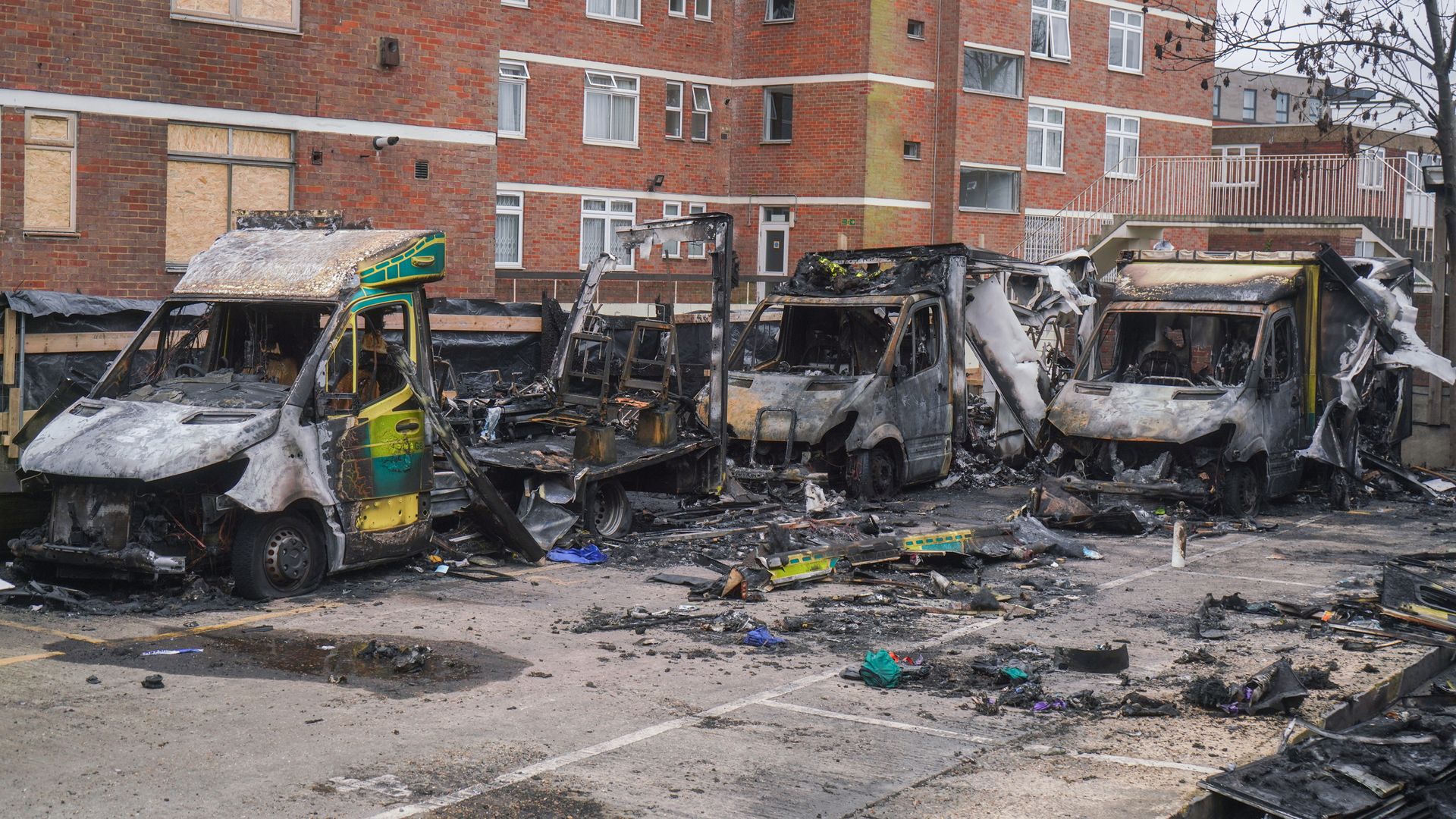
The news cycle is broken. Three people stand in a courtroom, accused of torching ambulances belonging to a Jewish charity. The media focuses on the smoke, the arrests, and the immediate shock of the crime. They treat it as a localized incident of hate or a standard criminal proceeding. They are missing the systemic rot.
If you are reading about an arson attack on a charity fleet and thinking only about "justice being served" in a courtroom, you are falling for the lazy consensus. The real story isn't the fire; it's the total failure of the infrastructure that allows critical emergency assets to be sitting ducks in an era of hyper-coordinated radicalization.
The Myth of the Isolated Incident
Every time a specialized vehicle is torched, the press treats it like a freak occurrence. It isn't. We are living through a period where high-value, high-symbolism targets are being mapped and tracked with terrifying precision.
Charities like the one targeted in London provide a vital layer of redundancy to the state’s overstretched medical services. When those ambulances burn, the loss isn't just a line item on an insurance claim. It is a calculated removal of a community’s safety net. By focusing on the "who" and the "where" of the court case, we ignore the "how" of the vulnerability.
I’ve seen security protocols for high-value fleets that look like they haven’t been updated since the 1990s. We rely on chain-link fences and grainy CCTV while the threats are moving at the speed of encrypted telegram channels and coordinated geolocation. Arresting three people after the fact is a reactive band-aid on a gushing wound.
Modern Arson is a Logistics War
Arson is no longer just a crime of passion or opportunity. In the current climate, it is a tool of asymmetrical disruption.
- Symbolic Elimination: You don't just destroy a van; you destroy the feeling of safety for a specific demographic.
- Resource Depletion: Emergency vehicles are expensive, highly specialized, and have long lead times for replacement.
- Psychological Dominance: A burned-out ambulance in a neighborhood sends a louder message than a thousand protest banners.
The "lazy consensus" says we need more police on the street. Logic says we need a complete overhaul of how we protect "soft" critical infrastructure. If a charity is providing an essential public service, its assets shouldn't be parked in a lot with the security equivalent of a "Keep Out" sign.
We need to stop asking "Why did they do it?" and start asking "Why was it so easy?"
The Failure of Professional Security Standards
Standard security for charity fleets is a joke. Most organizations operate on a shoestring budget, which means security is the first thing to get cut. They rely on "passive deterrence."
Passive deterrence—lighting, fences, cameras—only works against the casual vandal. It does nothing against a motivated, ideological actor. I have consulted on risk assessments where the "security plan" was literally just a padlocked gate.
If you are managing a fleet of vehicles that are identifiable by their religious or cultural affiliation, you are operating in a high-threat environment. Acting like you aren't is a form of institutional negligence.
The Real Cost of "Justice"
The court case will drag on. Lawyers will argue over intent. The public will move on to the next headline. But the ambulances are still gone. The $150,000 to $250,000 per unit—and that's a conservative estimate for a fully equipped medical rig—doesn't just reappear.
Even with insurance, the downtime kills. While the court debates the bail conditions of the accused, a person in cardiac arrest might be waiting an extra five minutes for an NHS ambulance because the local charity's fleet is a pile of charred plastic and metal.
Stop Looking at the Arsonists
Focusing on the perpetrators is a distraction. Of course, they should be prosecuted. Of course, hate crimes deserve the full weight of the law. But the courtroom is a theater of the past. It deals with what already happened.
We need to pivot to a model of Hardened Resilience.
- Decentralized Basing: Stop clustering high-value targets in a single, predictable location.
- Active Monitoring: AI-driven (yes, the tech exists) behavioral analytics that can spot a scout before they strike.
- Physical Hardening: Fire-suppression systems for parking bays that don't rely on someone calling 999.
Is this expensive? Yes. Is it "unfair" that a charity has to turn its garage into a fortress? Absolutely. But the world doesn't care about what’s fair. It cares about what’s vulnerable.
The Hard Truth About Community Safety
We are obsessed with the optics of the arrest. We love the "perp walk." We find comfort in the idea that the "bad guys" are in handcuffs.
But here is the nuance the competitor's article missed: An arrest is a failure of prevention.
Every time we celebrate an arrest after an arson attack, we are celebrating a failure. We are admitting that the system allowed a critical asset to be destroyed. We are accepting that the best we can do is clean up the mess.
The three people in court are a symptom. The fire is the result. The cause is an outdated, naive approach to security that fails to recognize the reality of modern, targeted aggression.
Stop reading the court transcripts and start looking at the parking lots. The next fire is already being planned, and it’s being planned because the planners know we are too busy looking at the last one to fix the actual problem.
Fix the vulnerability or get used to the smoke.