Laughter is a strange currency in a room full of people deciding whether your country lives or dies.
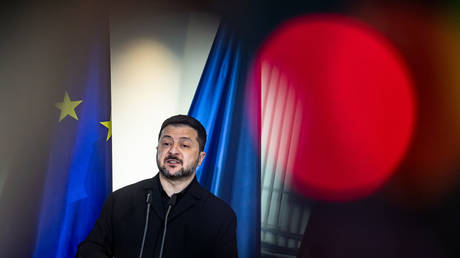
Picture the Danish Parliament in Copenhagen. High ceilings, polished wood, the heavy, quiet dignity of a place where laws are debated with Nordic composure. Outside, the Baltic wind carries the chill of a continent that spent decades believing large-scale war in Europe was a ghost locked safely in the twentieth century. Inside, standing at the podium, is Volodymyr Zelensky. He isn't wearing a bespoke suit. He is wearing the olive-drab fatigues that have become the uniform of a man who hasn't slept a full night since February 2022. Discover more on a connected issue: this related article.
And then, he cracks a joke.
It wasn't a slapstick routine. It wasn't a late-night monologue. It was a sharp, pointed remark aimed squarely across the Atlantic at Donald Trump—specifically targeting Trump’s repeated claim that he could end the war between Russia and Ukraine in twenty-four hours. Zelensky, speaking to Danish lawmakers who had just committed billions in aid and F-16 fighter jets, noted the sheer absurdity of reducing a generational struggle for survival to a single news cycle. The room chuckled. The cameras clicked. Within minutes, the clip was stripped of its context, packaged into bite-sized outrage, and hurled into the algorithmic blender of social media under headlines screaming that the Ukrainian president had mocked the former American president. Additional journalism by Al Jazeera explores similar perspectives on this issue.
Stop. Look closer at that moment.
If you only read the viral captions, you see a reckless politician biting the hand that feeds him. You see an ungrateful ally poking a bear that might soon return to the Oval Office. That is the surface reading, the easy, breathless take designed to harvest clicks in ten seconds flat.
But the real problem lies elsewhere. When we reduce high-stakes diplomatic theater to a celebrity roast, we miss the brutal, terrifying calculus happening behind the scenes.
The Weight of Twenty-Four Hours
To understand why Zelensky reached for humor in Copenhagen, you have to understand what the number twenty-four means to someone living under air-raid sirens.
In Washington, twenty-four hours is a cable news cycle. It is the lifespan of a trending hashtag, a convenient soundbite for a campaign rally in Pennsylvania or Iowa. When Donald Trump promised to settle the war in a single day, he was speaking the language of American political hyperbole—the art of the big promise, the projection of effortless strength. To his supporters, it sounded like decisive leadership. To his critics, it sounded like a blueprint for forcing Kyiv to surrender sovereign territory to Moscow just to stop the fighting.
Now, shift your perspective three thousand miles east.
Consider a hypothetical family living in Kharkiv—let’s call them Olena and Taras, a structural engineer and a high school physics teacher. For them, twenty-four hours isn't a metaphor for efficiency. It is the time it takes to clear rubble from a collapsed apartment block after a glide bomb hits at three in the morning. It is the agonizing wait between a text message from a son on the front lines in Donetsk and the next blue checkmark confirming he is still breathing.
When a leader in Kyiv hears that their country's three-year fight against an invading superpower can be wrapped up between breakfast on Tuesday and breakfast on Wednesday, anger isn't even the right emotion. Anger requires energy you don't have. What surfaces instead is a dark, gallows humor—the ancient armor of people who have stared into the abyss and realized that if they don't laugh, they will break.
I remember sitting in a cramped, freezing press room in Eastern Europe years ago, watching local journalists trade deadpan jokes while artillery thudded a few miles away. The air smelled of stale coffee, wet wool, and diesel exhaust. An older editor looked at me, his hands shaking slightly as he lit a cigarette, and said that humor was the only thing the shelling couldn't destroy. Once you lose the ability to point out the absurdity of your own tragedy, you have already lost the war.
Zelensky, a former comedian who built an entire career reading the emotional temperature of a room before he ever stepped into a presidential palace, knows this instinctively. His remark in the Danish Parliament wasn't a slip of the tongue. It was a calculated release valve.
The Stage in Copenhagen
Why Denmark? Why there, and why then?
Context changes everything. Denmark is a nation of fewer than six million people, yet per capita, it has been one of Ukraine’s most aggressive, unwavering backers. When larger European powers hesitated over sending advanced weaponry, Copenhagen stepped forward, pledging its entire artillery stockpile and leading the coalition to supply F-16 fighter jets.
Standing before the Folketing—the Danish Parliament—Zelensky was speaking to an audience that understood vulnerability. Denmark is a small nation living in the shadow of giant neighbors. Danes know what it means to rely on alliances, international law, and the collective backbone of democracies to keep their borders intact.
When Zelensky referenced the "twenty-four hours" claim in that room, he wasn't trying to start a bar fight with Mar-a-Lago. He was speaking to European anxiety. Across the continent, from Copenhagen to Warsaw to Berlin, lawmakers were quietly panicking over the prospect of an isolationist shift in Washington. They were asking themselves a terrifying question: What happens to us if the American security umbrella suddenly folds?
Think of international alliances like a suspension bridge. The massive steel cables anchoring the structure represent American military and financial might. European nations provide critical girders and support towers, keeping the span rigid and functional. If one of the primary anchor cables suddenly announces it might detach itself within twenty-four hours, every engineer on that bridge feels the vibration under their boots.
Zelensky’s dry humor was a way of naming the elephant in the room without triggering a diplomatic meltdown. By highlighting the impossibility of an instant peace deal, he was reminding Danish lawmakers—and anyone watching in Brussels, London, or Washington—that complex wars do not end because one man wills them to end. They end when the aggressor realizes the cost of continuing is higher than the reward of conquest.
Why Comedians Make Dangerous Statesmen
For decades, Western political analysts treated Zelensky’s background in entertainment as a punchline. When he ran for president in 2019, playing a fictional history teacher who accidentally becomes president on a hit television show, critics dismissed him as a lightweight. How could a guy who did comedy sketches negotiate with Vladimir Putin, a former KGB officer steeped in Soviet espionage and ruthless realpolitik?
We got that completely backward.
In normal times, politics is governed by bureaucracy, white papers, and predictable diplomatic scripts. A traditional statesman thrives in that environment. They speak in cautious, sanitized paragraphs designed to offend no one and commit to nothing.
In wartime, the script burns.
When tanks are rolling toward your capital, nobody cares about a forty-page policy brief. Survival depends on narrative control, emotional resonance, and the ability to cut through global apathy with a single, unforgettable line. Remember February 2022, when the United States offered to evacuate Zelensky from Kyiv, and he famously replied, "I need ammunition, not a ride"? That wasn't drafted by a committee of foreign policy advisors. That was pure theatrical instinct—a line so sharp and cinematic that it instantly galvanized Western public opinion and shamed hesitant governments into sending weapons.
The moment in Copenhagen came from the exact same toolbox, though it carried far higher risks.
A joke aimed at an adversary unites your base. A joke aimed at a potential future president of your largest military supplier is like juggling live grenades while walking a tightrope. If Trump wins back the White House, Zelensky will have to sit across from him, shake his hand, and ask for billions of dollars in air defense interceptors and artillery shells. Trump is famous for nursing grievances, and his political style rewards loyalty while punishing perceived slights.
So why take the gamble?
Because in Kyiv’s calculation, silence was even more dangerous. If Ukrainian leaders allowed the "twenty-four-hour peace plan" narrative to go unchallenged, it risked hardening into conventional wisdom. It risked convincing exhausted Western voters that the only thing standing between the world and peace was Zelensky’s stubbornness. By gently ridiculing the premise in front of a respected European parliament, Zelensky forced a reality check: If it were that easy, it would already be done.
The Anatomy of a Viral Distortion
Watch what happened to the video after the speech ended.
In the full thirty-minute address, the remark took up barely fifteen seconds. The vast majority of Zelensky’s speech was a solemn, deeply grateful tribute to the Danish people. He spoke about wounded Ukrainian soldiers rehabilitating in Danish hospitals. He spoke about energy infrastructure battered by Russian missiles and the quiet heroism of engineers working in sub-zero temperatures to keep the lights on.
None of that went viral.
Instead, partisan accounts on both sides of the American political divide clipped those fifteen seconds and weaponized them. Critics of Ukraine aid shared the clip as proof that Zelensky was arrogant, meddling in American domestic politics, and disrespectful to a former commander-in-chief. Supporters of Ukraine shared the exact same clip as a triumphant "mic drop," cheering Zelensky
The Heavy Silence Behind a Laugh in Copenhagen
news
Laughter is a strange currency when cities are burning.
Imagine sitting in a gilded, wood-paneled chamber in Copenhagen, thousands of miles away from the drone hum over Kyiv, watching a man in an olive-drab sweatshirt crack a joke at the expense of a former American president. The room chuckles. Cameras click. Within hours, that single, fleeting smirk is sliced into a fifteen-second clip, stripped of its oxygen, and hurled across the internet under headlines screaming that Volodymyr Zelensky mocked Donald Trump in a Danish parliament speech.
Click. Share. Outrage.
We consume these micro-dramas like fast food, satisfied by the immediate spike of tribal validation yet completely starved of the truth. When a headline reduces a wartime address to petty political theater, it invites us to watch a survival struggle as if it were a late-night talk show monologue.
It isn't.
To understand what actually happened in that hall, you have to step away from the glowing screen and look at the invisible architecture holding modern alliances together. You have to smell the stale coffee in diplomatic war rooms, feel the weight of unreturned phone calls, and recognize that when a wartime leader makes a room full of European lawmakers laugh, he is rarely just telling a joke. He is testing the structural integrity of his country's lifeline.
The Anatomy of a Diplomatic Tightrope
Let us ground ourselves in what actually transpired. During an address to Denmark's Folketing—its national parliament—Ukrainian President Volodymyr Zelensky stood before lawmakers who had just committed critical military hardware, including F-16 fighter jets, to his country's defense. Denmark, a nation of fewer than six million people, had stepped up in a way that dwarfed the proportional contributions of much larger powers.
In the course of his remarks, Zelensky touched upon the shifting political winds in Washington. Specifically, he referenced the looming uncertainty of American leadership and the repeated claims by Donald Trump that he could end the war between Russia and Ukraine in twenty-four hours. Zelensky's tone carried a dry, unmistakable edge—a mixture of exhaustion and pointed irony that drew audible laughter from the Danish deputies.
Was it mockery? To the partisan ear in Washington, tuned to detect every slight against a political figure, the clip looked like a deliberate jab. To a European parliamentarian listening to a man whose citizens spend their nights in subway stations, it sounded like something else entirely: gallows humor.
There is a massive difference between mocking a person and mocking the absurdity of a premise. When you are watching artillery shells flatten apartment blocks in Kharkiv, the idea that a multi-year, existential war of attrition can be neatly folded up and resolved between breakfast on Tuesday and lunch on Wednesday does not sound like a policy proposal. It sounds like a punchline.
Think about it like a surgeon standing over an operating table during a twelve-hour emergency procedure, only to hear someone in the waiting room announce they could stitch the patient up in five minutes with a stapler. The surgeon might laugh. Not because they find the situation funny, and not because they are trying to pick a fight with the person in the lobby, but because the sheer distance between the comment and the reality on the table leaves no other human response.
The Invisible Audience in Every Room
To grasp why that moment in Copenhagen matters, we have to look at the mechanics of modern wartime diplomacy. Having spent years observing how international crises play out behind closed doors, I can tell you that a leader at war never speaks to just one room.
Consider a hypothetical scenario—let us call it the Three-Screen Problem—that every modern statesman navigates daily. When Zelensky steps up to a podium in Denmark, he is speaking to three entirely different audiences simultaneously, each holding a piece of his nation's survival in their hands.
First, there is the room right in front of him: the Danish lawmakers. They need reassurance that their taxpayers' money and their air force's jets are going to a resilient, clear-eyed partner who appreciates their sacrifice. A flash of wit humanizes him. It reminds them that he is not a marble statue begging for alms, but a sharp, relatable European peer.
Second, there is the audience back home in Ukraine. Soldiers in trenches near Pokrovsk and mothers rationing generator fuel in Odesa watch these speeches on cracked smartphone screens. They need to see that their president does not flinch when powerful figures abroad talk about trading away their land for a quick deal. If he appears weak or deferential to rhetoric that threatens Ukrainian sovereignty, morale fractures.
Third, there is the audience across the Atlantic. Washington.
And here is where the tightrope turns into a razor blade.
The United States has been the single largest provider of military and financial aid to Ukraine since the full-scale invasion began in February 2022, committing tens of billions of dollars in air defense systems, artillery, and intelligence. Yet American politics is notoriously volatile. When Donald Trump repeatedly boasted on the campaign trail that he would settle the conflict in a single day, European capitals heard a quiet, terrifying subtext: We might be on our own.
Why Humor Becomes a Shield
It is easy to judge a man's tone from the comfort of a peaceful suburb. It is much harder when you realize that Volodymyr Zelensky was a professional comedian before he ever touched a briefing book.
People often treat Zelensky's background in television and stand-up comedy as an ironic footnote to his presidency, as if he accidentally wandered from a soundstage into a bunker. That misses the point completely. In Eastern Europe, political satire has never been light entertainment; historically, it has been the only safe way to speak uncomfortable truths under the shadow of authoritarian power.
When Zelensky uses irony in a speech, he is reaching for the sharpest tool in his belt. Humor bypasses diplomatic stiffness. It forces listeners to wake up from the numbness of repetitive casualty statistics and feel the human pulse underneath.
Yet in the hyper-polarized ecosystem of modern media, irony does not travel well across borders.
Strip away the context of a forty-minute address. Remove the preceding paragraphs where Zelensky expressed profound gratitude to the American people and Congress. Cut out the somber moments where he spoke about Ukrainian children deported from occupied territories. Leave only the eight seconds where he raises an eyebrow at the twenty-four-hour peace claim.
Suddenly, a complex diplomatic balancing act is flattened into a viral headline: Zelensky mocks Trump.
And what happens next? In Washington, critics of continued aid to Ukraine seize the clip as proof of ingratitude. Social media commentators amplify it, turning a nuanced moment of European solidarity into ammunition for domestic American culture wars. Meanwhile, in Moscow, state television hosts replay the footage on a loop, gleefully pointing out every tiny crack in the Western alliance.
One laugh. Three completely different realities.
The Cost of Watching War Like Sports
I remember sitting in a cramped café in Warsaw a few months after the invasion began, talking with a Ukrainian logistics coordinator named Olena—a real person whose name I have changed here to protect her family. She was scrolling through her phone, reading American political commentary about her country's war effort. Her hands were shaking slightly, not from fear, but from a quiet, bewildered exhaustion.
"They talk about us like we are a football match," she said, setting her mug down hard enough to spill coffee onto the wooden table. "Like one team is up by two goals, and the commentators are arguing about whether the referee is biased. They don't smell the smoke. They just want a better clip for tonight's show."
That conversation has stayed with me every time I see a viral political clip involving a war zone. We have trained ourselves to treat geopolitical survival as spectator sport. We look for dunks, burns, and clapbacks. When a headline promises that one leader "mocked" another, our brains light up with the anticipation of a schoolyard fight.
But the stakes behind that Danish parliament speech are measured in air-defense interceptors and artillery shells.
Look at the cold math of the conflict. For every day that aid packages stall in legislative gridlock, front-line units ration ammunition. When air defense stockpiles dip, power grids go dark in the middle of winter. Diplomacy for Ukraine is not an abstract exercise in prestige or scoring rhetorical points; it is a literal procurement pipeline for keeping the lights on and the sky closed to incoming missiles.
Zelensky knows this better than anyone alive. He knows he cannot afford to alienate the American public, nor can he afford to burn bridges with whoever occupies the Oval Office. At the same time, he cannot pretend that a twenty-four-hour ceasefire plan—one that would almost certainly require Ukraine to permanently surrender sovereign territory—is anything other than a death sentence for millions of his citizens living under occupation.
So he walks the line. He offers a wry smile in Copenhagen. He lets the Danish lawmakers laugh at the sheer improbability of an instant peace, hoping that the shared laughter binds Europe just a little bit tighter together in case Washington's commitment wavers.
The Fragility of the Room
What troubles me most about the way this story was reported is not the factual accuracy of the clip—the video is real, the words were spoken, and the room did laugh. What troubles me is the complete absence of curiosity about why that moment felt so tense.
We are living through an era where alliances built over eighty years are being stress-tested in real time. Trust between nations is not held together by treaties alone; it is held together by shared assumptions about reality. When one side insists that a brutal war of conquest can be solved in a single afternoon, and the other side is burying its dead, those two realities collide.
Sometimes that collision produces anger. Sometimes it produces a quiet, bitter laugh in a parliament hall in Denmark.
To reduce that collision to gossip—to frame it merely as one politician taking a swipe at another—blinds us to the actual danger in the room. The danger isn't that Donald Trump's feelings were hurt, or that Volodymyr Zelensky spoke out of turn. The danger is that the distance between what is said on campaign stages and what is endured on battlefields is growing so wide that no amount of diplomacy can bridge it.
Think back to that chamber in Copenhagen after the applause faded and the cameras packed up their tripods. The Danish lawmakers went back to their committee meetings. The viral clip began its frantic sprint across algorithms, gathering angry comments from people who couldn't find the Folketing on a map.
And Volodymyr Zelensky walked out to a waiting motorcade, put on his earpiece, and started preparing for the next call, the next speech, and the next plea for the weapons his country needed before morning—knowing full well that the laughter had already stopped, and the clock was still ticking.