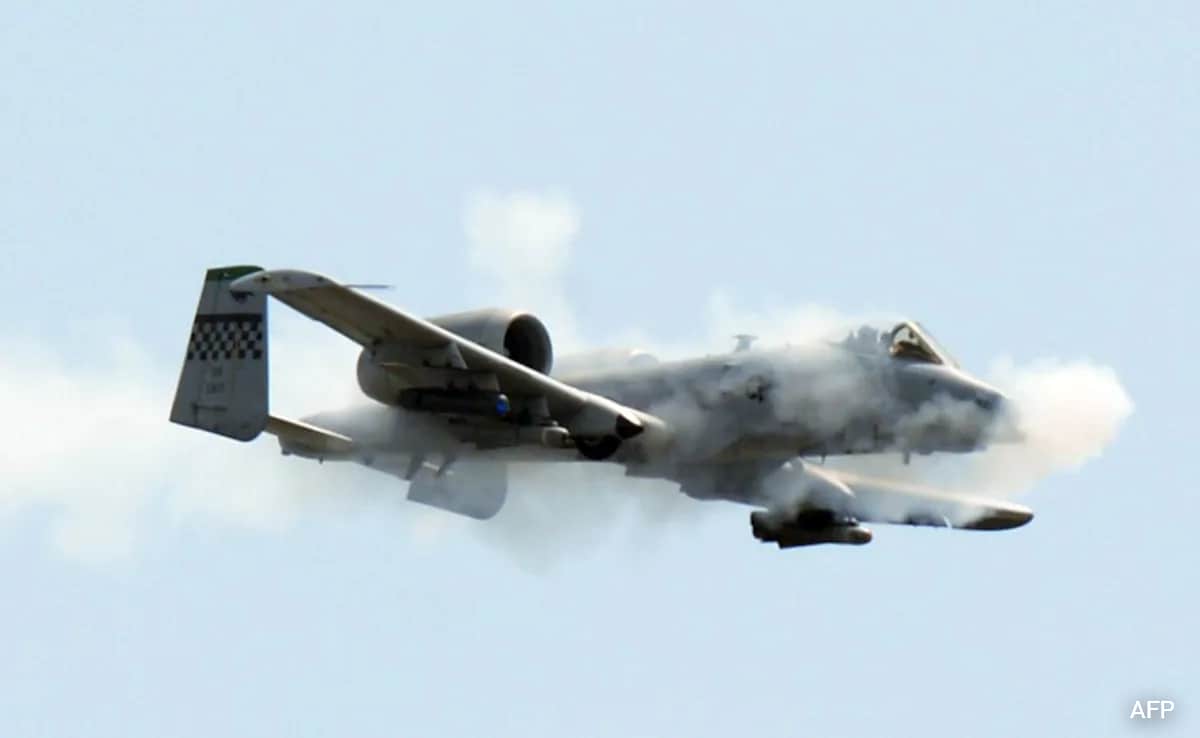
The reported downing of a United States A-10 Thunderbolt II by Iranian forces near the Strait of Hormuz represents a collision between Cold War-era close air support (CAS) doctrine and modern Integrated Air Defense Systems (IADS). Verifying such an engagement requires moving beyond state-sponsored rhetoric and analyzing the intersection of electromagnetic signatures, kinetic envelopes, and the structural resilience of the airframe in question. The strategic utility of the A-10 in the Persian Gulf is fundamentally tethered to its ability to loiter in contested maritime environments, a mission profile that inherently increases exposure to short-range air defense (SHORAD) and man-portable air-defense systems (MANPADS).
The Mechanics of Maritime Interdiction and Airframe Vulnerability
The A-10 Thunderbolt II, colloquially known as the Warthog, was engineered for high-intensity tank-killing operations in Central Europe. Its transition to the maritime chokepoints of the Middle East introduces a specific set of operational stressors. Unlike high-altitude stealth platforms, the A-10 operates within the "engagement heart" of most modern Iranian surface-to-air missile (SAM) systems.
The survivability of the A-10 relies on three primary redundant systems:
- Manual Flight Control Reversion: The aircraft uses a triple-redundant flight control system. If hydraulic pressure is lost, the pilot can switch to a mechanical cable system to maintain control.
- Titanium Armor (The Bathtub): A 1,200-pound titanium alloy cradle protects the pilot and critical flight systems from 23mm high-explosive incendiary rounds.
- Engine Displacement: The high-mounted General Electric TF34-GE-100 turbofans are positioned to mask their heat signature from ground-based infrared seekers and allow the vertical stabilizers to shield the exhaust.
Iranian claims of a successful shoot-down must be weighed against these design redundancies. A "hit" in the context of an A-10 does not equate to a "kill." Historically, the platform has returned to base with significant portions of its wing structure or a literal engine missing. For an A-10 to be confirmed "downed," the terminal ballistic event must overcome these mechanical fail-safes or target the fuel system in a manner that bypasses the self-sealing liners and fire-retardant foam.
The Iranian IADS Architecture in the Hormuz Sector
Iran’s defensive strategy in the Strait of Hormuz is defined by "Area Denial" through a layered network of indigenous and imported sensors. The claim of downing a U.S. asset suggests the involvement of specific tiered systems.
The 3rd Khordad medium-range SAM system, which gained notoriety for downing a U.S. RQ-4 Global Hawk in 2019, utilizes an X-band phased-array radar. This system provides the precision tracking necessary to guide missiles like the Taer-2B toward a target the size of an A-10. Alternatively, if the engagement occurred at lower altitudes, the Mersad or Ya Zahra systems—evolutions of Western technology—would be the primary actors.
The technical bottleneck for Iranian forces is the electronic warfare (EW) environment. The A-10 is typically supported by dedicated SEAD (Suppression of Enemy Air Defenses) assets or carries the ALQ-131/184 jamming pods. A successful strike implies either a failure in the A-10’s defensive aids suite or a sophisticated "silent" engagement using passive infrared tracking (IRST), which does not trigger the aircraft's Radar Warning Receiver (RWR).
Quantifying Information Warfare and OSINT Verification
In modern geopolitical friction, the kinetic event is often secondary to the information cycle. The validity of the Iranian claim can be tested through three distinct data streams:
Signal Intelligence (SIGINT) and Transponder Data
The Strait of Hormuz is one of the most heavily monitored geographic points on Earth. Any kinetic engagement triggers a surge in electromagnetic activity. If an A-10 were downed, Search and Rescue (SAR) frequencies would show immediate activation. Combat Search and Rescue (CSAR) assets, typically HC-130J aircraft or HH-60 Pave Hawk helicopters, would be scrambled from regional bases like Al Dhafra. The absence of such flight patterns in open-source flight tracking (ADSB-Exchange) or satellite imagery of the purported crash site creates a high probability of fabrication.
The "Battle Damage" vs. "Loss" Distinction
The A-10 is a slow-moving target, cruising at approximately 300 knots. This makes it an attractive target for psychological operations. Iranian military leadership often conflates "locking onto" or "targeting" an aircraft with an actual kinetic kill. In the logic of asymmetric signaling, forcing a U.S. pilot to jettison external fuel tanks or break a patrol pattern is often presented as a victory to domestic audiences, regardless of the aircraft's physical state.
Satellite Imagery and Debris Field Analysis
A crash in the shallow waters of the Strait would leave a predictable debris field and hydrocarbon sheen. Commercial satellite providers like Maxar or Planet Labs can identify these anomalies within a 24-hour window. Given the A-10's weight—roughly 30,000 pounds empty—a water impact would create a significant and visible underwater wreckage site in the relatively clear waters of the Gulf.
The Economic and Strategic Calculus of A-10 Deployment
The decision to fly A-10s over the Strait of Hormuz, rather than F-35s or F/A-18s, is a statement of resource allocation. The A-10's hourly operating cost is significantly lower than that of 5th-generation fighters, making it an efficient tool for "presence missions" and counter-swarm operations against Iranian fast-attack craft (FAC).
However, this efficiency introduces a risk-reward imbalance. The A-10's lack of stealth makes it a "provocation magnet." By placing a platform that is visually iconic and technologically vulnerable (relative to the F-22) in range of Iranian batteries, the U.S. creates a scenario where a tactical success for Iran yields a massive strategic PR dividend.
The "Cost Function" of an A-10 loss:
- Replacement Cost: The A-10 is no longer in production; any hull lost is an irreplaceable reduction in the total inventory.
- Political Capital: Losing a pilot in the Strait of Hormuz would likely force a kinetic escalation that neither Washington nor Tehran currently seeks.
- Technology Transfer: Even a crashed A-10 contains avionics and EW systems that, if salvaged by Iranian or Russian intelligence, would provide insights into U.S. mission computer logic.
Signal vs. Noise in the Persian Gulf
The current report must be categorized as a "High-Impact, Low-Probability" event until visual evidence of wreckage is provided. Iran’s military communications often utilize "reflexive control"—a technique designed to alter a competitor's behavior by feeding them specific information. By claiming a downing, Iran seeks to discourage low-altitude U.S. patrols and force the Air Force to use more expensive, high-altitude assets that are less effective at identifying small-boat movements.
The structural integrity of the A-10 remains its greatest defense. If an engagement did occur, the most likely outcome is a damaged airframe that successfully recovered to a regional airstrip under manual reversion. The absence of a massive CSAR operation or a Pentagon confirmation suggests that if metal met metal, the A-10’s design philosophy—prioritizing survival over sophistication—prevailed.
The strategic play here is for U.S. Central Command to maintain operational tempo while increasing the integration of unmanned surface vessels (USVs) to perform the loitering observation roles currently held by the A-10. This reduces the "PR target" available to Iranian air defenses without conceding control of the waterway. If Tehran cannot produce a serial number or a tail section, the event remains an exercise in electromagnetic posturing rather than a shift in the regional balance of power.



