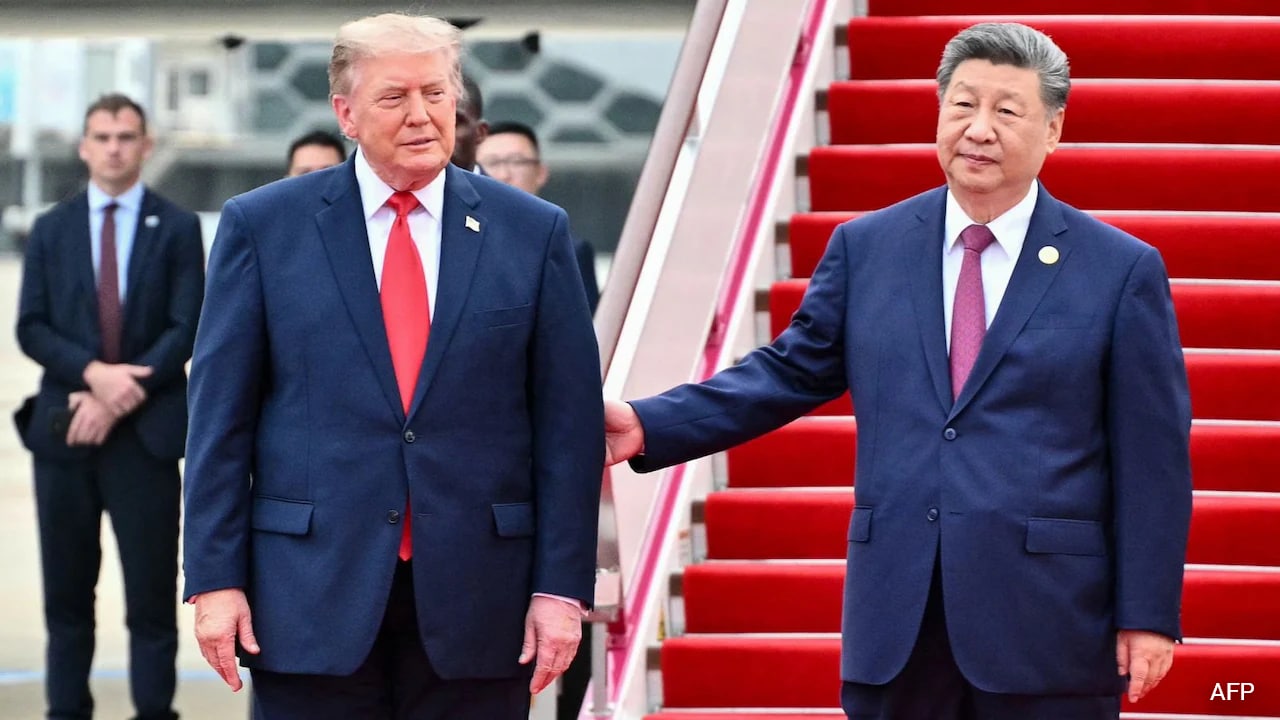
Projecting geopolitical dominance abroad requires uninterrupted operational reliability at home. When an executive administration conducts high-visibility diplomatic engagements with a primary strategic competitor like China, any simultaneous failure in domestic technological infrastructure creates an immediate credibility deficit. Reporting and commentary surrounding President Donald Trump's diplomatic posture toward Beijing alongside concurrent domestic technological disruptions highlight a fundamental structural vulnerability in modern statecraft: the decoupling of external strategic signaling from internal systems resilience.
To understand why domestic technical malfunctions undermine foreign policy leverage, analysts must evaluate state power not as a collection of isolated policy announcements, but as an integrated socio-technical system. In international relations theory, credible deterrence depends on perceived capability and institutional competence. If a state's domestic communication networks, aviation control systems, or executive digital infrastructure experience visible, unforced errors while leadership attempts to negotiate from a position of strength, the adversary's calculus shifts. The counterparty observes a gap between projected executive authority and actual operational execution. For an alternative view, check out: this related article.
The Architecture of Strategic Signaling
Diplomatic statecraft relies on costly signaling—actions and postures that demonstrate resolve and capability because they cannot be easily faked by a weak actor. When a U.S. administration engages Beijing on trade deficits, intellectual property enforcement, semiconductor export controls, or regional security in the Indo-Pacific, the underlying leverage rests on American technological and economic supremacy.
However, strategic signaling operates across two distinct theaters simultaneously: Similar analysis regarding this has been shared by BBC News.
- The External Diplomatic Theater: Controlled environments such as bilateral summits, formal state visits, tariff announcements, and orchestrated media appearances designed to project unilateral strength and executive command.
- The Domestic Operational Theater: The real-time performance of national infrastructure, federal communications, transportation networks, and public-facing digital platforms that validate or contradict the external narrative.
Media coverage of Trump's China engagements frequently notes the contrast between the administration's assertive rhetoric abroad and recurring technical glitches within domestic government or campaign-adjacent communications systems. While commentators often treat these events as mere political embarrassment or media distraction, a systems-engineering perspective reveals a deeper mechanics problem. High-stakes diplomacy compresses the margin for error. During a summit or major trade negotiation, global media and foreign intelligence apparatus scrutinize every transmission originating from the executive branch and domestic infrastructure. A dropped broadcast feed, a compromised scheduling platform, or a cascading failure in public infrastructure becomes a data point in the adversary's assessment of institutional decay.
Deconstructing Domestic Technological Snafus
Technological failures during high-profile political operations rarely stem from a single catastrophic flaw. Instead, they represent predictable failure modes in complex, tightly coupled systems operating under stress. Categorizing these disruptions exposes the structural causes behind seemingly random glitches:
- Legacy Infrastructure Debt: Federal agencies and critical national utilities routinely operate on decades-old software architectures patched together with modern interfaces. When peak demand or heightened security protocols are applied during major diplomatic events, latency spikes and interface bottlenecks emerge.
- Protocol and Communication Fragmentation: Rapidly assembled diplomatic or political teams often bypass standardized, hardened institutional communication channels in favor of commercial or ad-hoc platforms. This introduces configuration drift, unpatched endpoints, and synchronization failures across time zones.
- Human-Machine Interface Friction: Under the compressed timelines of international diplomacy, operators face cognitive overload. Misconfigured permissions, unverified software updates pushed during live operations, and inadequate failover testing turn minor configuration errors into public-facing outages.
- Supply Chain and Vendor Opacity: Modern government and commercial operations rely on multi-tiered cloud and telecommunications vendors. An upstream routing error or certificate expiration at a third-party provider can disrupt executive communications without any direct fault by the immediate operational team, yet the political accountability remains centralized at the executive level.
Observers and critics point out that when these malfunctions occur during a trip to Asia or amid tense trade negotiations with Beijing, they invite immediate scrutiny from domestic political opponents and foreign state media alike. State-controlled outlets in Beijing routinely amplify Western infrastructure disruptions—ranging from aviation software outages to telecommunications blackouts—to construct a counter-narrative of American systemic decline versus centralized Chinese efficiency.
The Feedback Loop Between Domestic Fragility and Foreign Leverage
In negotiation theory, Best Alternative to a Negotiated Agreement (BATNA) determines leverage. For the United States in negotiations with China, the implicit BATNA is economic decoupling and technological self-reliance—demonstrating that the U.S. innovation ecosystem can out-innovate and out-produce state-directed competitors without relying on Chinese supply chains or markets.
Domestic technological snafus directly erode the perceived strength of that BATNA through three mechanisms:
- Erosion of the Competence Premium: American soft power and negotiating leverage rest heavily on the reputation of Silicon Valley and U.S. engineering superiority. Publicized technical failures in basic digital execution—such as malfunctioning live-streams, broken federal portals, or disrupted transit networks—dilute the brand equity of American technological leadership.
- Diversion of Executive Bandwidth: Crisis management is a zero-sum resource. When senior officials must divert attention from complex bilateral negotiations to address domestic operational failures, congressional inquiries, or media fallout, their cognitive and strategic focus on the primary diplomatic objective degrades.
- Asymmetric Information Exploitation: Adversaries monitor open-source operational failures to map institutional response times. Watching how domestic agencies handle a routine technical glitch provides foreign analysts with telemetry on crisis escalation protocols, inter-agency coordination speed, and public messaging vulnerabilities.
This dynamic illustrates a critical distinction between tactical political communication and strategic institutional readiness. A leader can command a room in Beijing or project strength through aggressive tariff schedules, yet remain constrained by the underlying reliability of the domestic apparatus supporting the presidency.
Evaluating Causal Mechanisms Versus Political Narratives
When analyzing news reports that juxtapose foreign policy strength with domestic technical errors, practitioners must separate correlation from structural causation. Not every domestic outage is connected to foreign policy execution, and attributing routine IT failures to grand geopolitical decline is analytically unsound.
- Established Fact: Complex digital and physical infrastructure experiences regular baseline failure rates regardless of the diplomatic calendar. Telecommunications outages, software bugs, and administrative miscommunications occur across all administrations.
- Established Fact: High-visibility diplomatic events act as an attention multiplier. Media outlets, domestic opposition, and foreign rivals apply heightened scrutiny to the executive branch during foreign summits, elevating minor technical glitches into front-page narratives.
- Educated Hypothesis: The accelerated pace of modern executive decision-making, combined with a preference for lean, loyalist operational teams over traditional bureaucratic vetting, increases the probability of unforced technical errors during high-stress overseas operations. Bypassing established State Department or White House Communications Agency (WHCA) protocols to maintain operational agility often trades away redundancy and failover protection.
Furthermore, a balanced assessment requires acknowledging the dual-edged nature of technological visibility. Open democracies report, litigate, and publicly dissect their technical failures in real time. Authoritarian systems like the Chinese Communist Party suppress domestic infrastructure failures, censorship glitches, and economic bottlenecks through strict state media control. Consequently, an asymmetry of perception emerges: American snafus are transparent and amplified globally, while Chinese systemic vulnerabilities remain opaque until they reach critical mass.
Operationalizing Resilience in High-Stakes Statecraft
To prevent domestic technological friction from undermining foreign policy objectives, executive operations and institutional managers must treat domestic infrastructure stability as a prerequisite for diplomatic projection. Relying on ad-hoc troubleshooting during live international engagements is a losing strategy.
- Enforce Freeze Windows on Non-Critical Infrastructure: Borrowed from enterprise software deployment, executive agencies and affiliated operational teams must implement strict configuration freezes 72 hours prior to and throughout major bilateral summits. No unvetted software updates, routing changes, or platform migrations should occur while principals are in transit or in active negotiations.
- Mandate Redundant, Out-of-Band Communication Architectures: High-level delegations must decouple public-facing media infrastructure from core command-and-control communications. Utilizing hardened, isolated networks with pre-tested physical and satellite failover ensures that commercial cloud or telecommunications glitches do not interrupt diplomatic coordination.
- Audit Third-Party Vendor Dependencies: Before major foreign policy rollouts, operational teams must map single points of failure across commercial SaaS providers, content delivery networks, and telecommunications carriers, establishing dedicated incident-response escalation paths with private-sector engineers.
- Integrate Technical Readiness into Diplomatic War-Gaming: Standard diplomatic preparation focuses on policy briefs, economic modeling, and behavioral profiling of foreign counterparts. Operational planners must integrate red-team technical stress testing into summit preparation, simulating domestic infrastructure disruptions during peak negotiation windows to streamline crisis messaging and prevent executive distraction.
Limitations of Technical Hardening
Even the most disciplined operational protocols cannot eliminate systemic friction entirely. Hyper-complex networks inherently exhibit normal accidents—unanticipated interactions between independent subsystems that cascade rapidly. Over-securing communication channels can introduce latency and usability friction that slows down rapid diplomatic maneuvering, tempting principals to revert to insecure, convenient commercial tools. Moreover, no amount of technical reliability can compensate for incoherent policy objectives or misaligned economic fundamentals at the negotiating table. Technology is an enabler of leverage, not a substitute for strategy.
Strategic Forecast and Execution
As geopolitical competition between Washington and Beijing intensifies across artificial intelligence, semiconductors, and telecommunications standards, the boundary between domestic technical execution and foreign policy credibility will disappear entirely. Future administrations cannot afford to treat domestic IT infrastructure, public digital services, and executive communications as secondary administrative functions.
The immediate strategic imperative for executive leadership is to unify operational engineering with diplomatic planning. Before launching the next major trade offensive or high-level bilateral summit with Beijing, leadership must execute a comprehensive operational readiness audit across all public-facing and executive communication systems, locking down single points of failure so that domestic technical execution reinforces, rather than contradicts, the projection of national strength abroad.