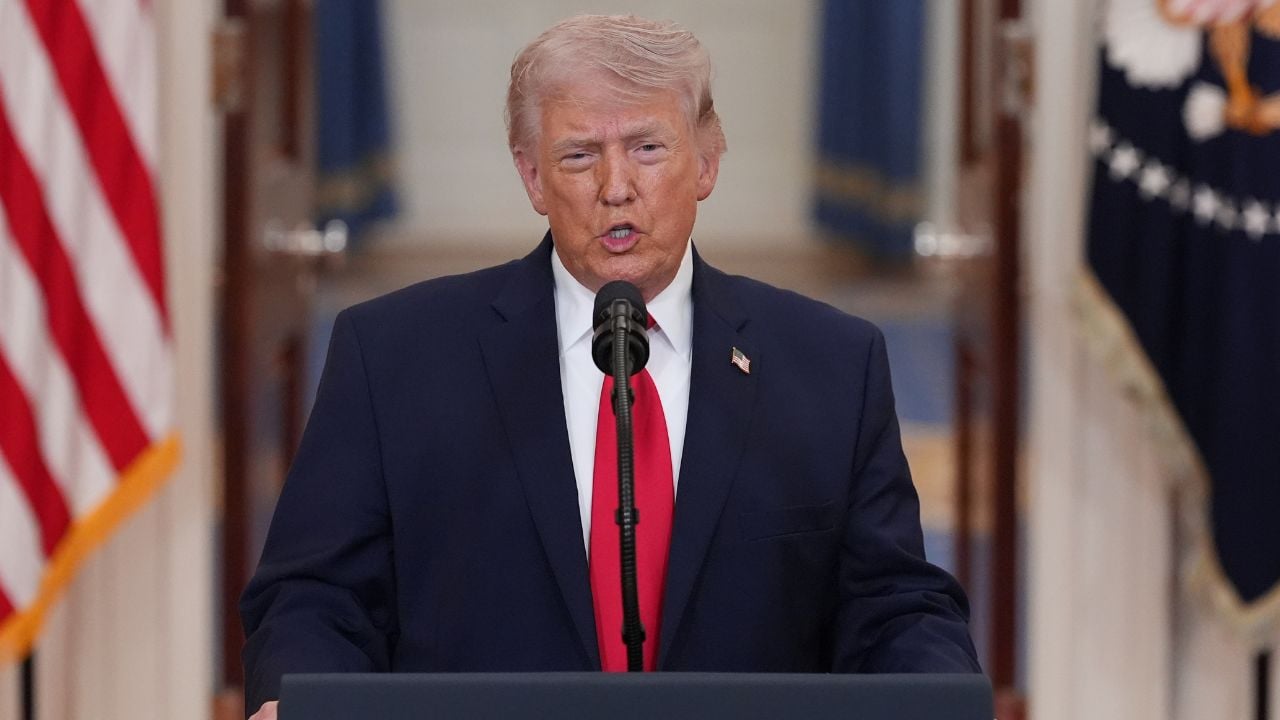
The rhetoric of "total destruction" or the "end of a civilization" serves as a blunt instrument of psychological warfare, but beneath the hyperbole lies a quantifiable framework of kinetic and economic risks. When a superpower threatens the dissolution of a sovereign regime, it shifts the operational calculus from limited engagement to an existential survival game. For the United States, the primary constraint is the global energy supply chain; for Iran, it is the preservation of internal command structures and regional proxy depth.
The Kinetic Equilibrium of the Strait of Hormuz
The Strait of Hormuz functions as the world's most sensitive economic chokepoint. Approximately 21% of global petroleum liquids consumption passes through this narrow waterway. Any military action that targets the Iranian state must account for the immediate "Hormuz Variable"—the Iranian military's ability to execute an anti-access/area denial (A2/AD) strategy.
The Iranian tactical doctrine does not rely on conventional naval superiority, which it lacks. Instead, it utilizes a "swarm-and-mine" methodology. This involves:
- Saturation Attacks: Deploying hundreds of fast-attack craft armed with short-range missiles to overwhelm the Aegis Combat Systems of U.S. destroyers.
- Subsurface Interdiction: Utilizing Kilo-class and midget Ghadir-class submarines to deploy smart mines in deep-water shipping lanes.
- Coastal Battery Redundancy: Mobile Silkworm and Noor missile batteries hidden in the rugged topography of the Iranian coastline, making them difficult to neutralize via preemptive air strikes.
The cost function of a conflict here is not measured in hulls lost, but in the time required to clear the waterway. If the Strait is closed for even 14 days, global oil prices face a projected spike of $30 to $50 per barrel, triggering an immediate inflationary shock in G7 economies.
The Proxy Multiplier and Regional Contagion
A direct strike on Tehran does not occur in a vacuum. It triggers a pre-programmed response from the "Axis of Resistance," a network of non-state actors that function as Iran’s external defense perimeter. This creates a multi-front theater that dilutes U.S. and allied resources.
- Levant Theater: Hezbollah possesses an estimated 150,000 rockets and missiles aimed at Israeli infrastructure. A full-scale war forces Israel into a high-intensity defensive posture, requiring massive U.S. logistical support.
- Mesopotamian Theater: Shia militias in Iraq, such as Kata'ib Hezbollah, shift from political actors to active insurgents, targeting U.S. personnel at Al-Asad Airbase and diplomatic facilities in Baghdad.
- Yemeni Theater: The Houthis utilize the Bab al-Mandab Strait to mirror the Hormuz blockade, effectively closing the Red Sea to commercial traffic and doubling the transit time for goods moving between Asia and Europe.
This distributed warfare model ensures that even if the central Iranian state is decapitated, the conflict persists as a decentralized, attritional campaign across the Middle East.
The Collapse of Diplomatic Signaling
Escalation reaches a point of no return when signaling becomes noise. The current diplomatic friction is characterized by a "Credibility Gap." The U.S. utilizes maximalist threats to force Iran to the negotiating table, while Iran utilizes tactical provocations (shooting down drones, seizing tankers) to demonstrate that the U.S. cannot protect its regional interests without a high cost in blood and treasure.
The breakdown occurs because of mismatched objectives. The U.S. seeks "Behavioral Change"—a halt to nuclear enrichment and regional interference. Iran views these two elements as its only "Survival Insurance." When a state perceives that its fundamental security pillars are being targeted, it loses the incentive to de-escalate. In game theory terms, this is a Zero-Sum interaction where the dominant strategy for both players becomes "Defect" rather than "Cooperate."
The Economic Attrition Logic
Sanctions are often described as "crippling," but their efficacy has a diminishing marginal return. Iran has spent decades developing a "Resistance Economy." This system is built on:
- Grey Market Exports: Utilizing "ghost fleets" to sell crude oil to independent Chinese refineries (teapots) at a discount, bypassing the SWIFT banking system.
- Industrial Autarky: Developing domestic manufacturing capabilities for essential goods, reducing the impact of import bans.
- Regional Barter: Trading energy for food and raw materials with neighbors like Iraq and Turkey, often using local currencies to avoid the U.S. Dollar.
The limitation of this strategy is the depletion of foreign exchange reserves. While the regime can survive, the civilian population bears the brunt of currency devaluation and hyperinflation. This creates an internal pressure cooker. The U.S. strategy bets on this pressure leading to an internal coup or revolution, but historical data on authoritarian regimes suggests that external threats often consolidate power by allowing the state to label all dissent as "foreign espionage."
The Nuclear Breakout Threshold
The most dangerous variable is the "Nuclear Breakout Time"—the duration required to produce enough weapons-grade uranium for a single device. As conventional options are exhausted, the likelihood of Iran crossing this threshold increases.
If Iran perceives that a U.S. invasion is imminent, the rational choice from a survivalist perspective is to achieve nuclear deterrence as quickly as possible. This creates a "Preemption Paradox": the very threat of force intended to stop nuclear proliferation may be the catalyst that ensures it happens.
The enrichment levels at facilities like Natanz and Fordow are the primary metrics for this risk. Moving from 20% enrichment to 90% (weapons grade) requires significantly less effort than moving from 0% to 5%. The physics of enrichment means that 90% of the work is already done once you reach the 20% mark.
Strategic Reconstitution or Total War
The path to a full-scale US-Iran war is paved with tactical miscalculations. A single misidentified radar blip or a rogue militia commander can trigger a kinetic chain reaction that neither Washington nor Tehran can easily halt.
The U.S. military possesses the capability to destroy the Iranian conventional military within weeks. However, the subsequent "Occupation Void" would be catastrophic. Iran’s geography—a central plateau surrounded by mountain ranges (the Zagros and Alborz)—makes it a natural fortress. For comparison, Iran is nearly four times the size of Iraq and has a population of over 85 million. An occupation would require a troop commitment that exceeds the current total active-duty strength of the U.S. Army and Marine Corps combined.
The Strategic Pivot
The only viable long-term strategy that avoids a global economic depression and a generational war involves a shift from "Maximum Pressure" to "Contained Competition." This requires:
- Regional Security Architecture: Establishing a direct "Hotline" between the U.S. Fifth Fleet in Bahrain and the IRGC Navy to prevent accidental skirmishes from escalating.
- Limited Sanctions Relief for Verification: Creating a tiered system where specific economic sectors (e.g., medicine, civilian aviation) are opened in exchange for verifiable freezes in enrichment levels.
- Proxy Decoupling: Negotiating local ceasefires in Yemen and Iraq to reduce the number of potential flashpoints where U.S. and Iranian interests collide.
The objective is not a grand bargain or a total peace, which is currently impossible. The objective is the management of a high-risk rivalry. The alternative—a total war aimed at the "destruction of a civilization"—is a mission without an achievable end-state, characterized by infinite costs and negligible gains in regional stability.
The immediate tactical move for any administration is to secure the "Hormuz Transit Guarantee" through multilateral naval patrols while simultaneously opening a back-channel in a neutral third-party location like Muscat or Geneva. Failure to de-link the energy markets from the political rhetoric ensures that the next tactical skirmish becomes a global financial catastrophe.


