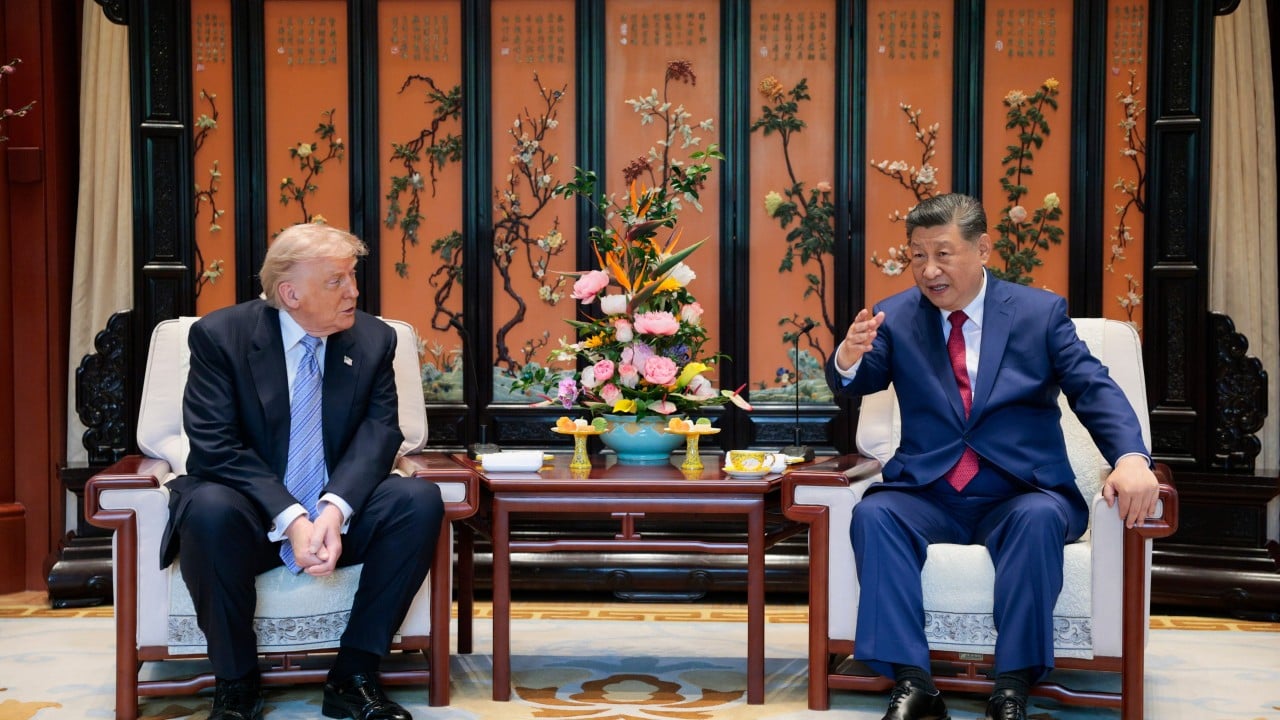
The mid-May 2026 summit in Beijing between Donald Trump and Xi Jinping establishes a transactional truce rather than a structural resolution. While political commentators frame the bilateral relationship through the lens of personal diplomacy or rhetorical escalation, a rigorous strategic analysis reveals a mathematical reality: the US-China rivalry has entered an asymmetric stalemate governed by distinct economic, technological, and resource-based cost functions.
The Busan agreement in October 2025, which lowered nominal US tariffs on Chinese imports from 57% to 47%, was not a pivot toward liberalization. It was an operational pause dictated by domestic constraints on both sides. To evaluate what happens next, the relationship must be deconstructed into three core operational pillars: the institutionalization of managed trade, the critical mineral chokehold, and the decoupling velocity of frontier technology.
1. The Managed Trade Framework and Legal Bottlenecks
The primary mechanism emerging from the Beijing summit is the proposal for a formalized Board of Trade. This represents a structural transition away from ad hoc, unilateral tariff adjustments toward an institutionalized system of managed bilateral flows.
[Unilateral Tariff Elasticity (Pre-2026)] ---> [Supreme Court / Federal Court Injunctions] ---> [Managed Trade Board / Board of Trade Framework]
The driving force behind this change is not a shared desire for harmony, but rather a series of internal constraints within the US domestic system.
- Judicial Constraints: The execution of US trade policy faced severe friction after the Supreme Court ruled that the executive branch lacked the authority to unilaterally impose several of the aggressive tariff hikes enacted in 2025. A subsequent federal court ruling invalidated the temporary replacement tariffs, creating a legal bottleneck for unilateral executive trade maneuvers.
- Affordability Politics: With domestic inflation linked to supply chain friction and an ongoing military conflict involving Iran, the US executive faces compressed political capital ahead of the November 2026 midterm elections. The agricultural sector, a critical political constituency, experienced a sharp contraction in export markets alongside a steep rise in inputs like fertilizer.
Consequently, the administration's strategic focus has shifted from enforcing structural changes in China’s state-capitalist model to securing immediate, quantifiable commercial concessions. The objective function of the US delegation relies on short-term commodity transfers:
$$Bilateral\ Balance\ Delta = \Delta Purchases_{Soybeans} + \Delta Purchases_{LNG} + \Delta Purchases_{Boeing\ Aircraft}$$
This framework allows the US to project a transactional victory to domestic audiences while bypassing legal challenges. For Beijing, entering a managed trade framework achieves a critical operational objective: it buys time. Facing an extended real estate contraction, sluggish fixed-asset investment, and growing international backlash against its industrial overcapacity, China views stable export floor values to the US as an essential economic cushion.
2. Weaponized Supply Chains and the Critical Mineral Chokehold
The strategic equilibrium between Washington and Beijing is fundamentally shaped by asymmetric supply chain dependencies. While the United States retains dominant leverage over international financial clearing mechanisms, China maintains a near-monopoly on the extraction and refining of critical minerals and rare earth elements (REEs).
http://googleusercontent.com/image_content/204
The geopolitical impact of this monopoly is defined by the processing bottleneck. China processes approximately 90% of global rare earth elements and controls nearly the entire global supply chain for high-coercivity permanent magnets (such as Neodymium-Iron-Boron, or NdFeB). These magnets are critical inputs for advanced guidance systems, electric vehicle powertrains, and wind turbine manufacturing.
The cost function of US defense procurement highlights this vulnerability. The extended consumption of conventional and precision-guided munitions in global conflicts has depleted US defense stockpiles. Replacing these stocks requires an accelerated manufacturing curve that is directly dependent on Chinese REE inputs.
China's legislative architecture for economic statecraft operates through three main mechanisms:
- The Anti-Foreign Sanctions Law: Provides the legal basis for retaliatory asset seizures and domestic non-compliance orders.
- The Unreliable Entity List: Restricts trade access for specific foreign corporations deemed a threat to national security.
- Export Licensing Frameworks: Regulates the physical flow of heavy rare earths and permanent magnets.
The temporary suspension of certain rare earth export controls under the Busan truce did not eliminate this leverage; it merely formalized it as a variable trigger. The restriction on heavy rare earths implemented in April 2025 remains active.
Washington’s counter-strategy—investing in domestic extraction at sites like Mountain Pass or forming processing alliances with Australia and Canada—is limited by long lead times. Building a fully decoupled, operational refining facility and magnet manufacturing plant requires a capital deployment and regulatory approval timeline of five to seven years. Until that infrastructure reaches scale, Beijing retains a structural veto over the velocity of US defense industrial production.
3. Technology Friction and the Limits of Segmented AI Safety
The technological dimension of the rivalry has shifted from broad containment to segmented insulation. The historical US strategy relied on comprehensive export controls, notably through the Bureau of Industry and Security (BIS), designed to restrict China’s access to advanced logic chips and semiconductor manufacturing equipment.
However, the enforcement mechanism faces structural decay. While advanced lithography access remains restricted, Washington permitted the export of specialized architectures, such as the Nvidia H200-variant chips tailored for the Chinese market. This opening allowed Chinese tech firms to sustain frontier model training pipelines while mitigating the immediate impact of capital equipment embargoes.
Frontier AI Trajectory:
[US Model Strategy] ----> Compute Abundance + Algorithmic Scale
[China Model Strategy] -> Hardware Constraints + Indigenization Efficiency + Specialized Architectures (e.g., H200 variants)
The proposal to establish a bilateral AI Safety Dialogue illustrates this tactical shift. Both states face a shared interest in mitigating catastrophic failure modes, systemic algorithmic risks, and accidental escalation driven by autonomous command-and-control systems.
Yet, the strategic intent behind the dialogue remains fundamentally divergent:
- The US Objective: To establish a narrow communication channel focused strictly on safety thresholds, guardrails, and catastrophic risk mitigation. This approach attempts to decouple existential safety concerns from ongoing competitive measures, allowing Washington to maintain tight export controls on hardware and capital equipment.
- The Chinese Objective: To use AI safety discussions as leverage to negotiate broader relief from technology sanctions. Beijing seeks to frame US export controls and investment restrictions as barriers to equitable technological development, leveraging safety participation to win concessions on market access and hardware availability.
Simultaneously, China's internal technology ecosystem is rapidly moving toward indigenization. Hardware constraints have driven significant optimization in algorithmic efficiency, allowing Chinese enterprises to train highly capable models with lower total compute budgets. This limits the long-term effectiveness of hardware-based denial strategies.
4. The Geopolitical Energy Variable
The conflict in the Middle East has altered the geopolitical energy balance. The blockade of the Strait of Hormuz led to higher global oil prices and disrupted standard maritime logistics channels. This disruption affects both powers differently based on their economic structures.
For the United States, high energy prices exacerbate inflationary pressures and complicate domestic monetary policy. The administration's ability to use energy exports as a diplomatic lever has been constrained by the need to prioritize domestic price stability.
For China, a nation dependent on imported crude oil, the maritime disruption presents a serious vulnerability. However, Beijing has used its diplomatic ties with Iran to position itself as a key intermediary capable of managing risk in the Strait.
By coordinating with regional actors, China has worked to secure safe passage for its own energy imports while reinforcing its status as an alternate global power center. This role offsets some of the leverage Washington traditionally derives from its maritime security capabilities.
The Strategic Play
The post-summit landscape will not be defined by a return to globalization or an absolute break in relations, but by an unbundling of the bilateral relationship into distinct operational layers.
========================================================================
                      UNBUNDLED BILATERAL RELATIONSHIP
========================================================================
[Layer 1: Transactional Stabilization] -> Managed Trade Board, Commodity Buys
[Layer 2: Structural Attrition]        -> Critical Minerals, Advanced Compute Controls
[Layer 3: Tactical De-escalation]     -> AI Safety Dialogue, Crisis Communications
========================================================================
Strategic planners must operate under the assumption that transaction-driven stability will coexist with deep, structurally driven competition.
The primary action item for corporate and defense strategists is to build resilience against supply chain disruptions, assuming that any agreement on commodity trade can be upended by friction over technology or industrial capacity. True structural leverage will not be decided by diplomatic summits, but by the relative speed at which the US can build alternative mineral supply chains and China can develop independent, indigenous technology ecosystems.