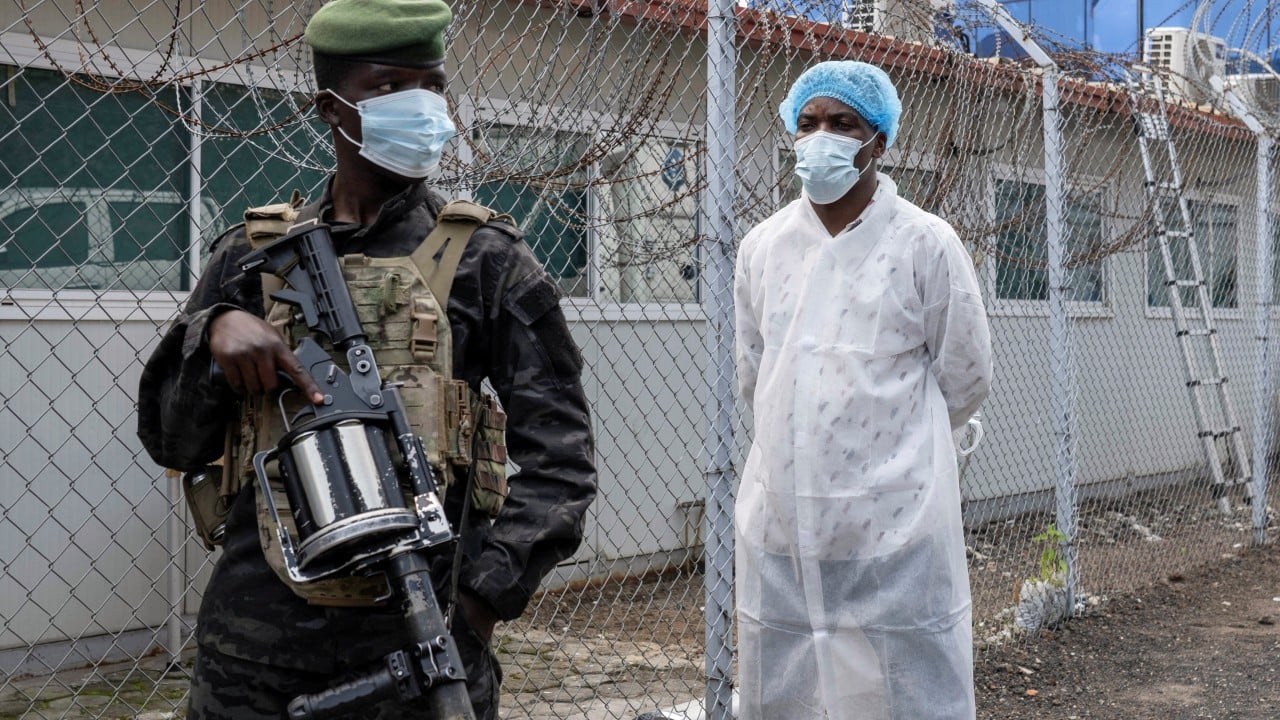
The global risk level of an infectious disease outbreak is an analytically poor proxy for localized catastrophic impact. When the World Health Organization evaluates the current outbreak of the Bundibugyo ebolavirus strain in the Democratic Republic of the Congo (DRC) and Uganda, its dual-axis classification—labeling the threat "low" globally but "high" at national and regional levels—exposes a deep structural asymmetry in epidemiological mechanics. Aggregated global risk models assume fluid, long-range transmission parameters that viral hemorrhagic fevers rarely satisfy. Conversely, localized risk is governed by network topology, diagnostic latency, and resource-depleted health systems, creating an environment where a pathogen can establish deep systemic reservoirs long before global sentinel systems register an anomaly.
To evaluate the trajectory of this outbreak requires shifting focus away from macro-level binary labels and toward the mechanical bottlenecks and network accelerants that govern its true vector.
The Diagnostics Bottleneck: Strain-Specific Assay Failures and Latency Cascades
The foundational error in early-stage containment of this outbreak lies in diagnostic misclassification, a structural vulnerability driven by the genetic divergence of the virus. Epidemiological containment relies on a low value for diagnostic latency, defined as the time elapsed between patient symptom onset ($T_0$) and laboratory confirmation ($T_c$). In this deployment, the latency function collapsed.
Standard operational protocol in northeastern DRC utilizes rapid diagnostic tests (RDTs) and polymerase chain reaction (PCR) assays optimized for the Zaire ebolavirus strain, which historically drives the region's highest-profile epidemics. Because the current outbreak is driven by the rarer Bundibugyo ebolavirus strain, initial local diagnostic assays yielded false-negative results. The structural consequences of this mismatch cascaded across three distinct vectors:
- Undetected Community Transmission: The virus circulated unhindered within the Ituri and North Kivu provinces for multiple weeks. Because initial tests discounted Ebola, standard community care and burial practices continued without viral containment protocols.
- Logistical Centralization Penalties: Confirming the anomalous strain required bypassing local field clinics and transporting biological samples to the National Institute of Biomedical Research (INRB) in Kinshasa. This logistical routing introduced a 3,000-kilometer transport loop across terrain with severely compromised transit infrastructure, inflating diagnostic latency from hours to weeks.
- Triage Mixing: In local clinical centers, such as Salama Hospital in Bunia, the absence of early, accurate diagnostics forced clinicians to mix patients exhibiting undifferentiated febrile symptoms. Patients presenting with common regional endemics like malaria or typhoid were co-located with undiagnosed, highly infectious Bundibugyo Ebola cases, transforming standard medical wards into local amplification engines.
Network Topology of Regional Transmission
The transition of the outbreak from a localized cluster to a cross-border public health emergency of international concern highlights the highly integrated network topology of the Albertine Rift region. Pathogen transmission across geographic borders is not a function of simple distance; it is a function of node connectivity and population mobility.
[Local Epicenter: Mongbwalu]
       │
       ▼ (Gold Mining Trade / High Mobility)
[Regional Hub: Bunia]
       │
       ▼ (Transit Corridors / Fluid Borders)
[International Nodes: Kampala / Neighboring States]
The Mining-Hub Vector
The epicenter in Mongbwalu is defined by informal gold mining economies. These extraction sites operate as open thermodynamic systems with high population turnover. Laborers migrate fluidly based on micro-economic shifts, creating dense, transient social networks. When an individual becomes infected within an informal mining camp, their symptom onset often coincides with their return migration to larger urban centers like Bunia, bypassing static border monitoring points.
Transnational Vulnerability
The frontier between northeastern DRC and western Uganda features intense cross-border connectivity. Formal border posts represent only a fraction of actual crossings; informal agricultural and trade pathways dominate daily regional commerce. The confirmation of two cases in the Ugandan capital of Kampala demonstrates that the pathogen has already transitioned from a localized network into primary transportation corridors. Once a pathogen enters a high-density urban transit hub, the reproduction number ($R_0$) scales non-linearly due to increased contact rates and complex contact-tracing environments.
The Clinical Cost Function: Infrastructure Deficits and Resource Exploitation
At the clinical level, the high regional risk is sustained by a stark supply-and-demand mismatch within local healthcare delivery systems. The clinical capacity of a health zone to absorb an epidemic can be modeled as a strict function of isolation volume, barrier equipment availability, and trained personnel density.
Currently, these variables are trending toward zero across the primary affected nodes.
Isolation Capacity Elasticity
In affected zones like Bunia, medical facilities face zero elasticity in isolation space. Field reports indicate that sentinel hospitals are completely saturated with suspected cases, forcing clinics to deny admission to new symptomatic individuals. This introduces an immediate feedback loop: rejected patients return to their domestic residences, transferring the bio-burden directly back into households and expanding community transmission clusters.
Barrier Disruption and Supply Shock
The local market dynamics for personal protective equipment (PPE) exhibit extreme price volatility. In Bunia, the retail price of basic chemical disinfectants inflated by 300 percent within days of the outbreak's confirmation. This price shock systematically prices out local, underfunded clinics and private households from implementing basic barrier nursing protocols.
Staff Depletion Mechanics
Nongbwalu General Hospital exemplifies the systemic vulnerability regarding personnel. Staff lack specialized clinical training for viral hemorrhagic fevers and operate without basic personal protective gear. When healthcare workers are exposed to an undifferentiated pathogen without barrier defenses, nosocomial amplification occurs. This not only turns the hospital into a transmission vector but rapidly deconstructs the existing medical workforce via infection and mortality, reducing the systemic capacity to treat non-Ebola acute pathologies.
The Global Mitigation Paradox: Low Vulnerability, High Structural Failure
The justification for classifying the global risk as low rests on the physical transmission mechanics of filoviruses. Unlike respiratory pathogens, the Ebola virus requires direct contact with infectious bodily fluids. In high-resource settings characterized by centralized wastewater treatment, ubiquitous barrier precautions, and immediate diagnostic isolation, the effective reproduction number ($R_t$) naturally falls below the critical threshold of 1.0.
However, this low global threat profile introduces a dangerous paradox in international health financing. International aid structures and vaccine procurement frameworks operate on reactive, high-visibility cycles.
Therapeutic Gaps and Experimental Deployment
Unlike the Zaire ebolavirus, for which licensed, highly effective counter-measures exist (such as the Ervebo vaccine), therapeutics for the Bundibugyo ebolavirus remain largely experimental. The current strategic intervention relies on deploying candidate vaccines developed by research institutions like Oxford. Because these vaccines are experimental, their deployment requires complex regulatory authorizations, ethical clearances, and clinical trial protocols in the field. This institutional friction slows down the speed of ring vaccination strategies.
The Aid Funding Deficit
The emergence of this outbreak occurred alongside structural contractions in international health funding, including targeted budget cuts to global health programs via organizations like the U.S. Agency for International Development (USAID). When international development agencies draw down their baseline health security investments, they dismantle the underlying surveillance infrastructure. The absence of sustained funding for local laboratories directly caused the diagnostic blind spot that allowed the Bundibugyo strain to circulate undetected for weeks.
Strategic Recommendation
To halt the regional cascade and prevent the transformation of this outbreak into a prolonged multi-year epidemic, global health actors and national ministries must abandon broad-spectrum geographic containment strategies and execute an aggressive, network-centric intervention.
- Decentralize Strain-Specific Diagnostic Capacity: Immediately bypass the Kinshasa logistical bottleneck by deploying mobile, field-ready RT-PCR platforms equipped with Bundibugyo-specific primer sets directly to Bunia and Mongbwalu. Triage decisions must occur within a six-hour window of presentation to prevent nosocomial mixing.
- Establish Targeted Transit Triage Along Economic Corridors: Abandon static, formal border monitoring in favor of active, mobile health surveillance nodes placed at informal mining transit bottlenecks and high-density markets linking Ituri Province to western Uganda.
- Subsidize IPC Supply Chains: Execute an immediate international procurement and distribution mandate to flood the local market with barrier nursing supplies and disinfectants, artificially deflating the local cost function and neutralizing market speculation.
The containment of the Bundibugyo outbreak depends entirely on reducing diagnostic latency and reinforcing local clinical capacity. Relying on the virus's poor long-range transmission mechanics to keep global risk low is a strategy of passive failure; containment must be won at the primary nodes of the regional network.
An expert breakdown of the epidemiological challenges and cross-border risks associated with this rare strain can be understood through further expert commentary on Ebola Outbreak: Infectious Disease Experts Explain The Global Risk, which highlights the constraints on transmission alongside the critical importance of regional containment structures.