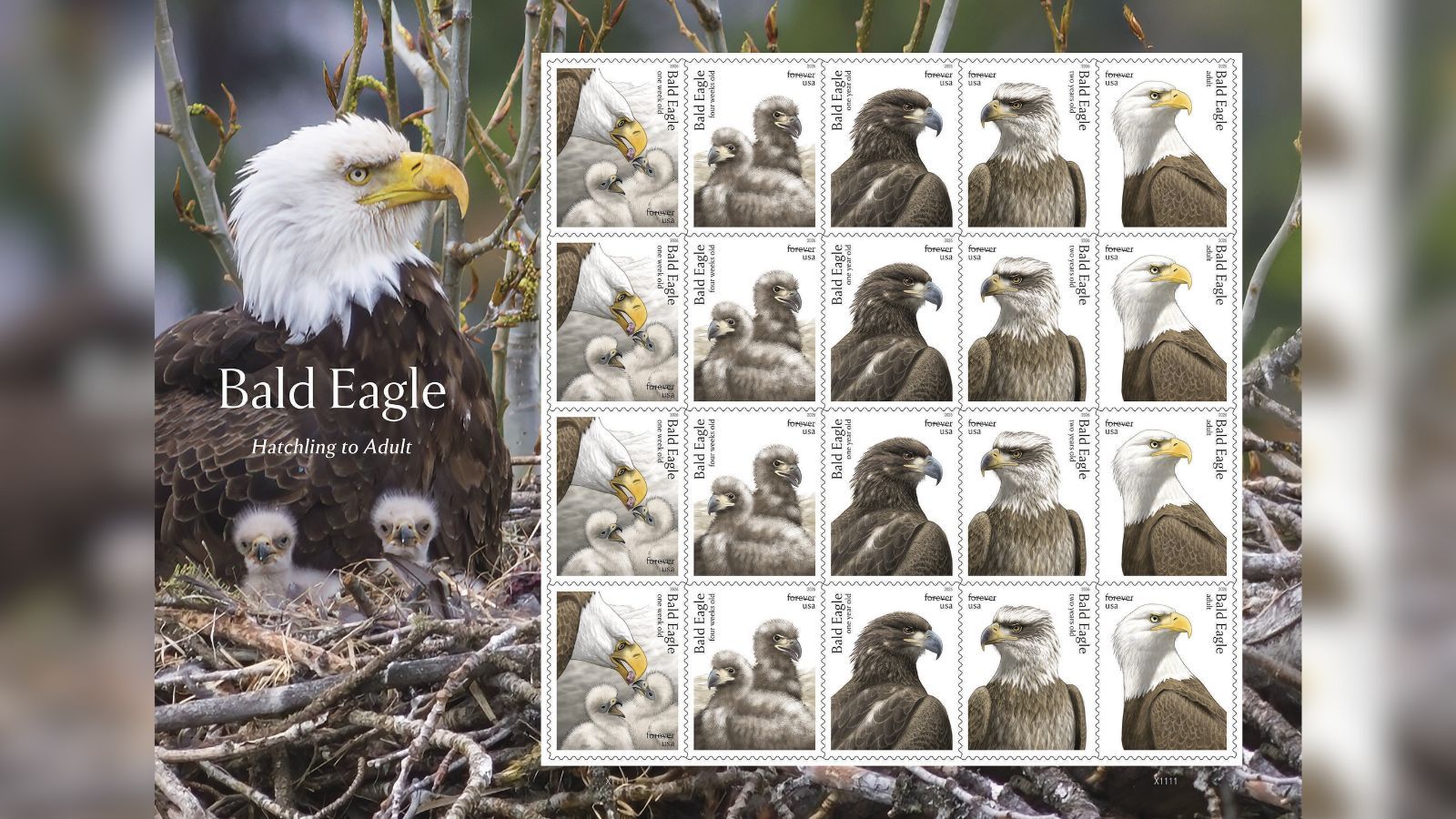
The United States Postal Service is readying a massive rollout of bald eagle stamps to mark the nation’s 250th anniversary. This move aims to tether the 2026 celebrations to a bird that has served as the ultimate American shorthand since 1782. While the USPS markets these stamps as a tribute to national unity, the history of the bald eagle as a symbol is less about a peaceful consensus and more about a calculated, centuries-long effort to project raw power and continental dominance.
The choice of the bald eagle for the Semicentennial isn't just about aesthetics or birdwatching. It is a strategic deployment of an icon that survived near-extinction to become a branding powerhouse. To understand why this bird still carries the weight of the American identity, one must look past the majestic wingspan and examine the political friction that nearly kept it off the Great Seal entirely.
The Myth of the Reluctant Symbol
We are often told the story of Benjamin Franklin’s preference for the turkey over the bald eagle. Popular history frames it as a quirky anecdote about a "respectable" farm bird versus a "rank coward" scavenger. However, the debate in the late 18th century was far more serious. The Continental Congress spent six years and three different committees trying to decide what should represent the nascent republic.
The eagle won because it signaled a break from European heraldry while simultaneously demanding the same level of respect afforded to the Roman legions. It was a visual declaration of sovereignty. By placing the eagle on everything from currency to the new 2026 postal issues, the government reinforces a specific narrative of resilience. The bird is unique to North America, making it a biological claim to the land itself.
http://googleusercontent.com/image_content/219
Federal Branding and the 2026 Semicentennial
The USPS isn't just selling postage; it is managing a legacy. The upcoming stamps are part of a broader "Semiquincentennial" initiative designed to bridge a polarized public through shared iconography. It is a tall order for a piece of adhesive paper.
For the Postal Service, the bald eagle is the safest bet in the vault. Unlike historical figures who are subject to modern re-evaluation and "cancelation," the eagle remains largely beyond reproach. It represents a "natural" authority. When the government faces internal division, it habitually retreats to these biological symbols. They are unarguable. A bird does not have a voting record or a controversial private life. It simply exists as a peak predator, which is exactly how a superpower wants to be perceived even when its internal politics are messy.
The Biological Reality versus the National Icon
There is a glaring irony in using the eagle to celebrate 250 years of progress. For a significant portion of those two and a half centuries, the United States actively presided over the bird’s demise. The bald eagle was not always a protected treasure. Farmers once shot them by the thousands, believing—mostly erroneously—that they were a threat to livestock.
The introduction of DDT in the mid-20th century nearly finished the job. By 1963, only 417 nesting pairs remained in the lower 48 states. The bird’s recovery is often cited as a triumph of American environmental policy, specifically the Endangered Species Act.
But the recovery also highlights a contradiction in the American psyche. We worship the symbol while frequently endangering the reality. We put the bird on a stamp to celebrate our "freedom," yet that same freedom includes the industrial activities that once pushed the species to the brink. The 2026 stamps act as a form of "greenwashing" for history, focusing on the comeback story rather than the decades of neglect that made the comeback necessary.
The Eagle as a Tool of Diplomacy
International observers recognize the eagle not as a bird, but as a signature of intent. In the context of the 250th anniversary, the re-assertion of this symbol is a message to the global stage. It says that despite internal strife, the foundational identity of the U.S. remains unchanged.
Consider the physical design of the Great Seal held in the eagle's talons. On one side, an olive branch; on the other, thirteen arrows. This "peace through strength" duality is the core of the American brand. The new stamps will likely lean into the "majesty" of the bird, but the underlying subtext is always the arrows. You cannot separate the bird from the military-industrial complex it has come to represent. From the uniforms of the Revolutionary War to the tail fin of a modern fighter jet, the eagle is the face of American force.
The Aesthetics of the New Stamps
Early previews of the 2026 collection suggest a move toward high-definition photography and vibrant, patriotic color palettes. This is a departure from the more stylized, engraved look of early 20th-century stamps. The goal is realism. By using crisp, lifelike imagery, the USPS wants to make the symbol feel "real" and immediate to a generation that consumes information through screens.
- Color Theory: Expect heavy use of "Old Glory" red and blue backgrounds to trigger immediate patriotic associations.
- Typography: Clean, sans-serif fonts that suggest a forward-looking nation rather than one stuck in the past.
- Production: Use of special foils or embossing to make the stamps feel like "collector’s items" rather than mere utilities.
Why the Symbol Persists
Why haven't we moved on? In 250 years, surely there is another animal or object that better defines the modern American experience. Some suggest the bison, which was named the national mammal in 2016. Others point to the diversity of our landscape as a better representation than a single predator.
The eagle persists because it is an aspirational symbol. It represents a version of America that is solitary, fierce, and above the fray. It is an image of rugged individualism that ignores the reality of a highly interconnected, social-media-driven society. We cling to the eagle because it allows us to imagine ourselves as the frontiersmen we haven't been for a century.
The Economics of Patriotism
There is a financial engine behind the 250th-anniversary merchandise. The USPS has struggled with declining mail volumes for years. Commemorative stamps are a high-margin product. They are often bought by collectors and never used, meaning the Postal Service keeps 100% of the revenue without having to actually deliver a letter.
The bald eagle is the "bestseller" of the federal government. It is the Mickey Mouse of the public sector. By centering the 250th-anniversary branding on this bird, the government ensures the widest possible commercial appeal. It is a symbol that sells in both deep-blue cities and deep-red rural towns. In a capitalist society, the ultimate proof of a symbol’s power isn't its historical accuracy, but its marketability.
The Burden of the Next 50 Years
As we approach 2026, the bald eagle faces a new set of challenges that a stamp cannot fix. Lead poisoning from spent ammunition and the loss of habitat due to coastal development are the modern threats. The bird has moved from the "Endangered" list to the "Recovered" list, but it remains a ward of the state. It exists because we allow it to.
This mirrors the state of the American experiment at the quarter-millennium mark. The institutions represented by the eagle are no longer self-sustaining; they require active, conscious maintenance. If the 2026 stamps are to mean anything more than a clever marketing ploy, they must serve as a reminder that icons are fragile.
We use the eagle to look tough. We use it to look permanent. But a symbol is only as strong as the conviction of the people who use it. When you lick that stamp or see it on a package in 2026, recognize it for what it is: a 244-year-old marketing campaign for a dream that is still under construction.
The eagle isn't a reflection of what we are. It is a reminder of what we are trying to convince the rest of the world we've become.
The survival of the bird was the result of a rare moment of national consensus—a decision that some things are too important to let die. As the anniversary approaches, the question isn't whether the bird will endure on our stamps, but whether that same spirit of preservation can be applied to the republic the bird is supposed to represent. If the symbol outlasts the substance, the stamp is just a ghost of a nation that used to be.
Focus on the talons, not just the feathers.