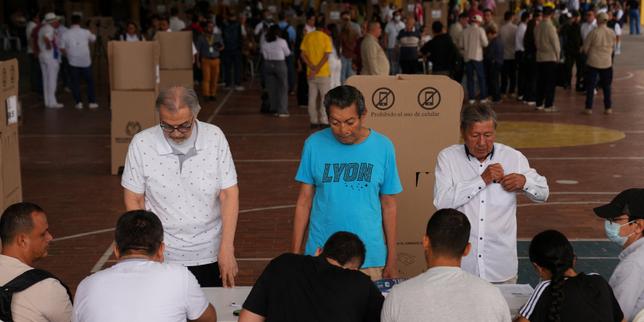
The ink on a Colombian voter’s thumb dries in less than a minute, but the memory of how it got there can last generations.
Imagine a woman named Maria. She is a hypothetical composite of the thousands of voters who woke up before dawn in the rural hills of Catatumbo, washing the coffee grounds from her hands, dressing in her finest Sunday blouse. She walks down a dirt track where the mud clings to her boots like the past itself. To her left, a freshly painted piece of graffiti warns locals against collaborating with state forces. To her right, a soldier stands under the shade of a banana tree, his finger resting just above the trigger guard of an assault rifle.
Maria is walking to a polling station. In her pocket, she carries a small slip of paper that represents her share of ownership in the future of Colombia. Around her, the air is thick with a silence that isn't peaceful. It is the silence of anticipation. It is the quiet that settles over a valley when everyone knows that choosing a leader is not an abstract exercise in civic duty, but a direct, physical gamble.
This is the reality of a Colombian presidential election held under the shadow of renewed conflict. For a brief moment after the 2016 peace accords, the nation breathed a collective sigh of relief. The longest-running guerrilla war in the Western Hemisphere was supposed to be drawing to a close. But peace is not a document signed in a theater; it is a living ecosystem that requires cultivation. When the state failed to fill the vacuum left by demobilized fighters, other forces rushed in. Dissident guerrilla factions, drug cartels, and right-wing paramilitary groups carved up the countryside.
Now, the polling stations open against a backdrop of violence that feels devastatingly familiar, yet distinctly fractured.
The Sound of Voting in a War Zone
To understand the stakes of this election, you have to look away from the polished television studios of Bogotá, where candidates in tailored suits debate fiscal policy and international trade. You have to look at the regional outposts where the state is an idea represented only by a flag and a uniform.
In the weeks leading up to the vote, the statistics compiled by independent observers told a grim story. Attacks on local leaders spiked. Defending human rights or promoting a particular candidate in the wrong municipality became a death sentence. Armed groups declared paros armados—armed strikes—effectively locking down entire provinces, forbidding transit, and turning vibrant market towns into ghost communities.
Consider the mechanics of terror. A cartel does not need to bomb a polling place to alter an election. They only need to leave a handwritten note on a community center door. They only need to make a single phone call to a local organizer. The message is always the same: Stay home. We are watching.
Yet, when the doors of the schoolhouses and municipal halls swing open at eight in the morning, the lines form anyway.
The act of standing in those lines is a form of defiance that rarely makes the international news ticker. It is a quiet heroism. People walk for hours across terrain laced with landmines, passing through checkpoints manned by teenage boys with balaclavas and automatic weapons, just to press a piece of paper into a wooden box. They do it because they know the alternative is complete abandonment.
A Nation Split by Geography and Memory
The political divide in Colombia is deeply rooted in geography. There are two Colombias.
The first is the urban Colombia of Medellín, Cali, and the capital. Here, the concerns of voters mirror those of any modern democracy: inflation, corruption, urban safety, and job opportunities for the youth. The violence of the countryside is something seen on the evening news, a distant storm murmuring on the horizon.
Then there is the peripheral Colombia. This is the country of the Pacific coast, the eastern plains, and the southern jungles. In these regions, the state is largely absent, replaced by a shifting patchwork of criminal syndicates competing for coca crops and illegal mining routes. For these citizens, the presidential vote is not about choosing between left-wing or right-wing economic theories. It is about choosing who might offer them a sliver of protection against the next massacre.
The candidates on the ballot reflect this profound polarization. On one side stands the promise of radical change, a break from the traditional elites who have governed the country for centuries. This platform speaks directly to the young, the urban poor, and the marginalized rural communities who feel the current system offers them nothing but poverty and empty promises.
On the other side is the appeal to order, security, and the preservation of the economic status quo. This platform resonates with those who remember the darkest days of the guerrilla war in the late 1990s and early 2000s, when car bombs shattered city streets and kidnapping was a thriving industry. For these voters, any concession to armed groups looks like weakness, a dangerous slide back into chaos.
The tension between these two visions is palpable at every voting table. The older generation remembers the terror of the past and craves stability above all else. The younger generation, having grown up during the brief window of hope following the peace agreement, craves justice and opportunity, refusing to accept that violence is the natural state of their country.
The Invisible Infrastructure of a Vote
Conducting an election under these conditions requires a logistical effort that resembles a military campaign. The registry office must transport ballot boxes via helicopter to remote Amazonian villages, navigate riverways controlled by river pirates, and mule crates of paperwork up into the high páramos.
Every ballot box is accompanied by a story of risk. Registrars and international observers travel into zones where the law of the gun is the only law that matters. They do so knowing that their presence is the only thing preventing systemic fraud or intimidation.
But the real infrastructure of the election is psychological. It is the collective agreement among millions of citizens that, despite the threats, despite the assassination of community leaders, and despite the profound cynicism left by decades of broken political promises, the vote still matters.
It is easy to be cynical about democracy when you live in a place where it functions smoothly, where the worst consequence of an election is a policy shift you dislike. It is much harder to be cynical when your neighbor was murdered last week for trying to organize a political rally, and you still choose to walk out your front door to cast your ballot. In that environment, the vote loses its mundane character. It becomes a sacred, dangerous act.
The Evening Count
As the afternoon wanes, the tropical sun dips behind the Central Cordillera, casting long shadows across the polling stations. The standard-issue digital clocks on the walls tick down to four o'clock. The gates close. The tension shift is instantaneous.
Now comes the count. In thousands of small rooms across the country, under the flickering light of fluorescent bulbs or the glow of flashlights, election workers open the wooden boxes. They unfold the papers one by one, calling out the names of the candidates into the humid air.
Outside, the streets are empty. The usual Sunday music from the local bars is absent. Everyone is waiting inside, listening to the radio, watching the bars on their phones as the preliminary results begin to trickle in from the capital.
The tragedy of this election is that whoever wins will inherit a house on fire. The fractures within Colombian society cannot be healed by a victory speech or an inauguration ceremony. The criminal structures that profit from the conflict will not lay down their arms because a new president takes the oath of office in the Plaza de Bolívar.
The real test will come tomorrow, when the soldiers pack up their gear and leave the rural schoolhouses, when the international observers board their flights back to Bogotá, and when Maria must walk back down that same dirt track, past the same graffiti, wondering if the mark on her thumb was enough to change the world, or if it simply marked her as a target.
The ink will fade from her skin by Tuesday. The question of whether her country can ever truly escape the cycle of the bullet remains written in the dust of the roads she walks every day.