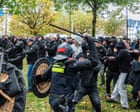
The sirens echoing through the administrative heart of the Netherlands are no longer an anomaly. When riot police deployed batons, tear gas, and mounted units to disperse a volatile far-right mobilization in The Hague, mainstream media outlets framed the confrontation as a sudden eruption of hooliganism. That superficial diagnosis misses the entire architecture of modern political decay. Street clashes do not materialize from thin air. They represent the visible rupture of a political contract that has been quietly fraying for decades beneath the polished veneer of the Dutch polder model.
To understand why thousands converged on the political capital and why state forces met them with overwhelming kinetic force, one must examine the intersection of housing scarcity, anti-immigration rhetoric, and institutional fatigue. The demonstration in The Hague was ostensibly organized around nationalist grievances, yet the raw energy powering the crowds stemmed from a potent mixture of economic anxiety and profound alienation. People who feel entirely unmoored by rapid demographic shifts and skyrocketing cost-of-living pressures find themselves drawn into radical networks that offer simple enemies for complex systemic failures. Expanding on this topic, you can also read: The Forgotten Tragedy of Eritrea Imprisoned War Heroes and Their Families Left Behind.
The Ignition Point of Civil Unrest
For years, political analysts warned that the Netherlands was importing the polarizing political dynamics familiar to the United States and neighboring European states. Those warnings were routinely dismissed by technocratic leaders who believed the country's historic consensus-driven governance model possessed an inherent immunity to extremist infection. That confidence looks increasingly naive. The confrontations outside government ministries demonstrate that institutional complacency has allowed radical factions to institutionalize their presence on the streets.
The tactical response deployed by law enforcement on that afternoon was swift and uncompromising. Officers in riot gear formed impenetrable cordons, pushing back crowds that hurled cobblestones, fireworks, and bicycle frames. Police horses charged down boulevards that usually host peaceful diplomatic delegations and international courts of law. Yet treating this confrontation purely as a public order problem misunderstands the underlying pathology. Every time a protest ends in mass arrests and shattered glass, the underlying ideological grievance hardens rather than dissipates. Experts at The New York Times have provided expertise on this matter.
Beneath the Surface of Dutch Prosperity
Decades of neo-liberal economic restructuring have left vast segments of the working class feeling economically invisible. While the Netherlands boasts impressive macroeconomic indicators, median earners face a brutal housing shortage that makes homeownership or even stable renting an impossible dream. When young men with few economic prospects gather under extremist banners, they are seizing upon a vehicle for expressing rage against a system they perceive as rigged against them. The far-right leadership exploits this vulnerability with ruthless efficiency, channeling genuine socioeconomic distress into xenophobic scapegoating.
The ideological pipeline feeding these demonstrations operates primarily through decentralized digital communication channels. While public squares serve as the physical theater of conflict, the recruitment and radicalization occur behind glowing screens late at night. Algorithms designed to maximize engagement amplify inflammatory rhetoric regarding national identity and cultural preservation. By the time individuals march into The Hague equipped with facial coverings and improvised weapons, their worldview has been thoroughly calcified by months of digital reinforcement. They are not protesting specific legislation; they are rejecting the legitimacy of the democratic state itself.
The Mechanics of Radicalization and Governance
Governance in the Netherlands has long prided itself on moderation, compromise, and polite debate. However, the rise of uncompromising populist factions has exposed the limits of traditional diplomacy. When political figures normalize anti-immigrant rhetoric in parliamentary chambers, they create a permissive environment for street-level radicalism. The distance between inflammatory parliamentary rhetoric and bricks hurled at police lines in The Hague is shorter than institutional leaders care to admit. Mainstream parties attempt to co-opt populist talking points to win back voters, but this strategy invariably legitimizes extremist narratives rather than neutralizing them.
Policing political dissent presents a profound constitutional dilemma for democratic societies. Authorities must protect the fundamental right to protest while simultaneously preventing public violence and safeguarding public safety. When peaceful demonstrations inevitably warp into violent riots, police forces face intense scrutiny regarding their tactical restraint or lack thereof. Critics on the political left argue that authorities often handle far-right demonstrators with kid gloves compared to climate or anti-racism activists. Conversely, extremist organizers claim state overreach whenever riot squads clear a square. Navigating this minefield requires an extraordinary degree of operational neutrality, an attribute that is increasingly difficult to maintain in a hyper-politicized environment.
The Broader European Echo Chamber
The economic anxieties driving individuals into extremist arms are rooted in structural failures that require genuine policy intervention rather than heavy-handed policing. Addressing the housing crisis, reforming labor markets, and rebuilding public trust in civic institutions represent monumental tasks that political elites have repeatedly postponed. Short-term crackdowns on street violence provide dramatic television footage and temporary order, but they do not alter the underlying trajectory. Without addressing the root causes of public disillusionment, authorities will find themselves deploying riot squads with increasing frequency.
International observers watching the events unfold in The Hague recognize familiar tremors. Similar scenes have played out across France, Germany, and the United Kingdom, reflecting a broader continental malaise. The European project, founded on promises of peace, prosperity, and open borders, now contends with fierce populist pushback. National identity has re-emerged as the primary battleground of twenty-first-century politics. The Dutch state, historically celebrated for its tolerance and pragmatism, is discovering that these virtues are insufficient shields against the rising tide of ideological polarization.
The physical cleanup of shattered glass and scorched asphalt along the streets of The Hague happens quickly after the television crews depart. Municipal workers sweep away the remnants of civil disobedience, restoring a semblance of normalcy to the government district. But the underlying ideological fractures remain completely unsealed. The confrontation captured on camera was merely one skirmish in a protracted struggle over the future of the European social contract. Until political architects confront the deep structural failures corroding social cohesion, the sirens will return to the capital, and the barricades will rise again.