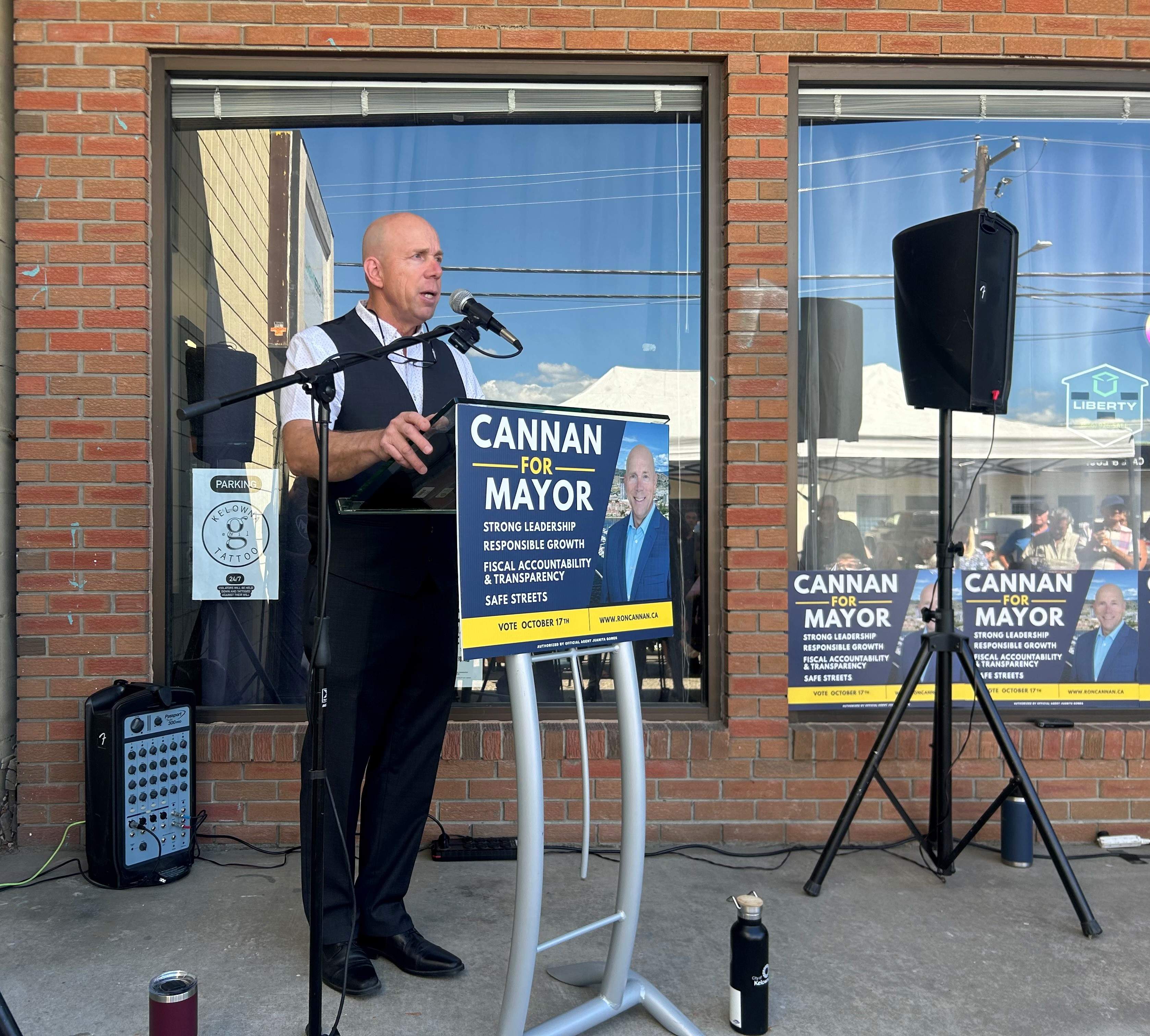
Ron Cannan wants his old job back, or more accurately, the bigger version of it. The current Kelowna city councillor and former Member of Parliament has officially thrown his hat into the mayoral ring, positioning himself as the law-and-order candidate ready to fix a city grappling with rapid growth and escalating street-level anxiety. But while Cannan’s announcement focuses heavily on public safety, his campaign represents something much deeper. It is a referendum on how Okanagan's central hub manages its identity crisis.
Kelowna is no longer just a sleepy summer resort town. It is a mid-sized urban center experiencing big-city pains. Cannan is betting that voters are tired of incremental bureaucratic tweaks and are hungry for a more aggressive, traditional approach to municipal governance.
The Public Safety Gambit
Public safety is the undeniable centerpiece of Cannan's platform. For a city that has routinely found itself ranking higher than the national average in Statistics Canada’s Crime Severity Index, the issue isn't abstract. It affects local business owners downtown, residents in the urban core, and the tourism industry that feeds the local economy.
Cannan’s pitch relies on a straightforward premise. The current council has not done enough to secure the streets. He promises an immediate review of municipal policing resources, a tougher stance on open drug use, and closer coordination with provincial authorities to tackle repeat offenders.
But declaring a war on street disorder is the easy part of a mayoral campaign. The execution is where municipal politics hits a hard wall of jurisdictional reality.
Cities do not control the criminal justice system. They do not write the Criminal Code, nor do they manage provincial courts or correctional facilities. A mayor can advocate for change, but they cannot force a judge to keep a repeat offender behind bars. When a local politician promises to clean up the streets, they are largely promising to use the bully pulpit of their office to pressure higher levels of government. Cannan knows this, having spent nearly a decade in Ottawa as a Conservative MP. His strategy depends on voters believing that his federal and local experience gives him the specific leverage needed to force Victoria and Ottawa to listen.
The Limits of the RCMP Contract
Kelowna relies on the RCMP for its policing. Unlike Vancouver or Victoria, which operate independent municipal police forces, Kelowna contracts its law enforcement from the federal government. This structure creates distinct operational hurdles.
- Cost Escallation: The municipality shoulders the vast majority of the policing bill, but has limited control over internal RCMP wage increases and federal mandates.
- Staffing Bottlenecks: Recruiting and retaining officers through the national RCMP pipeline remains a chronic challenge across British Columbia.
- Bureaucratic Inertia: Altering deployment strategies or introducing specialized local units requires navigating both federal and provincial red tape.
Throwing more municipal tax dollars at the RCMP budget does not instantly put more boots on the ground. If the officers are not available in the national pool, the local vacancy rate simply grows. Cannan will have to explain how he intends to bypass these structural constraints to deliver the visible police presence he has promised.
Growth Capital and the Affordable Housing Disconnect
You cannot talk about public safety in Kelowna without talking about housing. The two issues are fundamentally linked. Over the past decade, a massive influx of capital has transformed the city's skyline. Luxury high-rises now line the waterfront, drawing affluent retirees, remote tech workers, and real estate speculators.
This boom has generated significant tax revenue, but it has also priced out the local workforce. Service workers, young families, and frontline staff are increasingly squeezed out of the market. When housing costs outpace local wages by a wide margin, the social safety net frays. The visible homelessness on Leon Avenue and throughout the downtown core is the most extreme symptom of this economic dislocation.
Kelowna Housing Affordability Gap (Hypothetical Asset Comparison)
[Typical Luxury Condo Valuation: $900,000+ vs. Median Local Household Income: ~$85,000]
The current council administration has favored high-density development as a solution to supply shortages. The theory is simple. Build more units, and prices will eventually stabilize. In practice, the new inventory has skewed heavily toward the premium market, doing little to alleviate pressure at the lower end of the spectrum.
Cannan’s challenge will be to offer an alternative development model that doesn't choke off economic growth. He has historically favored a more cautious approach to high-density zoning, expressing concern over how rapid tower construction affects neighborhood character and existing infrastructure. To win, he must convince voters that slowing down luxury development will somehow lead to more genuinely affordable housing for the people who actually live and work in the city year-round.
The Friction of a Fragmented Council
Cannan’s mayoral bid introduces immediate political tension into City Hall. He is not running from the outside. He is running from within the current governing body. This creates an awkward dynamic for the remainder of the current council term, as debates on the floor will inevitably be viewed through the lens of the upcoming mayoral race.
Local government in British Columbia does not use a formal party system. Mayors do not command a disciplined caucus. They have exactly one vote at the council table, just like every other councillor. A mayor’s power is entirely persuasive. They must build shifting coalitions on every single vote to pass a budget or approve a zoning amendment.
Cannan has often found himself casting dissenting votes on the current council, particularly on matters involving major high-rise developments and specific spending initiatives. While this independent streak burns crops his maverick credentials with disaffected voters, it raises practical questions about his ability to lead a fractured chamber. If he wins the mayor's chair but faces a council dominated by political opponents, the city could face four years of legislative gridlock.
Navigating the Provincial Divide
Any municipal leader in British Columbia must navigate the shifting dynamics of provincial politics. The provincial government holds ultimate constitutional authority over municipalities, controlling the funding levers for healthcare, mental health support, addictions treatment, and social housing.
The current provincial framework emphasizes harm reduction and supportive housing complexes. This approach has drawn sharp criticism from conservative-leaning municipal politicians who argue that centering services in urban hubs without sufficient mandatory treatment options exacerbates street disorder. Cannan aligns closely with this critical view.
His campaign will test whether a municipal leader can successfully push back against provincial policy directives. If Kelowna takes a harder line on enforcement while provincial ministries continue to fund low-barrier housing models, the resulting policy mismatch could create friction that slows down the delivery of provincial funds for critical infrastructure projects.
The Infrastructure Deficit Beyond Downtown
While the media focus remains fixed on the downtown core and the immediate public safety crisis, Kelowna’s suburban neighborhoods are dealing with a different set of anxieties. Areas like Rutland, the Mission, and Glenmore feel increasingly disconnected from the investments being made in the city center.
Traffic congestion along Highway 97 remains a chronic headache. Public transit options in the outer suburbs are sparse, forcing a heavy reliance on personal vehicles. Extension of core services like water integration and park maintenance in outlying areas has lagged behind the rapid pace of residential construction.
Cannan’s political roots are deeply embedded in these suburban communities. His path to victory relies on mobilizing voters outside the downtown core who feel that their property taxes are funding urban revitalization projects that offer them little direct benefit. He needs to construct a narrative that balances the urgent need for downtown security with the unglamorous, day-to-day infrastructure needs of the wider municipality.
The Generational Shift in the Electorate
The demographic makeup of Kelowna is shifting rapidly. The traditional voter base—older, conservative, and focused primarily on property tax stability—is being supplemented by a younger demographic drawn to the region by the tech sector and UBC Okanagan.
These newer residents often hold different priorities. They tend to favor investments in active transportation, climate resilience, and progressive social policies. They view the city's problems not as failures of law enforcement, but as systemic failures of housing policy and social support networks.
Cannan's political brand was forged in an earlier era of Kelowna's history. His career spans decades of public service, during which the city's population was significantly smaller and more homogenous. His mayoral campaign is a test of whether his traditional message can resonate with a modern, more diverse electorate that views the role of municipal government through a fundamentally different lens. He cannot rely solely on nostalgia for a safer, quieter Kelowna. He must articulate a forward-looking vision that acknowledges the realities of a city that has permanently outgrown its small-town origins.
The upcoming campaign will not be a simple popularity contest. It will be a debate over the core function of local government. Voters will be forced to choose between an establishment that preaches managed growth and incremental policy shifts, and a challenger who argues that the current trajectory is fundamentally broken. Cannan has laid down his marker on public safety, but the path to the mayor's office requires convincing a complicated city that he possesses the structural tools, the political capital, and the legislative consensus required to actually deliver on that promise.