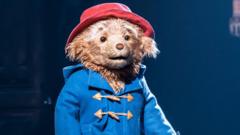
The floorboards of the London Palladium don’t just creak. They groan under the weight of a century of ghosts, from Judy Garland to Houdini. But on a rain-slicked night in early 2026, the air inside that gilded cavern felt different. It wasn’t just the standard electric hum of an awards ceremony. It was the sound of a paradigm shift—the kind that happens when a Peruvian bear in a duffle coat finally stops being a childhood memory and starts being a theatrical powerhouse.
We have spent years watching the West End struggle to find its pulse. We saw the jukebox musicals take over, the safe bets, the endless recycling of eighties pop catalogs. Then came the 24th Annual WhatsOnStage Awards. It was supposed to be a night of polite applause and predictable victories. Instead, it became a coronation for a marmalade-loving immigrant who reminds us exactly why we sit in the dark with strangers to watch stories.
The Heavy Lifting of a Small Bear
When the nominations were first announced, the skeptics were out in force. A musical based on Paddington? It sounded like a cynical cash grab, another intellectual property being milked for the family tourist dollar. But the audience—the actual theater-goers who vote for these specific awards—saw something the critics missed. They saw a story about belonging.
Paddington didn’t just show up. He dominated. The production swept through the categories, clinching Best New Musical and Best Performer in a Musical for the lead. But to understand why this matters, you have to look past the trophy count. You have to look at the "Invisible Stakes."
Consider a hypothetical stagehand named Elias. He’s worked the fly rail for thirty years. He’s seen the "big" shows come and go—the ones with the $20 million sets and the pyrotechnics. He tells you that most nights, the audience leaves humming the scenery. But with this show, he watches them leave differently. They leave looking at each other. They leave looking for a way to be kinder. That is the "human element" that traditional reporting misses when it focuses on box office numbers.
The Architecture of a Sweep
The night wasn’t just a win for the bear. It was a victory for the ensemble. The WhatsOnStage Awards are unique because they aren't decided by a shadowy panel of industry insiders sipping lukewarm Chardonnay in a boardroom. They are the People’s Choice. When Paddington took home Best Supporting Performer and Best Choreography, it wasn't a fluke. It was a mandate.
The choreography in this production doesn't rely on the "seamless" precision of a military drill. It relies on the chaotic, beautiful mess of London life. It’s the movement of a busy train station, the frantic energy of a kitchen disaster, and the quiet, rhythmic swaying of a family finally finding their footing.
- Best New Musical: Paddington
- Best Performer: Lead Actor (Paddington)
- Best Supporting Performer: (The Brown Family Matriarch)
- Best Direction: The visionary team behind the magic
The sheer scale of the win reflects a shift in what we crave. We are tired of the "dark and gritty" reboots. We are exhausted by irony. The voters chose a show that wears its heart on its blue-serge sleeve. They chose sincerity.
The Ghost in the Machine
Behind every great musical is a director who had to fight for a vision that sounded ridiculous on paper. "It's a bear, but he's a puppet, but he's also the soul of the city." Try selling that to a room full of investors.
The direction of Paddington won because it treated the source material with a terrifying amount of respect. It didn't wink at the audience. It didn't try to be "meta." It treated the loss of a home and the search for a new one as the high-stakes drama it truly is. When the bear stands alone on the platform at Paddington Station, the stage feels three miles wide. You feel the cold. You feel the crushing weight of being a stranger.
Then, the music starts.
It isn't a "game-changer" in the sense that it invents a new genre. It’s a success because it remembers the old ones. It uses folk-infused melodies that sound like they were pulled directly from the pavement of Portobello Road. It’s music that feels like it has always existed, waiting for someone to finally sing it.
The Ripple Effect
The win has sent shockwaves through the industry. For years, the narrative was that "family theater" was a subset—a lesser category designed to keep the kids quiet while the adults waited for the "real" drama to start in the autumn season.
This awards sweep killed that idea.
When a musical about a bear beats out high-concept revivals and star-studded dramas, it proves that "family" is not a dirty word in art. It proves that the themes of displacement and kindness are universal. We saw it in the eyes of the performers who took the stage to accept their statues. There was no smugness. There was only a profound sense of relief that this specific story—this quiet, polite story—had been heard.
Why the Critics Were Wrong
The traditional press often misses the "emotional core" of a production because they are too busy looking at the "robust" technical specs. They talk about the lighting design (which, to be fair, was stunning) or the "holistic" approach to the set. But they forget the girl in the third row.
Let’s call her Maya. Maya is eight. She’s never been to London before. She doesn't care about the "synergy" of the marketing campaign or the "pivotal" role this show plays in the West End’s post-pandemic recovery. She cares that the bear found a bed. She cares that the lady in the orange hat was mean, but then she wasn't.
When we write about theater, we should write like Maya feels. We should acknowledge that a piece of wood and some velvet can become a sanctuary.
The Night the Lights Stayed On
As the ceremony ended and the crowds spilled out into the London night, the air was still thick with that peculiar theater magic. The Paddington team didn't just walk away with trophies; they walked away with a new responsibility. They have set the bar for what a modern musical can be. It doesn't have to be cynical. It doesn't have to be loud. It just has to be true.
The West End is a brutal place. Shows close in a week. Careers end with a single bad review in the Times. It is a "landscape" (if you must call it that) of ghosts and broken dreams. But every once in a while, something breaks through the floorboards.
Something small.
Something polite.
Something wearing a red hat.
The "invisible stakes" of the night weren't about who got the most gold-plated statues. They were about whether or not we still believe in the power of a simple story told well. The voters have given us their answer. They have told us that in a world that feels increasingly cold, we are still looking for a place to belong.
We are all just standing on the platform, waiting for someone to notice the tag around our necks.
Please look after this theater. Thank you.