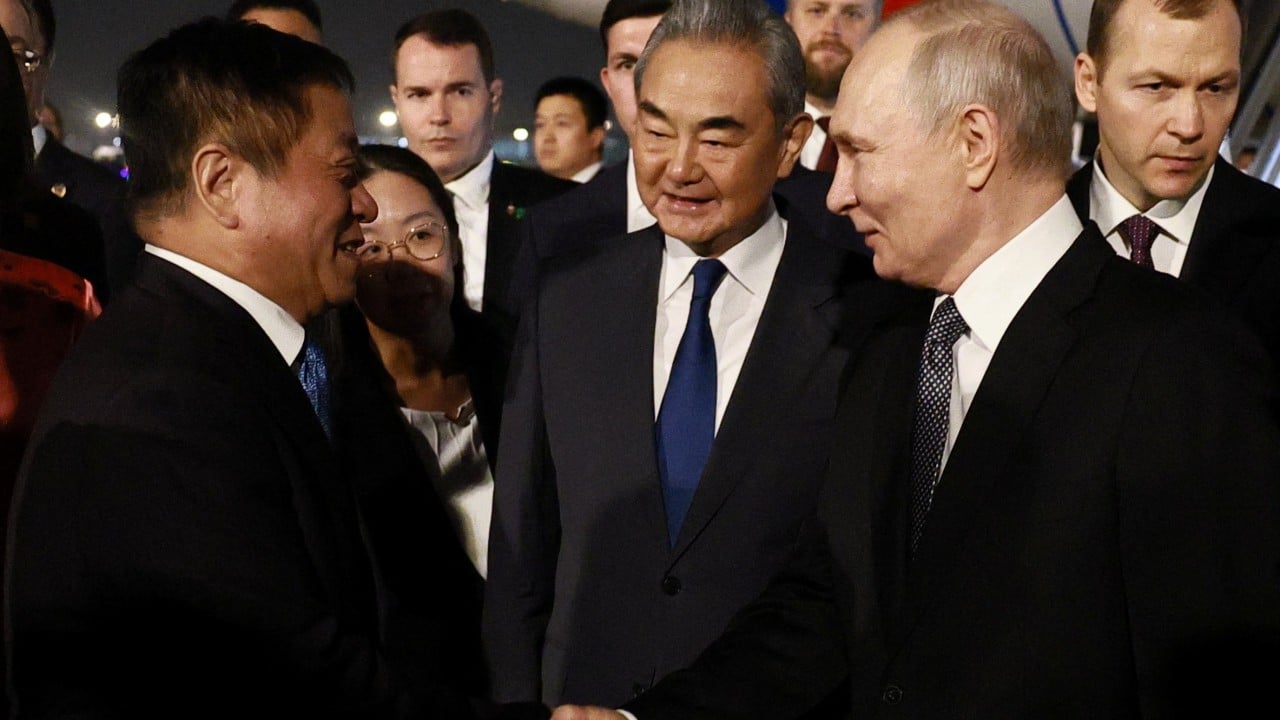
The mainstream media loves a predictable script. When two high-profile global figures visit Beijing within days of each other, the commentary writes itself. Pundits rush to their keyboards to declare a "new Cold War alignment," framing China as either a neutral arbiter being courted by Washington or a co-conspirator locking arms with Moscow.
They are missing the entire chessboard.
The back-to-back visits of Donald Trump and Vladimir Putin to Beijing are not proof of a shifting global balance of power. They are proof that the old balance is dead, and Western analysts are still reading the obituaries upside down. The lazy consensus views these visits through a Western-centric lens, asking what Trump or Putin want from China. The real question is far more unsettling: how is Beijing using both men to cement its position as the unavoidable clearinghouse of global trade and geopolitics?
The Courtship Fallacy
Let’s dismantle the first assumption. The narrative suggests that Trump’s visit was an attempt to reset trade relations or flash American muscle, while Putin’s arrival immediately after was a defiant counter-signal to show Western isolation isn't working.
This interpretation treats China as a passive stage where Western and Russian actors perform. In reality, Beijing is the director.
When a US leader arrives in China, the Western press focuses on tariffs, intellectual property, and currency manipulation. They treat these meetings as bilateral negotiations between equals. But anyone who has managed supply chains across the Pearl River Delta knows how the calculus actually works. The US is trapped in a structural dependency that cannot be untangled by a few high-profile summits or aggressive rhetoric.
Consider the raw mechanics of global trade. The United States relies on Chinese manufacturing not just for cheap consumer goods, but for the intermediate components that drive American industry. Attempting to abruptly sever these ties is a form of economic self-harm. Beijing understands this perfectly. Every negotiation is structured to exploit this leverage, offering minor concessions on agricultural imports while maintaining absolute control over critical supply chains.
Moscow’s Subordinate Reality
Then comes Putin. The common talking point is the "no-limits partnership" signed between Moscow and Beijing. Analysts wring their hands over a massive, unified Eurasian bloc threatening Western hegemony.
Look closer at the economic data. This is not a partnership of equals; it is a transactional arrangement where Moscow holds the weaker hand.
Since the escalation of sanctions against Russia, China has become the primary buyer of Russian energy. But Beijing is not paying premium rates. It demands, and receives, massive discounts on crude oil and natural gas. Gazprom’s pivot toward the East has come at a steep price, effectively turning Russia into an economic vassal state that provides raw materials to fuel China’s industrial engine.
Imagine a scenario where a struggling supplier loses their biggest client and is forced to sell exclusively to a single, predatory buyer. That buyer does not view the supplier as a partner. They view them as an asset to be squeezed. Putin’s trip to Beijing wasn't a victory lap; it was a check-in with his chief creditor.
The Mirage of De-Risking
Corporate boardrooms across North America and Europe have embraced a new buzzword: "de-risking." The theory is that by moving manufacturing to countries like Vietnam, India, or Mexico, Western businesses can insulate themselves from Chinese geopolitical risk.
It is a comforting illusion that falls apart under scrutiny.
If you look at the component level of factories in Hanoi or Monterrey, you find a striking reality. The raw materials, the specialized machinery, and the sub-assemblies are still coming directly from mainland China. Western companies are not eliminating their dependence on Beijing; they are merely adding a middleman and paying a premium for a different label on the shipping box.
This reality completely undermines the Western diplomatic position. When American leaders threaten sanctions or tariff hikes, Beijing can simply throttle the export of foundational inputs—like rare earth elements or advanced battery components—that the rest of the world relies on to build its "independent" infrastructure. The leverage remains firmly in one direction.
The Fallacy of the Three-Way Balance
For decades, foreign policy scholars have relied on the concept of the strategic triangle, a framework popularized during the Nixon administration. The idea is that the US, Russia, and China are three competing poles, and the smartest play is always to be closer to the other two than they are to each other.
Applying this 20th-century model to the current dynamic is a fundamental error.
The strategic triangle assumed a level of ideological and economic separation that no longer exists. Today, China is deeply integrated into the global financial architecture while simultaneously building alternative systems like the Cross-Border Interbank Payment System (CIPS). It does not need to choose between a Western alliance or a Russian alignment. It profits from both.
- The Western Track: China maintains access to massive consumer markets and acquires Western capital to fund its domestic technology initiatives.
- The Russian Track: China secures cheap, reliable energy resources and a captive market for its industrial surplus, all while keeping a nuclear-armed neighbor dependent on its goodwill.
By hosting Trump and Putin in close succession, Beijing demonstrates that it is the center of gravity. It does not go to the world; the world comes to it.
The High Cost of the Sovereign Play
To be fair, this position is not without significant vulnerabilities. Beijing's strategy requires maintaining a delicate balancing act that could easily unravel.
By keeping Russia on life support, China risks provoking a unified European regulatory backlash that could jeopardize its access to its largest export market. European capitals, historically more cautious than Washington regarding decoupling, are increasingly viewing Beijing's economic support of Moscow as a direct threat to continental security. If Europe decides to align its trade policies precisely with Washington, China's economic model faces a severe demand shock that domestic consumption cannot replace.
Furthermore, the strategy of economic dominance relies on a massive accumulation of debt within China's provincial banking systems. Funding global infrastructure projects and propping up domestic state-owned enterprises has created an opaque financial bubble. If that bubble pops, the external leverage Beijing holds over global supply chains will matter very little compared to the internal instability it will face.
The Flawed Questions We Ask
The international community continually asks the wrong questions about these high-level summits.
| Standard Media Inquiry | The Brutal Reality |
|---|---|
| Will Trump convince China to alter its trade policies? | China will adjust its rhetoric, but its core industrial strategy remains entirely unchanged. |
| Is Putin building a military alliance with Beijing? | China will buy cheap Russian oil but will avoid any formal military commitments that trigger secondary sanctions. |
| Can the West successfully isolate the Chinese economy? | The global supply chain is so thoroughly integrated that complete isolation would trigger immediate domestic economic collapse in the West. |
Stop looking at these visits as diplomatic negotiations. They are performance art designed for domestic audiences back home. Trump needs to look tough on trade for his base; Putin needs to look internationally relevant to his inner circle.
Beijing humors both because the theater serves its purpose. While the West debates the optics of who sat at which table or the phrasing of a joint communique, China continues to build the ports, control the mines, and manufacture the components that ensure regardless of who wins the political cycle in Washington or Moscow, the road still runs through Beijing.
Stop analyzing the tourists. Start looking at the landlord.