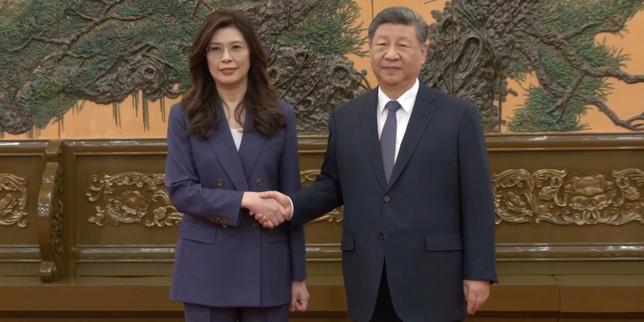
Xi Jinping just signaled that the road to Taiwan runs through the Kuomintang (KMT). In a high-stakes meeting in Beijing with Cheng Li-wun and the KMT leadership, the Chinese President reinforced a vision of "inevitable" unification while bypassing the sitting Democratic Progressive Party (DPP) government entirely. This wasn't a mere diplomatic courtesy. It was a calculated move to utilize the KMT as a conduit for cross-strait influence, aiming to convince the Taiwanese public that economic prosperity and peace are only possible under the "1992 Consensus." By treating the opposition party as the legitimate voice of the island, Beijing is effectively attempting to hollow out the authority of the current administration in Taipei.
The Strategy of Selective Recognition
Beijing has mastered the art of the cold shoulder. Since 2016, the Chinese Communist Party (CCP) has largely frozen official communications with the DPP, citing their refusal to acknowledge that Taiwan is part of "one China." However, the red carpet stays rolled out for the KMT. When Cheng Li-wun and her delegation arrived in the capital, they weren't just visitors; they were treated as partners in a historical project.
This selective recognition creates a dual-track reality. On one track, there is the official friction marked by fighter jet incursions and trade bans. On the other, there is a polished narrative of brotherhood and shared destiny. Xi’s rhetoric focuses on the "spiritual harmony" of the people, a phrase designed to bypass political structures and appeal directly to cultural identity. The goal is to make the DPP look like the sole obstacle to a stable life.
Trade as a Weapon and a Gift
Beijing uses the economy as both a leash and a lure. For years, China has targeted specific Taiwanese industries—notably agriculture and aquaculture—with sudden bans based on "biosecurity" concerns. Magically, these bans often lift or soften after KMT delegations visit Beijing to "negotiate" on behalf of the people.
The optics are intentional. If the KMT can secure market access for Taiwanese pineapples or grouper fish while the DPP cannot, the CCP wins a psychological victory. They prove that cooperation with the mainland brings immediate financial relief. This isn't just trade; it is a demonstration of power over the Taiwanese dinner table.
However, this reliance on the mainland market is a double-edged sword. While it offers short-term gains for farmers and exporters, it deepens an economic dependency that Beijing can weaponize at any moment. The "future" Xi speaks of is one where Taiwan's economy is so deeply integrated into the mainland's supply chains that the cost of political independence becomes ruinous.
The Ghost of the 1992 Consensus
Everything in this relationship hinges on a verbal agreement made over thirty years ago. The 1992 Consensus—where both sides agree there is "one China" but hold different interpretations of what that means—is the only bridge Beijing is willing to walk across.
The KMT clings to this framework because it allows them to maintain a Chinese identity while governing Taiwan. The CCP accepts it because the "different interpretations" part is, in their eyes, a temporary concession. For Xi, the consensus isn't a permanent status quo; it is a transition phase.
During the meeting with Cheng Li-wun, Xi’s emphasis on being "fully convinced" of a shared future suggests a narrowing of that interpretation. Beijing is no longer content with the ambiguity that once allowed the KMT to thrive. They are pushing for a more concrete commitment to the "One Country, Two Systems" model, despite its total loss of credibility following the crackdown in Hong Kong.
Subverting the Democratic Process
By dealing directly with the KMT, Beijing is running a sophisticated influence operation designed to sway the 2026 local elections and the subsequent 2028 general election. They are betting that the Taiwanese electorate will eventually grow weary of the constant threat of conflict.
The narrative being pushed is simple: Vote for the DPP and face "war and decline." Vote for the KMT and receive "peace and prosperity."
This strategy ignores the shifting demographics of the island. Younger generations in Taiwan increasingly identify as "Taiwanese" rather than "Chinese" or "both." For these voters, the promise of economic integration feels less like an opportunity and more like a trap. They saw what happened to Hong Kong’s autonomy, and they aren't eager to see the same script played out in Taipei. Xi’s "conviction" in a shared future assumes that cultural heritage will eventually trump democratic values, a gamble that has yet to pay off at the ballot box.
The Silicon Shield and Strategic Calculations
While Xi talks of brotherhood, his military commanders are looking at the ports of Kaohsiung and the semiconductor fabs of Hsinchu. Taiwan’s dominance in the high-end chip market—the "Silicon Shield"—is a factor that Beijing cannot ignore.
A forced unification that destroys this infrastructure would be a pyrrhic victory for China. The global economy would crater, and the CCP’s own technological ambitions would be set back by decades. Therefore, the preference remains "peaceful reunification" through political subversion and economic pressure.
The meeting with Cheng Li-wun is a piece of this non-kinetic warfare. If Beijing can win over the political elite and the business interests of the island, they don't need to fire a single shot. They are playing a generational game, waiting for the political climate in Taipei to shift back toward the center-right KMT, which they view as a more manageable partner.
The Burden on the KMT
The KMT finds itself in an increasingly precarious position. To Beijing, they are the key to a bloodless takeover. To many Taiwanese voters, they are viewed with suspicion as a potential Trojan Horse.
Cheng Li-wun’s delegation has to walk a razor-thin line. They must bring back enough "gifts" from Beijing—like trade concessions or travel permits—to prove their utility, without appearing to sell out the island’s sovereignty. Every smile in the Great Hall of the People is scrutinized back home.
The party’s survival depends on its ability to redefine the "China relationship" in a way that doesn't alienate a fiercely democratic public. But as Xi Jinping tightens his grip and demands more explicit loyalty to the concept of unification, the room for the KMT to maneuver is shrinking.
The Gray Zone Reality
Beyond the high-level meetings, the daily reality for Taiwan is a "gray zone" of pressure. This includes cyberattacks, disinformation campaigns on social media, and the persistent presence of Chinese naval vessels just outside Taiwan’s contiguous zone.
Xi’s words of "common destiny" are delivered against this backdrop of intimidation. It is a classic "good cop, bad cop" routine, where the CCP plays both roles simultaneously. The meetings with the KMT represent the "good cop" offering a hand, while the People's Liberation Army (PLA) provides the constant shadow of the "bad cop."
This pressure is intended to create a sense of inevitability. Beijing wants the world—and the Taiwanese people—to believe that the current state of affairs is unsustainable and that a return to the mainland's fold is the only logical conclusion.
Internal CCP Pressures
It is a mistake to view Xi Jinping’s confidence as entirely unshakable. China faces its own massive internal hurdles: a shrinking population, a cooling property market, and high youth unemployment.
For the CCP, "resolving" the Taiwan question is a cornerstone of national rejuvenation. It is the ultimate metric of Xi’s legacy. If the economic "miracle" on the mainland continues to stumble, the pressure to deliver a nationalist victory increases. This makes the diplomatic channels with the KMT even more vital. Xi needs a victory that doesn't involve the catastrophic risks of an amphibious invasion. He needs a political surrender.
The Washington Variable
No discussion of the cross-strait future is complete without acknowledging the United States. While Beijing talks to the KMT, they are watching Washington.
The U.S. policy of "strategic ambiguity" has shifted toward "strategic clarity" in recent years, with increased arms sales and high-level visits to Taipei. Beijing views these moves as "collusion" and uses them to justify their own aggression.
For the KMT, the U.S. relationship is equally important. They cannot afford to be seen as anti-American, even as they seek closer ties with China. The party frequently sends its own envoys to Washington to reassure policymakers that they are not Beijing's pawns. This creates a bizarre triangle where the KMT is trying to be the primary interlocutor for both superpowers, a role that becomes harder to sustain as the U.S.-China rivalry intensifies.
The Limits of Conviction
Xi Jinping says he is "fully convinced" of the common future. But conviction is not the same as reality. The reality is an island that has functioned as a self-governed democracy for decades, with its own military, its own currency, and a distinct national identity.
The "common future" Beijing envisions is one where the KMT acts as a provincial administrator under a central authority. The "common future" many in the KMT envision is a return to a stable, profitable status quo where they can trade freely with the mainland without losing their way of life. These two visions are fundamentally incompatible.
As long as Beijing refuses to acknowledge the legitimacy of the elected government in Taipei, these meetings with the opposition will remain a performative exercise. They serve to keep the door ajar, but they do not address the core issue: the people of Taiwan have no desire to be absorbed into the CCP’s political system.
The cross-strait drama is moving into a phase where the soft power of trade and "spiritual harmony" will be tested against the hard reality of a public that has tasted freedom. Xi Jinping is betting that he can buy or bully his way to a unified China. The KMT is betting they can manage a giant without being swallowed. Both are playing a game with the highest possible stakes, where a single miscalculation could set the entire Pacific on fire.
The next move won't happen in a meeting hall in Beijing. It will happen in the hearts of Taiwanese voters who are watching these high-level handshakes with an increasingly skeptical eye. If the KMT cannot translate these trips into a vision that protects Taiwan's autonomy, they will find that the "common future" Xi talks about is one where they have no role left to play.