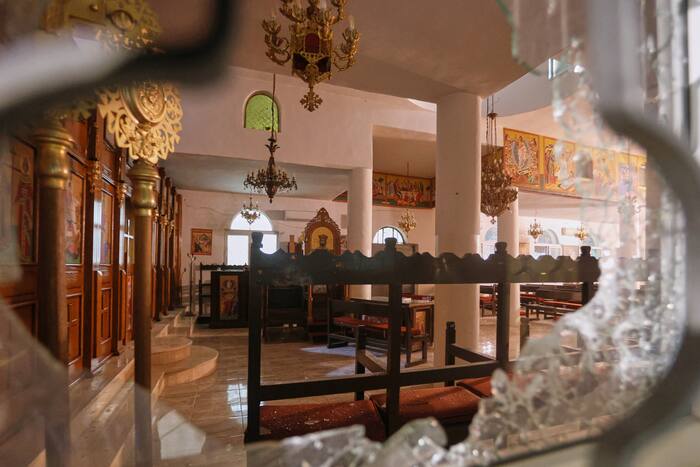
Silence.
In Amman, silence is never truly absolute, not even at three in the morning when the limestone hills cool under a desert sky and the call to prayer has faded into the hum of distant traffic. There is always the murmur of neighbors sharing sweet mint tea on a balcony, the clatter of a backgammon piece slapped onto a wooden board, or the soft chime of church bells drifting across a valley where minarets and steeples have shared the same horizon for centuries. For another look, check out: this related article.
When that silence is shattered by gunfire inside a sanctuary, the sound does not just echo off stone walls. It travels straight into the marrow of a nation that has spent decades building an island of calm in the middle of a regional storm.
Eight people are dead. Eight lives—sons, mothers, neighbors, worshippers who walked through heavy wooden doors expecting the familiar scent of frankincense and beeswax, only to be met with cold steel and sudden terror. In the immediate aftermath of the attack on a church in Jordan, King Abdullah II did not offer diplomatic platitudes or cautious bureaucratic hedging. He ordered an "iron fist" response. Further reporting on the subject has been shared by Associated Press.
To an outside observer scrolling past a breaking news alert on a phone screen in New York or London, the phrase sounds like standard statecraft—the predictable muscle-flexing of a head of state facing a crisis. But if you have ever stood on the dusty streets of Zarqa, watched the border crossings at Jaber, or sat in a family living room in Fuheis while television screens flicker with chaos from neighboring countries, you know that those two words carry a very different weight. They are not merely a promise of retaliation. They are a desperate, calculated defense of an invisible social contract that keeps an entire region from tipping into the abyss.
The Architecture of a Fragile Peace
To understand why a single shooting in a Jordanian church triggers the full, unyielding weight of the monarchy, you have to understand what Jordan actually is. Look at a map of the Middle East. Jordan sits wedged between Syria to the north, Iraq to the east, Saudi Arabia to the south, and Israel and the West Bank to the west. For the better part of twenty years, every single direction on that compass has experienced war, insurgency, economic collapse, or profound political upheaval.
Jordan has absorbed millions of refugees from those conflicts—Palestinians, Iraqis, Syrians—while possessing almost no oil, scarce water reserves, and an economy perpetually walking a tightrope. By every conventional metric of geopolitical risk, Jordan should have fractured years ago.
It didn't. And the reason it didn't lies in an unspoken agreement between the Hashemite monarchy and the people on the street.
Consider a hypothetical family living in Madaba, a town famous for its sixth-century Byzantine mosaics and its deeply intertwined Muslim and Christian communities. Let us call the father Tariq, a retired schoolteacher, and his neighbor Elias, who runs a small bakery two doors down. For forty years, Tariq and Elias have borrowed each other's tools, attended each other's weddings, and mourned at each other's funerals. During Ramadan, Elias keeps his shop shutters half-drawn out of respect; during Easter, Tariq brings over trays of ma'amoul stuffed with dates and walnuts.
This coexistence is not an accident of geography. It is the result of deliberate, generational engineering. Christians make up roughly two to four percent of Jordan’s population, yet they hold reserved seats in parliament, serve at the highest levels of the military and judiciary, and form an integral pillar of the country's identity. The state does not merely tolerate religious minorities; it defines its own legitimacy through their protection.
When a gunman walks into a church and murders eight people, the bullet is aimed at Elias, yes. But the true target is the trust between Elias and Tariq. The attacker wants Tariq to look away in fear, and Elias to pack his bags in despair. The shooter is betting that if you strike the smallest, most visible thread of a society, the entire fabric will unravel.
The Anatomy of the Iron Fist
When King Abdullah II used the phrase "iron fist," he was speaking a language every intelligence officer, tribal leader, and extremist cell in the Levant understands fluently.
In security terms, an iron fist in Jordan means the immediate mobilization of the General Intelligence Directorate—the Mukhabarat—widely regarded as one of the most capable and penetrating security apparatuses in the Middle East. Unlike western intelligence agencies that often rely heavily on signals intelligence and satellite surveillance, Jordanian security operates through deep human networks, tribal alliances, and intimate knowledge of every neighborhood, mosque, and border trail in the kingdom.
Within hours of such an attack, the machinery moves in ways invisible to the public eye. Known sympathizers of extremist ideologies who were previously monitored from a distance are suddenly brought in for interrogation. Safe houses are raided before dawn. Border patrols along the vast, arid stretches bordering Syria and Iraq are reinforced with elite rapid-reaction units. Financial trails—often disguised as small remittances or informal hawala transfers—are frozen and traced back to their origins.
I remember speaking years ago with a former security analyst in Amman after the 2016 Karak Castle attack, when gunmen holed up in a Crusader fortress and killed ten people, including security officers and a Canadian tourist. What struck me wasn't the tactical response—though the storming of the castle was swift and brutal—it was the psychological shift in the city afterward. People didn't lock themselves inside in panic. Instead, lines formed outside blood banks. Neighbors checked on neighbors. There was a fierce, almost stubborn refusal to let terror dictate the rhythm of daily life.
Yet behind that public resilience lies a terrifying reality that anyone who has lived through security crackdowns knows well: an iron fist has no soft edges.
When a state tightens its grip to crush an existential threat, the pressure is felt everywhere. Checkpoints multiply on highways. Digital surveillance expands. Civil liberties, already navigated carefully in a constitutional monarchy, shrink further in the name of national survival. For ordinary Jordanians—young graduates struggling with unemployment rates hovering above twenty percent, shopkeepers battling inflation—the trade-off is visceral. They will accept the checkpoints. They will accept the curfews and the raids. They will accept almost anything, provided the state upholds its end of the bargain: keeping the wolves outside the door.
Why This Attack Feels Different
Mass shootings and sectarian attacks are tragically familiar across the broader region, which makes it easy for international commentators to lump Jordan into a generalized narrative of Middle Eastern instability. That is a profound mistake.
Rare. That word in the headlines is doing heavy lifting, and it deserves to be unpacked.
Jordan has largely escaped the wave of sectarian violence that tore apart Iraq after 2003 and ravaged Syria after 2011. Even when ISIS stood directly on Jordan’s northern border at the height of its territorial control, the group struggled to establish an enduring domestic foothold inside the kingdom. In 2005, al-Qaeda in Iraq bombed three hotels in Amman, killing sixty people—a trauma that reshaped Jordanian counterterrorism doctrine overnight. Since then, major attacks have been few and fiercely contained: the 2016 Karak siege, a few isolated shootings targeting security personnel, and foiled plots dismantled quietly before they ever reached the news cycle.
Attacks specifically targeting Christian houses of worship in Jordan are virtually unheard of in the modern era.
Think about what that means. In neighboring countries, ancient Christian communities have been decimated over the last two decades—driven from the Nineveh Plains in Iraq, displaced from Aleppo and Homs in Syria. Through all of it, Jordan positioned itself as a sanctuary. King Abdullah II personally funded the restoration of the Tomb of Christ in Jerusalem's Church of the Holy Sepulchre and established the Baptism Site at Bethany Beyond the Jordan as an international pilgrimage center. To the Vatican, to Washington, and to Christians across the Arab world, Jordan was the proof of concept that Islam and Christianity could not only coexist in the twenty-first-century Middle East, but thrive side by side.
By striking a church, the assailant attacked the crown jewel of Jordan's international reputation and domestic identity simultaneously.
If an extremist group—or a radicalized lone actor inspired by the endless violence spilling across regional borders—can walk into a Jordanian church and kill eight worshippers, the message sent to the world is devastating: Nowhere is safe. Not even here.
The Invisible Stakes
Let us strip away the geopolitical jargon and look at what happens in the quiet hours after the funerals end.
Imagine a young Christian couple in Amman—let's call them Rami and Nour—sitting at their kitchen table tonight. Both are in their late twenties. Both hold university degrees. Like tens of thousands of young Jordanians, they have spent the last two years debating whether to build their future at home or apply for visas to Canada, Australia, or Germany. Until yesterday, their reasons for leaving were purely economic: high taxes, stagnant wages, the cost of buying an apartment. Their reasons for staying were emotional: family, culture, the deep comfort of belonging to the land their ancestors walked for two thousand years.
Tonight, a new variable sits on that kitchen table between them. Fear.
It is a quiet, insidious poison. It doesn't scream; it whispers. It asks whether their children will be safe walking into Sunday school. It wonders if the guard at the church gate will be enough next time. If Rami and Nour decide to leave, they won't make the headlines. There will be no breaking news banner reading Young Couple Books One-Way Ticket to Toronto. Yet multiplied by hundreds or thousands of families over a decade, that quiet departure is how ancient communities vanish. Once a community drops below a critical threshold, its churches become museums, its traditions become folklore, and the society left behind loses a vital organ it didn't realize was keeping it alive.
This is the true battlefield King Abdullah II is fighting on.
The iron fist is meant to hunt down the perpetrators, dismantle any network that armed or radicalized them, and deter anyone else contemplating a similar atrocity. Intelligence officials will scour encrypted messaging apps, trace weapon serial numbers—many of which have flooded the region from conflict zones in Syria and beyond—and interrogate every associate within three degrees of separation.
But you cannot arrest an idea with a SWAT team, and you cannot rebuild fractured trust with a military convoy.
The Weight of the Crown
There is an inherent vulnerability in leadership during moments like this, one rarely acknowledged in official palace statements. A king can command an army, deploy special forces, and sign emergency decrees, yet he remains at the mercy of a single fanatic with a firearm and a willingness to die. Security is an asymmetric game: the state has to get it right every single day, at every single border post and street corner; the attacker only has to get lucky once.
For Jordanians watching their monarch respond, there is both comfort and anxiety in the display of force. Comfort, because hesitation in the Middle East is fatal; weakness invites predators, and decisiveness reassures a frightened public that someone has their hands firmly on the wheel. Anxiety, because everyone knows that the deeper roots of radicalization—economic desperation, generational trauma from regional wars, the relentless hum of extremist propaganda on social media—cannot be eradicated purely by force.
In the days ahead, forensic investigators will finish cataloguing the shell casings on the church floor. Stone masons will repair the chipped limestone. Painters will cover the bullet holes. Eventually, the yellow police tape will come down, and the heavy wooden doors will swing open again.
On that first Sunday morning when the doors reopen, the true test of Jordan will take place—not in the interrogation rooms of the intelligence directorate, and not in the halls of the royal palace, but on the stone steps outside the sanctuary. It will be measured by whether the pews are full, whether Muslim neighbors stand quietly outside the gates in solidarity as they have done in moments of crisis before, and whether the church bells ring out across the valley loud enough to be heard over the memory of gunfire.
The iron fist can clear the streets. Only the people who walk them can keep the silence from returning.